
AI & Tech One-page note
How AI Image Generators Work
How does typing a sentence turn into a picture? It starts with static. Here's how AI image generators actually work. Save this page.
Good to know
Simplified explanation of diffusion models (Sohl-Dickstein 2015, Ho 2020). Checked Nov 2026.
What's on the page
The note as text, so you can read it, copy it or use a screen reader.
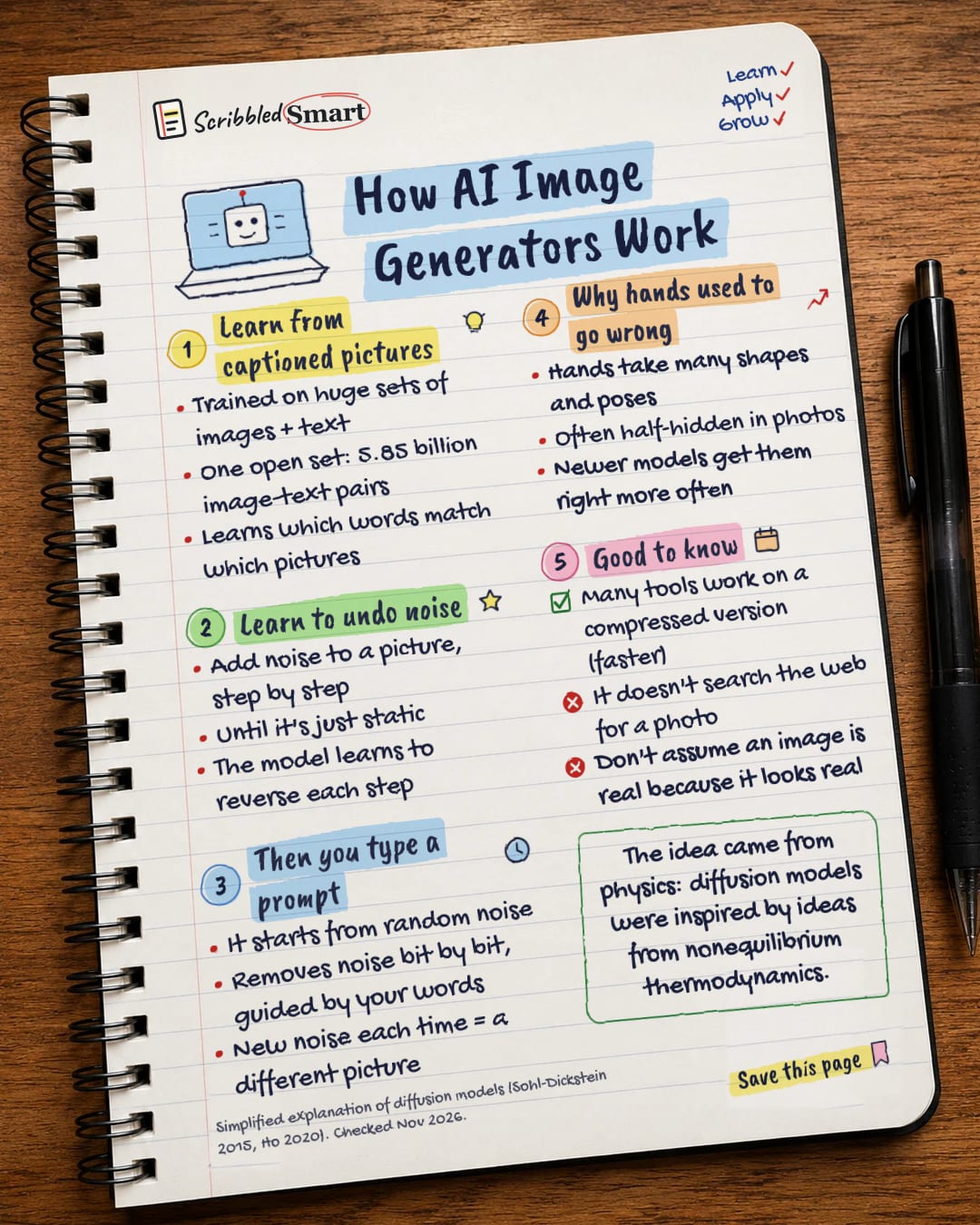
Learn from captioned pictures
- Trained on huge sets of images + text
- One open set: 5.85 billion image-text pairs
- Learns which words match which pictures
Learn to undo noise
- Add noise to a picture, step by step
- Until it's just static
- The model learns to reverse each step
Then you type a prompt
- It starts from random noise
- Removes noise bit by bit, guided by your words
- New noise each time = a different picture
Why hands used to go wrong
- Hands take many shapes and poses
- Often half-hidden in photos
- Newer models get them right more often
Good to know
- Many tools work on a compressed version (faster)
- It doesn't search the web for a photo
- Don't assume an image is real because it looks real
Sources
- Sohl-Dickstein et al. (2015): Deep Unsupervised Learning using Nonequilibrium Thermodynamics
- Ho, Jain, Abbeel (2020): Denoising Diffusion Probabilistic Models
- Rombach et al. (2022): High-Resolution Image Synthesis with Latent Diffusion Models
- Radford et al. (2021): Learning Transferable Visual Models From Natural Language Supervision (CLIP)
- Schuhmann et al. (2022): LAION-5B
- KDnuggets: Diffusion and Denoising, Explaining Text-to-Image Generative AI
- PetaPixel: Why AI image generators can't get hands right
- Gigazine: Art and engineering experts explain why AI is not good at drawing hands
How we checked this
Every fact on this note comes from the 8 sources listed here, checked against official or peer-reviewed sources where possible. AI tools help with drafting; a person checks every fact against the sources. How we research
Spotted a mistake? Tell us and we'll fix it and log it on the corrections page.


