
General knowledge One-page note UK only
How Fossils Form
How does a dead animal turn into stone? And who was the girl from Lyme Regis who changed science? Save this page.
Good to know
Jurassic Coast is in England, UK.
What's on the page
The note as text, so you can read it, copy it or use a screen reader.
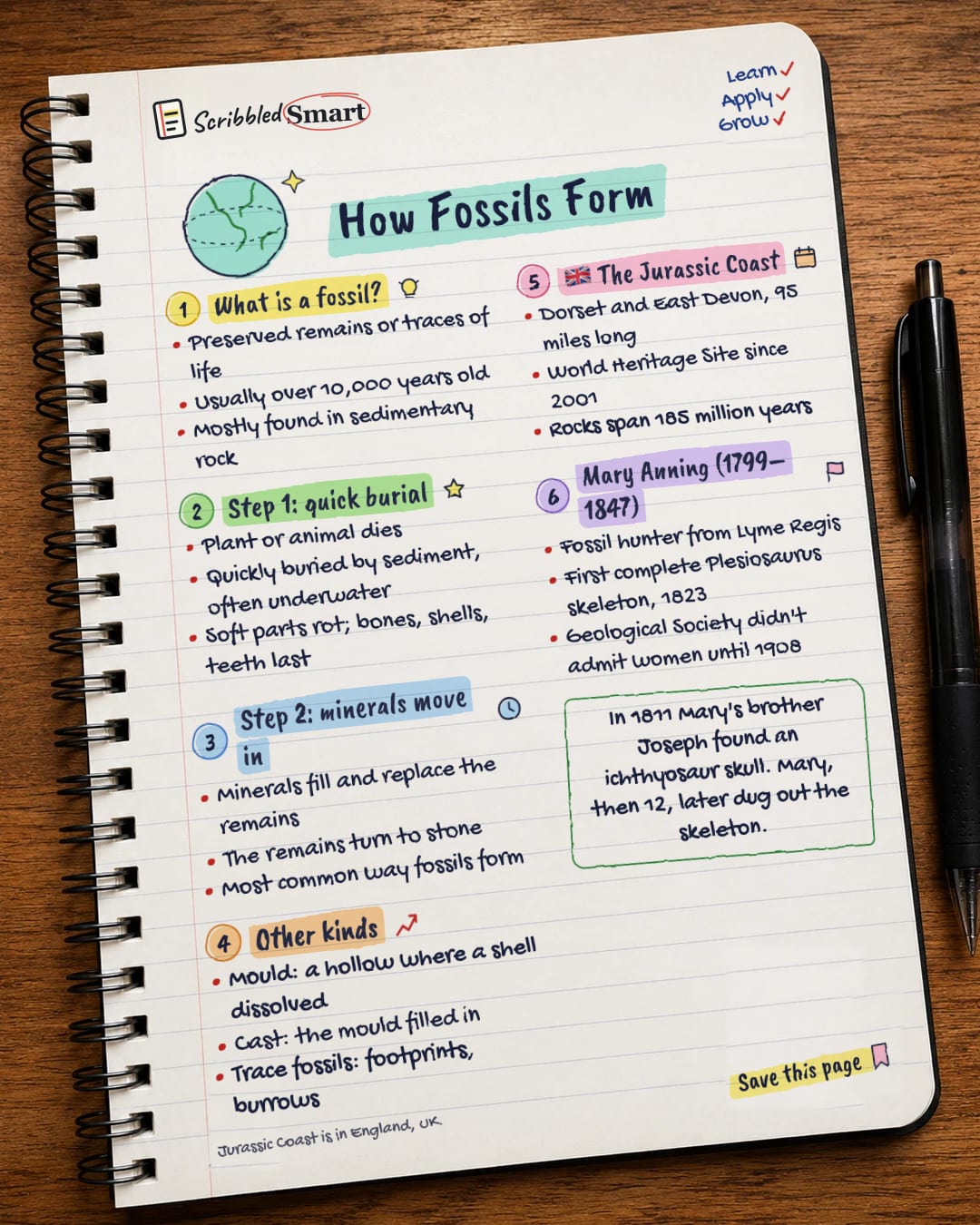
What is a fossil?
- Preserved remains or traces of life
- Usually over 10,000 years old
- Mostly found in sedimentary rock
Step 1: quick burial
- Plant or animal dies
- Quickly buried by sediment, often underwater
- Soft parts rot; bones, shells, teeth last
Step 2: minerals move in
- Minerals fill and replace the remains
- The remains turn to stone
- Most common way fossils form
Other kinds
- Mould: a hollow where a shell dissolved
- Cast: the mould filled in
- Trace fossils: footprints, burrows
🇬🇧 The Jurassic Coast
- Dorset and East Devon, 95 miles long
- World Heritage Site since 2001
- Rocks span 185 million years
Mary Anning (1799–1847)
- Fossil hunter from Lyme Regis
- First complete Plesiosaurus skeleton, 1823
- Geological Society didn't admit women until 1908
Sources
How we checked this
Every fact on this note comes from the 3 sources listed here, checked against official or peer-reviewed sources where possible. AI tools help with drafting; a person checks every fact against the sources. How we research
Spotted a mistake? Tell us and we'll fix it and log it on the corrections page.


