
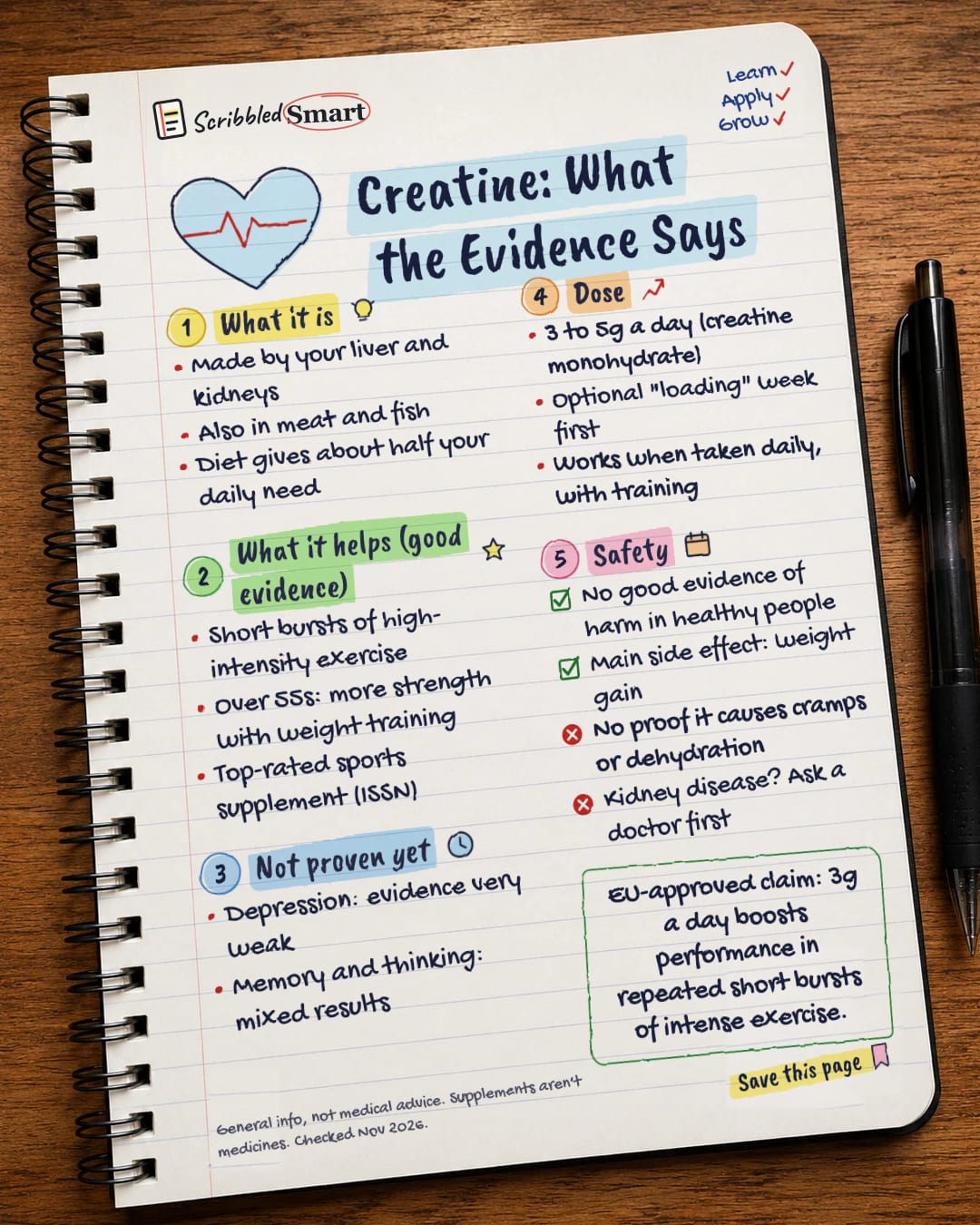
Health One-page note
Creatine: What the Evidence Says
Everyone's talking about creatine. Here's what it really does, what's hype, and the dose studies use. Save this page.
Good to know
General info, not medical advice. Supplements aren't medicines. Checked Nov 2026.
What's on the page
The note as text, so you can read it, copy it or use a screen reader.
What it is
- Made by your liver and kidneys
- Also in meat and fish
- Diet gives about half your daily need
What it helps (good evidence)
- Short bursts of high-intensity exercise
- Over 55s: more strength with weight training
- Top-rated sports supplement (ISSN)
Not proven yet
- Depression: evidence very weak
- Memory and thinking: mixed results
Dose
- 3 to 5g a day (creatine monohydrate)
- Optional "loading" week first
- Works when taken daily, with training
Safety
- No good evidence of harm in healthy people
- Main side effect: weight gain
- No proof it causes cramps or dehydration
- Kidney disease? Ask a doctor first
Sources
- Kreider RB et al. (2017). International Society of Sports Nutrition position stand: safety and efficacy of creatine supplementation in exercise, sport, and medicine. JISSN 14:18
- legislation.gov.uk: Commission Regulation (EU) No 432/2012, Annex (retained)
- EFSA (2016). Creatine in combination with resistance training and improvement in muscle strength. EFSA Journal 14(2):4400
- Commission Implementing Regulation (EU) 2017/672
- British Journal of Nutrition (2025): Creatine supplementation for treating symptoms of depression: a systematic review and meta-analysis
- The effects of creatine supplementation on cognitive function in adults: a systematic review and meta-analysis (2024)
How we checked this
Every fact on this note comes from the 6 sources listed here, checked against official or peer-reviewed sources where possible. AI tools help with drafting; a person checks every fact against the sources. How we research
Spotted a mistake? Tell us and we'll fix it and log it on the corrections page.


