
Health One-page note
How Exercise Helps Your Mood
Walking, yoga and lifting weights all helped depression in a big 2024 study. Here's what the research says and how much to do. Save this page.
Good to know
General info, not medical advice. Studies are mostly small and lower quality. NHS services: England. Checked Nov 2026.
What's on the page
The note as text, so you can read it, copy it or use a screen reader.
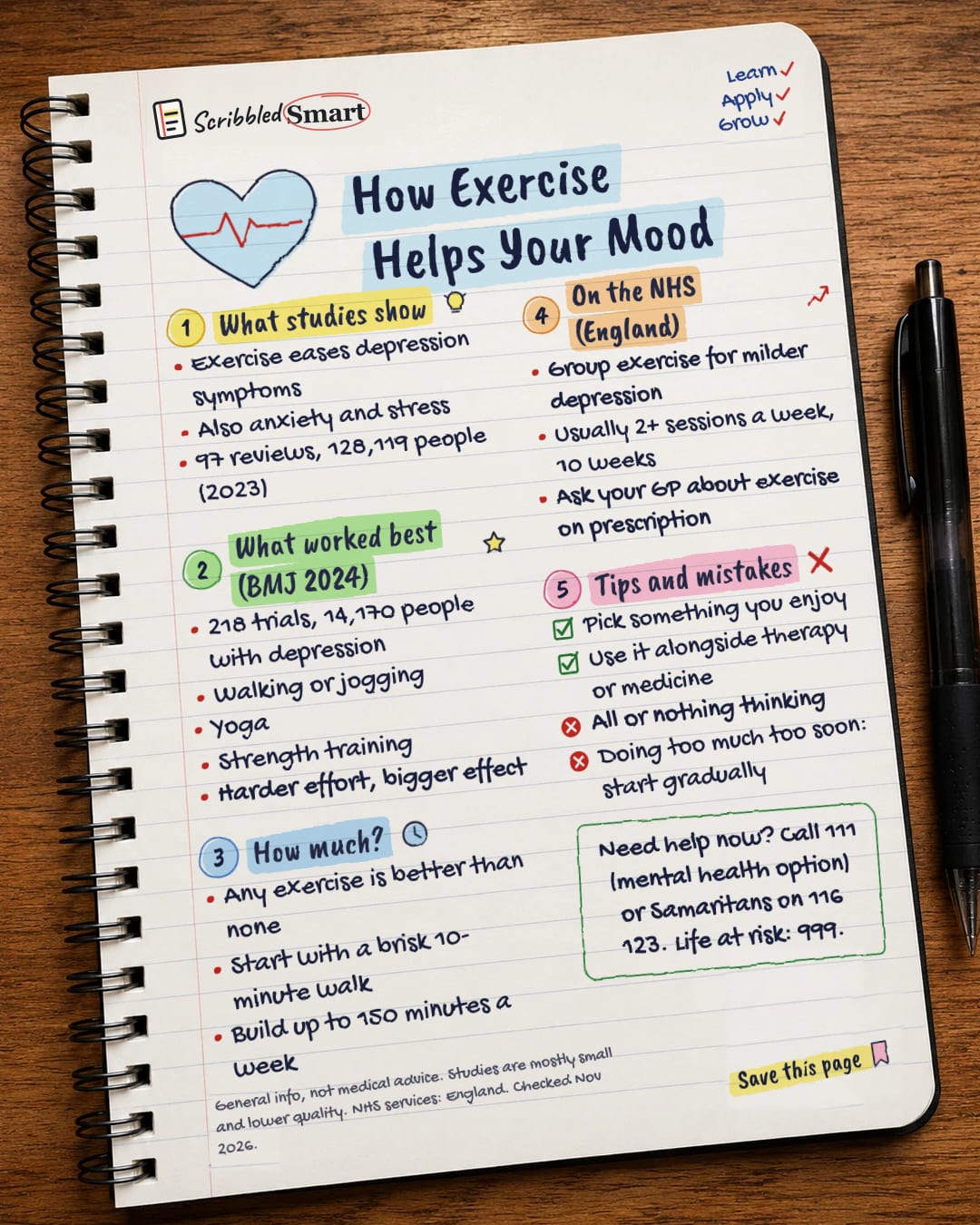
What studies show
- Exercise eases depression symptoms
- Also anxiety and stress
- 97 reviews, 128,119 people (2023)
What worked best (BMJ 2024)
- 218 trials, 14,170 people with depression
- Walking or jogging
- Yoga
- Strength training
- Harder effort, bigger effect
How much?
- Any exercise is better than none
- Start with a brisk 10-minute walk
- Build up to 150 minutes a week
On the NHS (England)
- Group exercise for milder depression
- Usually 2+ sessions a week, 10 weeks
- Ask your GP about exercise on prescription
Tips and mistakes
- Pick something you enjoy
- Use it alongside therapy or medicine
- All or nothing thinking
- Doing too much too soon: start gradually
Sources
- Noetel M et al. Effect of exercise for depression: systematic review and network meta-analysis of randomised controlled trials. BMJ 2024;384:e075847. doi:10.1136/bmj-2023-075847 (PMID 38355154)
- Singh B et al. Effectiveness of physical activity interventions for improving depression, anxiety and distress: an overview of systematic reviews. Br J Sports Med 2023. doi:10.1136/bjsports-2022-106195 (PMID 36796860)
- NHS: Exercise for depression
- NICE: Depression in adults: treatment and management (NG222), recommendations (blocked; search summary)
- NHS: Where to get urgent help for mental health
How we checked this
Every fact on this note comes from the 5 sources listed here, checked against official or peer-reviewed sources where possible. AI tools help with drafting; a person checks every fact against the sources. How we research
Spotted a mistake? Tell us and we'll fix it and log it on the corrections page.


