
Productivity One-page note
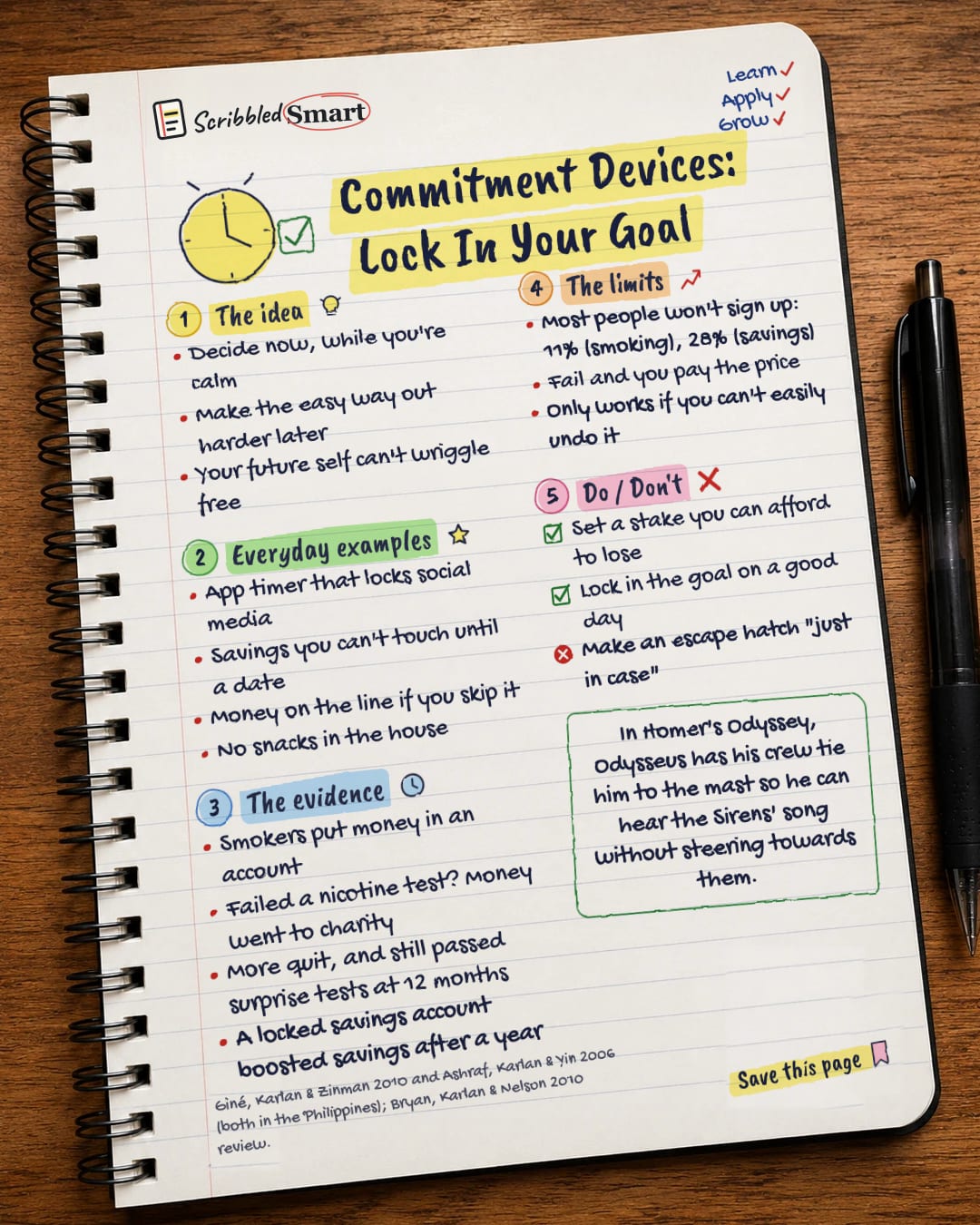
Commitment Devices: Lock In Your Goal
Can't trust future you? Tie yourself to the mast. Here's how commitment devices work, and when they don't. Save this page.
Good to know
Giné, Karlan & Zinman 2010 and Ashraf, Karlan & Yin 2006 (both in the Philippines); Bryan, Karlan & Nelson 2010 review.
What's on the page
The note as text, so you can read it, copy it or use a screen reader.
The idea
- Decide now, while you're calm
- Make the easy way out harder later
- Your future self can't wriggle free
Everyday examples
- App timer that locks social media
- Savings you can't touch until a date
- Money on the line if you skip it
- No snacks in the house
The evidence
- Smokers put money in an account
- Failed a nicotine test? Money went to charity
- More quit, and still passed surprise tests at 12 months
- A locked savings account boosted savings after a year
The limits
- Most people won't sign up: 11% (smoking), 28% (savings)
- Fail and you pay the price
- Only works if you can't easily undo it
Do / Don't
- Set a stake you can afford to lose
- Lock in the goal on a good day
- Make an escape hatch "just in case"
Sources
- Bryan G, Karlan D, Nelson S (2010): Commitment Devices. Annual Review of Economics 2:671–698
- Giné X, Karlan D, Zinman J (2010): Put Your Money Where Your Butt Is: A Commitment Contract for Smoking Cessation. American Economic Journal: Applied Economics 2(4):213–235
- Ashraf N, Karlan D, Yin W (2006): Tying Odysseus to the Mast: Evidence From a Commitment Savings Product in the Philippines. Quarterly Journal of Economics 121(2):635–672
- Homer, The Odyssey, Book XII, trans. Samuel Butler (Project Gutenberg)
How we checked this
Every fact on this note comes from the 4 sources listed here, checked against official or peer-reviewed sources where possible. AI tools help with drafting; a person checks every fact against the sources. How we research
Spotted a mistake? Tell us and we'll fix it and log it on the corrections page.


