
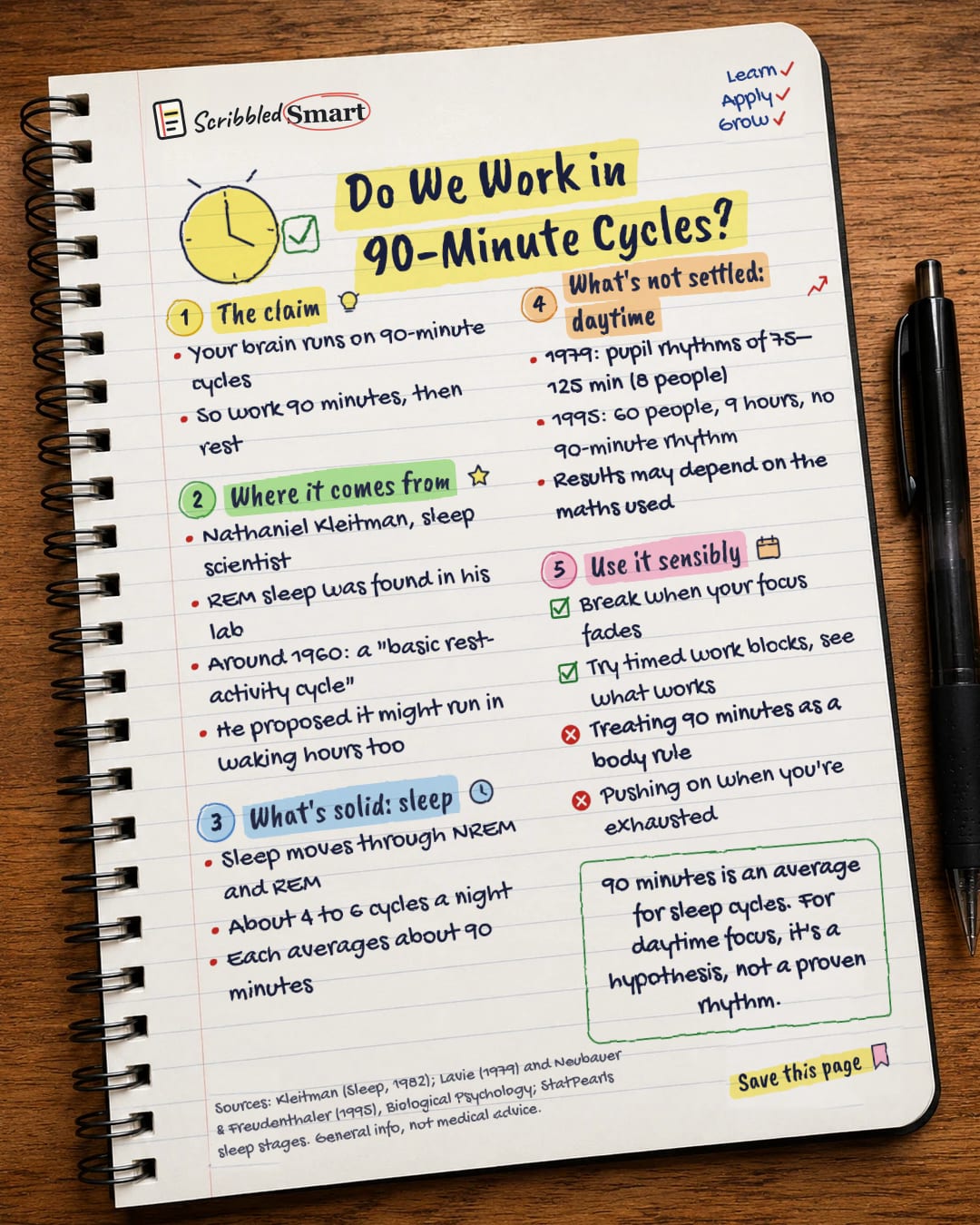
Productivity One-page note
Do We Work in 90-Minute Cycles?
"Work in 90-minute sprints" is everywhere. The 90 minutes is real for sleep. For your workday, the evidence is mixed. Save this page.
Good to know
Sources: Kleitman (Sleep, 1982); Lavie (1979) and Neubauer & Freudenthaler (1995), Biological Psychology; StatPearls sleep stages.
What's on the page
The note as text, so you can read it, copy it or use a screen reader.
The claim
- Your brain runs on 90-minute cycles
- So work 90 minutes, then rest
Where it comes from
- Nathaniel Kleitman, sleep scientist
- REM sleep was found in his lab
- Around 1960: a "basic rest-activity cycle"
- He thought it ran day and night
What's solid: sleep
- Sleep moves through NREM and REM
- About 4 to 6 cycles a night
- Each averages about 90 minutes
What's not settled: daytime
- 1979: pupil rhythms of 75–125 min (8 people)
- 1995: 60 people tested for 9 hours
- No 90-minute rhythm found
- Results depend on the maths used
Use it sensibly
- Break when your focus fades
- Try 60–90 minute blocks, see what works
- Treating 90 minutes as a body rule
- Pushing on when you're exhausted
Sources
- Europe PMC: Kleitman N. Basic rest-activity cycle—22 years later. Sleep 1982
- Europe PMC: Blessing WW. Thermoregulation and the ultradian basic rest-activity cycle (2018)
- Europe PMC: Patel AK et al. Physiology, Sleep Stages. StatPearls
- Europe PMC: Lavie P. Ultradian rhythms in alertness – a pupillometric study (1979)
- Europe PMC: Neubauer AC, Freudenthaler HH. Ultradian rhythms in cognitive performance: no evidence for a 1.5-h rhythm (1995)
- Wikipedia: Basic rest–activity cycle
- Nature: Moses J et al. Rapid eye movement cycle is a sleep-dependent rhythm (1977)
How we checked this
Every fact on this note comes from the 7 sources listed here, checked against official or peer-reviewed sources where possible. AI tools help with drafting; a person checks every fact against the sources. How we research
Spotted a mistake? Tell us and we'll fix it and log it on the corrections page.


