
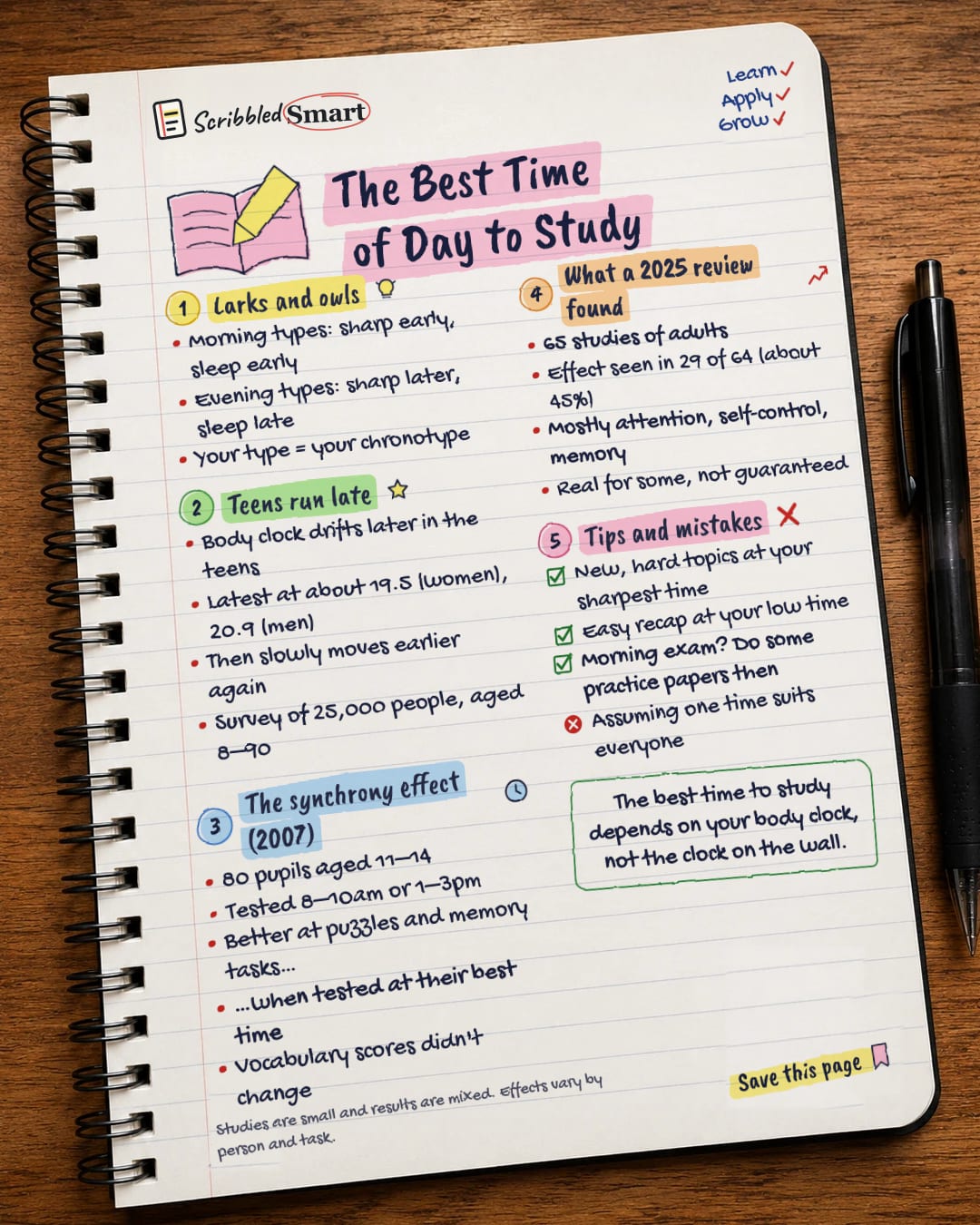
Study One-page note
The Best Time of Day to Study
Morning or night: when should you study? It depends on your body clock, and teens run later than everyone else. Save this page.
Good to know
Studies are small and results are mixed. Effects vary by person and task.
What's on the page
The note as text, so you can read it, copy it or use a screen reader.
Larks and owls
- Morning types: sharp early, sleep early
- Evening types: sharp later, sleep late
- Your type = your chronotype
Teens run late
- Body clock drifts later in the teens
- Latest at about 19.5 (women), 20.9 (men)
- Then slowly moves earlier again
- Survey of 25,000 people, aged 8–90
The synchrony effect (2007)
- 80 pupils aged 11–14
- Tested 8–10am or 1–3pm
- Better at puzzles and memory tasks…
- …when tested at their best time
- Vocabulary scores didn't change
What a 2025 review found
- 65 studies of adults
- Effect seen in 29 of 64 (about 45%)
- Mostly attention, self-control, memory
- Real for some, not guaranteed
Tips and mistakes
- New, hard topics at your sharpest time
- Easy recap at your low time
- Morning exam? Do some practice papers then
- Assuming one time suits everyone
Sources
- Goldstein, D., Hahn, C.S., Hasher, L., Wiprzycka, U.J. & Zelazo, P.D. (2007): Time of day, intellectual performance, and behavioral problems in Morning versus Evening type adolescents: Is there a synchrony effect? Personality and Individual Differences 42(3), 431–440
- Roenneberg, T. et al. (2004): A marker for the end of adolescence. Current Biology 14(24), R1038–R1039
- Nature News (Schneider, A., 30 Dec 2004): report on Roenneberg survey
- LMU Munich press release via idw (29 Dec 2004)
- Chauhan, S. et al. (2025): Chronotype and synchrony effects in human cognitive performance: a systematic review. Chronobiology International 42(4), 463–499
- Schmidt, C., Collette, F., Cajochen, C. & Peigneux, P. (2007): A time to think: circadian rhythms in human cognition. Cognitive Neuropsychology 24(7), 755–789
How we checked this
Every fact on this note comes from the 6 sources listed here, checked against official or peer-reviewed sources where possible. AI tools help with drafting; a person checks every fact against the sources. How we research
Spotted a mistake? Tell us and we'll fix it and log it on the corrections page.


