
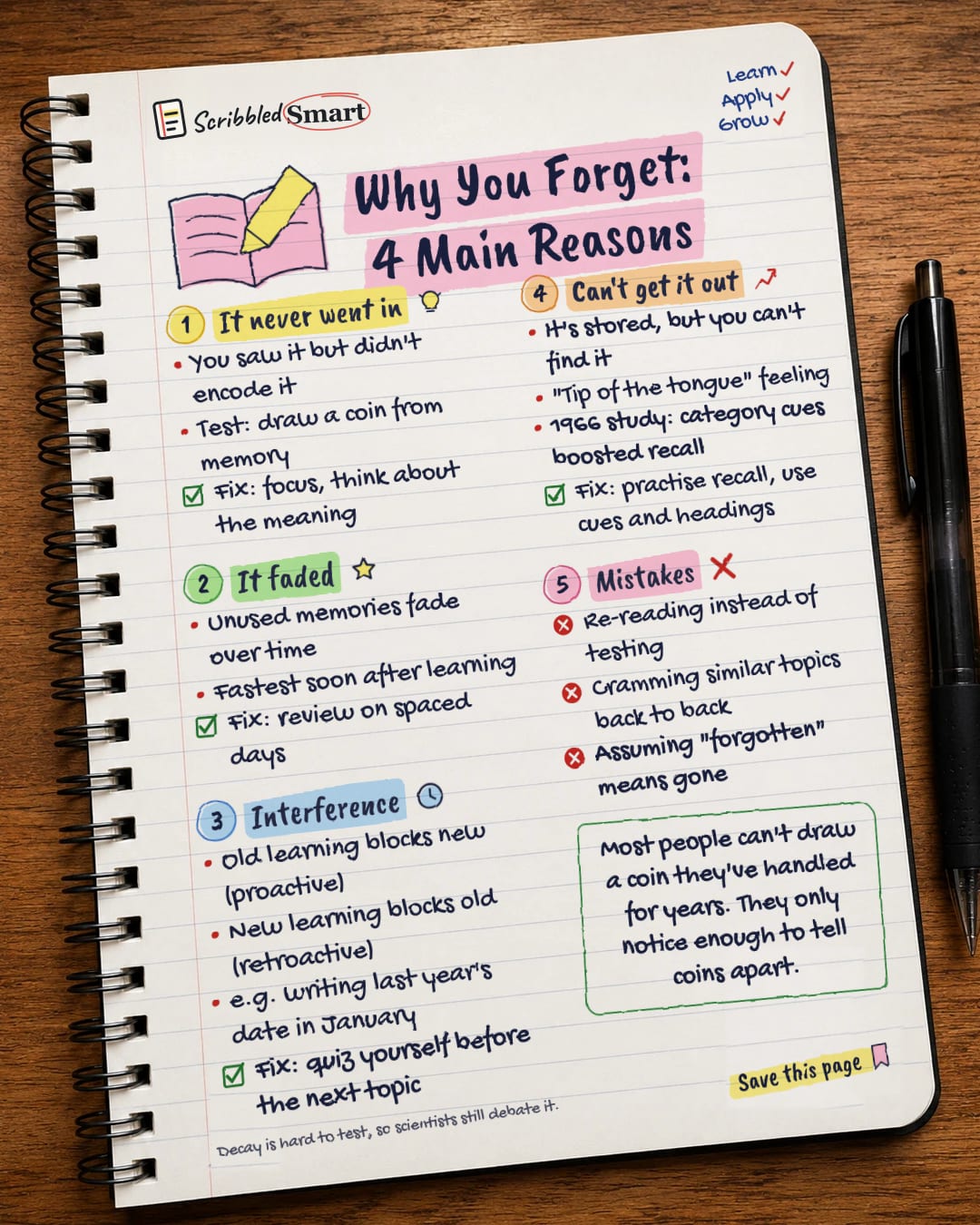
Study One-page note
Why You Forget: 4 Main Reasons
Forgot it already? There are 4 main reasons, and each has a fix. Save this page.
Good to know
Decay is hard to test, so scientists still debate it.
What's on the page
The note as text, so you can read it, copy it or use a screen reader.
It never went in
- You saw it but didn't encode it
- Test: draw a coin from memory
- Fix: focus, think about the meaning
It faded
- Unused memories fade over time
- Fastest soon after learning
- Fix: review on spaced days
Interference
- Old learning blocks new (proactive)
- New learning blocks old (retroactive)
- e.g. writing last year's date in January
- Fix: quiz yourself before the next topic
Can't get it out
- It's stored, but you can't find it
- "Tip of the tongue" feeling
- 1966 study: category cues boosted recall
- Fix: practise recall, use cues and headings
Mistakes
- Re-reading instead of testing
- Cramming similar topics back to back
- Assuming "forgotten" means gone
Sources
- OpenStax: Psychology 2e, 8.3 Problems with Memory
- OpenStax: Psychology 2e, 8.4 Ways to Enhance Memory
- Bäuml, K.-H.T. & Kliegl, O. (2013): The critical role of retrieval processes in release from proactive interference. Journal of Memory and Language 68, 39–53
- Tulving, E. & Pearlstone, Z. (1966): Availability versus accessibility of information in memory for words. Journal of Verbal Learning and Verbal Behavior 5, 381–391
- Underwood, B.J. (1957): Interference and forgetting. Psychological Review 64, 49–60
- Nickerson, R.S. & Adams, M.J. (1979): Long-term memory for a common object. Cognitive Psychology 11, 287–307
How we checked this
Every fact on this note comes from the 6 sources listed here, checked against official or peer-reviewed sources where possible. AI tools help with drafting; a person checks every fact against the sources. How we research
Spotted a mistake? Tell us and we'll fix it and log it on the corrections page.


