
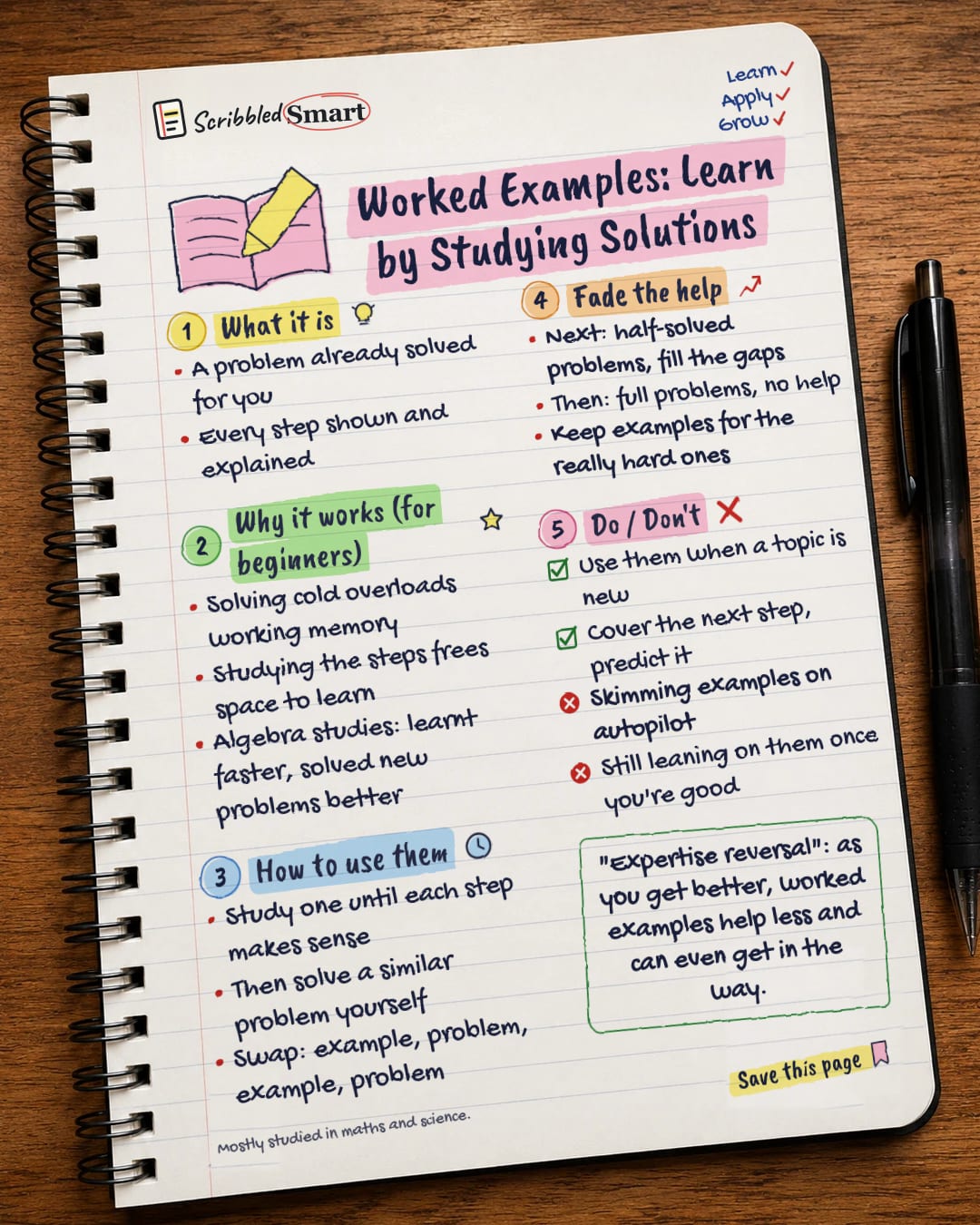
Study One-page note
Worked Examples: Learn by Studying Solutions
Stuck on a new maths topic? Studying a solved problem can teach you more than struggling alone. Save this page.
Good to know
Mostly studied in maths and science.
What's on the page
The note as text, so you can read it, copy it or use a screen reader.
What it is
- A problem already solved for you
- Every step shown and explained
Why it works (for beginners)
- Solving cold overloads working memory
- Studying the steps frees space to learn
- Algebra studies: learnt faster, solved new problems better
How to use them
- Study one until each step makes sense
- Then solve a similar problem yourself
- Swap: example, problem, example, problem
Fade the help
- Next: half-solved problems, fill the gaps
- Then: full problems, no help
- Keep examples for the really hard ones
Do / Don't
- Use them when a topic is new
- Cover the next step, predict it
- Skimming examples on autopilot
- Still leaning on them once you're good
Sources
- NSW Centre for Education Statistics and Evaluation (2017): Cognitive load theory: Research that teachers really need to understand
- Rosenshine, B. (2012): Principles of Instruction: Research-Based Strategies That All Teachers Should Know. American Educator, Spring 2012
- Renkl, A. (2014): Toward an instructionally oriented theory of example-based learning. Cognitive Science 38(1), 1–37
- Kalyuga, S., Ayres, P., Chandler, P. & Sweller, J. (2003): The Expertise Reversal Effect. Educational Psychologist 38(1), 23–31
- Sweller, J. & Cooper, G.A. (1985): The Use of Worked Examples as a Substitute for Problem Solving in Learning Algebra. Cognition and Instruction 2(1), 59–89
- Barbieri, C.A. et al. (2023): A Meta-analysis of the Worked Examples Effect on Mathematics Performance. Educational Psychology Review 35, 11
How we checked this
Every fact on this note comes from the 6 sources listed here, checked against official or peer-reviewed sources where possible. AI tools help with drafting; a person checks every fact against the sources. How we research
Spotted a mistake? Tell us and we'll fix it and log it on the corrections page.


