
AI & Tech One-page note
The Turing Test Explained
In 1950, Alan Turing swapped "Can machines think?" for a simple game. In 2025, a chatbot was picked as "the human" more often than real people. Here's what the Turing test is, and why passing it doesn't mean AI understands. Save this page.
Good to know
Sources: Turing, Mind (1950); Jones & Bergen, PNAS (2026); Bank of England. Checked Nov 2026.
What's on the page
The note as text, so you can read it, copy it or use a screen reader.
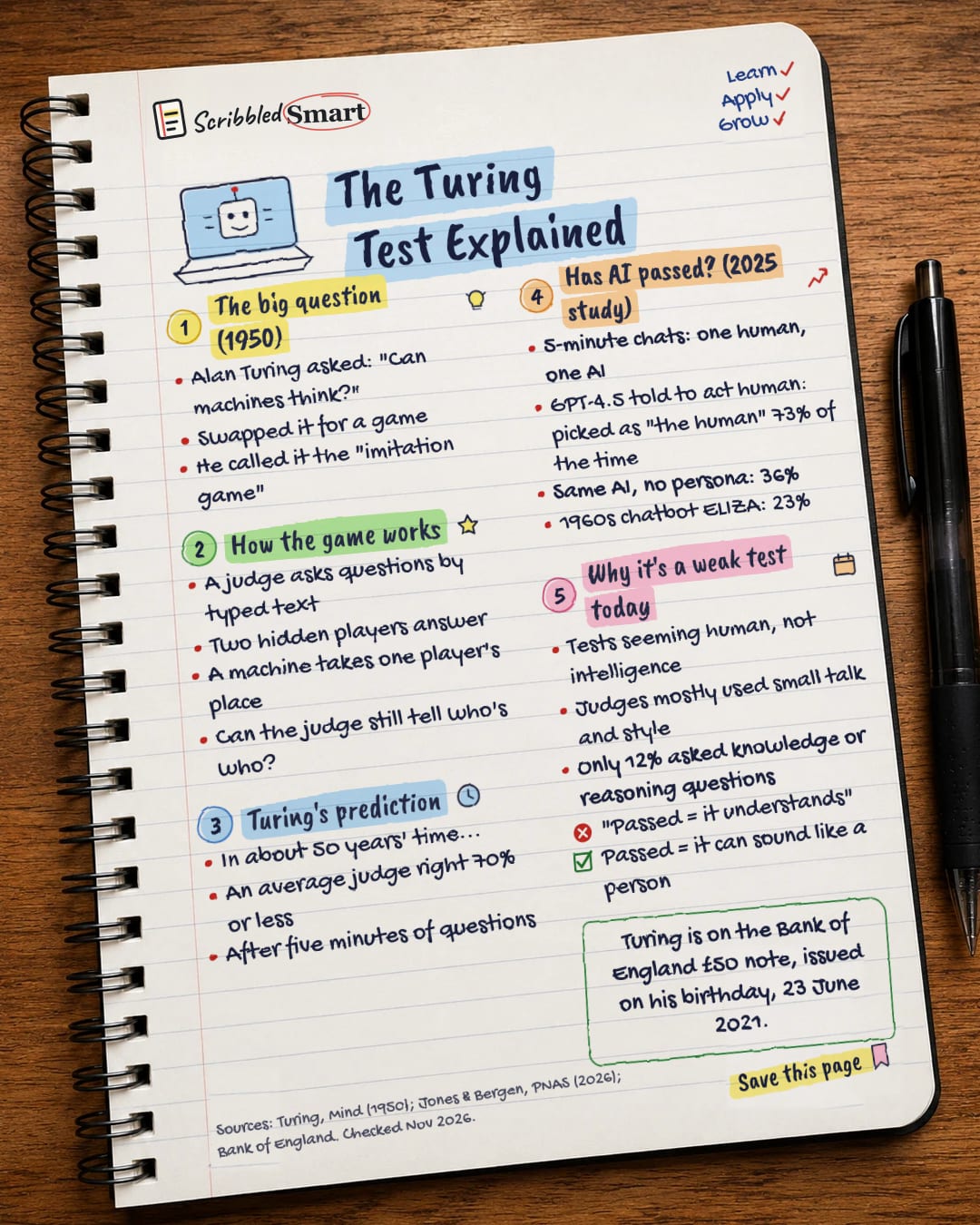
The big question (1950)
- Alan Turing asked: "Can machines think?"
- Swapped it for a game
- He called it the "imitation game"
How the game works
- A judge asks questions by typed text
- Two hidden players answer
- A machine takes one player's place
- Can the judge still tell who's who?
Turing's prediction
- In about 50 years' time...
- An average judge right 70% or less
- After five minutes of questions
Has AI passed? (2025 study)
- 5-minute chats: one human, one AI
- GPT-4.5 told to act human: picked as "the human" 73% of the time
- Same AI, no persona: 36%
- 1960s chatbot ELIZA: 23%
Why it's a weak test today
- Tests seeming human, not intelligence
- Judges mostly used small talk and style
- Only 12% asked knowledge or reasoning questions
- "Passed = it understands"
- Passed = it can sound like a person
Sources
- Turing, A. M.: Computing Machinery and Intelligence. Mind 59(236), 1950
- Jones, C. R. & Bergen, B. K.: Large Language Models Pass the Turing Test (arXiv, 2025)
- UC San Diego via EurekAlert!: news release on the PNAS paper (May 2026)
- Weizenbaum, J.: ELIZA. Communications of the ACM 9(1), 1966
- Bank of England: Polymer £50 note
- Bank of England: The new £50 note unveiled (25 March 2021)
How we checked this
Every fact on this note comes from the 6 sources listed here, checked against official or peer-reviewed sources where possible. AI tools help with drafting; a person checks every fact against the sources. How we research
Spotted a mistake? Tell us and we'll fix it and log it on the corrections page.


