
Career One-page note
How to Negotiate Your Salary
The first number in a negotiation matters more than you think. What research says about asking for more. Save this page.
What's on the page
The note as text, so you can read it, copy it or use a screen reader.
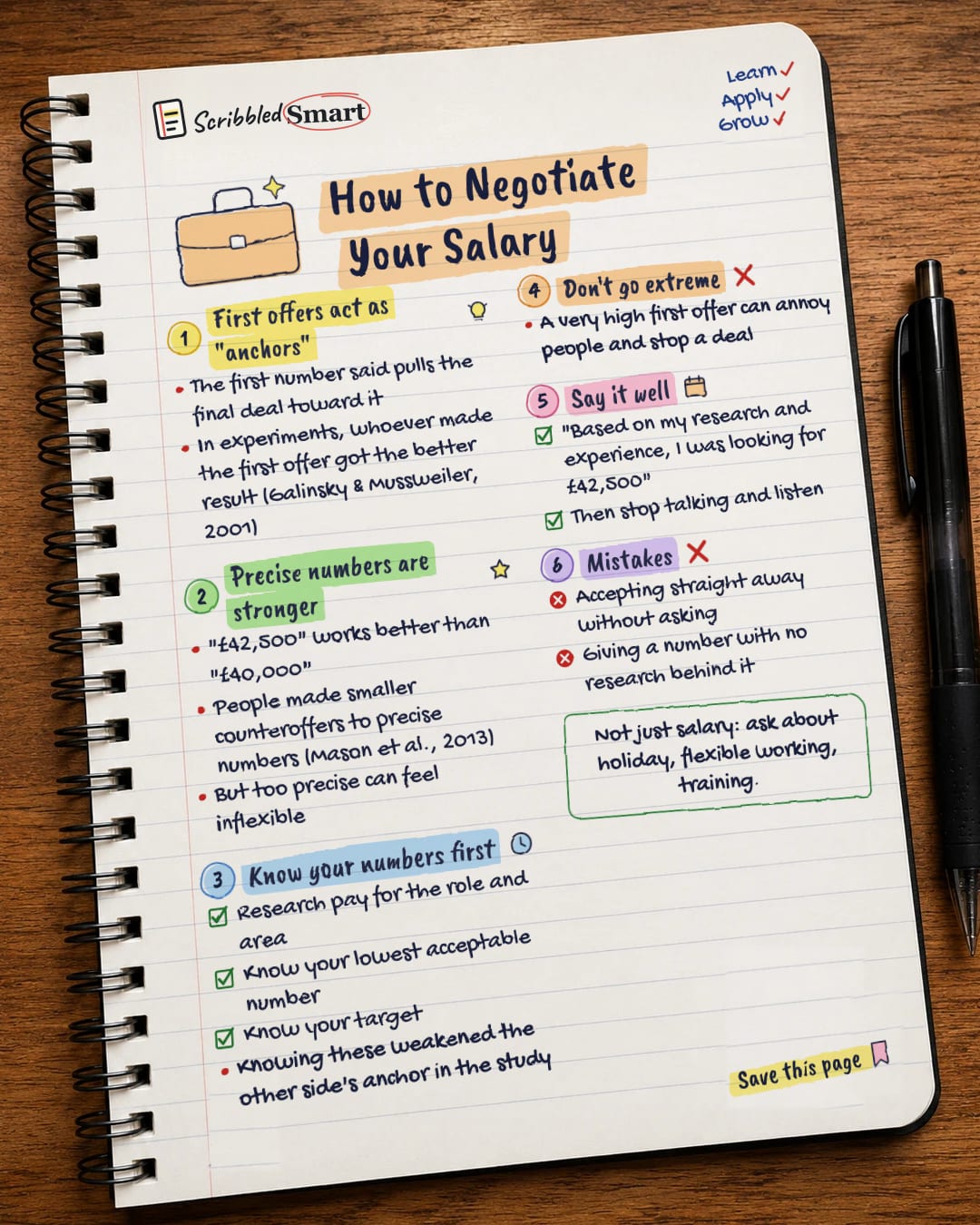
First offers act as "anchors"
- The first number said pulls the final deal toward it
- In experiments, whoever made the first offer got the better result (Galinsky & Mussweiler, 2001)
Precise numbers are stronger
- "£42,500" works better than "£40,000"
- People made smaller counteroffers to precise numbers (Mason et al., 2013)
- But too precise can feel inflexible
Know your numbers first
- Research pay for the role and area
- Know your lowest acceptable number
- Know your target
- Knowing these weakened the other side's anchor in the study
Don't go extreme
- A very high first offer can annoy people and stop a deal
Say it well
- "Based on my research and experience, I was looking for £42,500"
- Then stop talking and listen
Mistakes
- Accepting straight away without asking
- Giving a number with no research behind it
Sources
- PubMed: Galinsky & Mussweiler (2001), First offers as anchors (abstract)
- HBS Working Knowledge: When to make the first offer in negotiations
- Columbia Business School: Asking for a precise, not round, number
- Mason et al. (2013): Precise offers are potent anchors (Journal of Experimental Social Psychology)
- Lee et al. (2018): Too precise to pursue (IDEAS/RePEc)
How we checked this
Every fact on this note comes from the 5 sources listed here, checked against official or peer-reviewed sources where possible. AI tools help with drafting; a person checks every fact against the sources. How we research
Spotted a mistake? Tell us and we'll fix it and log it on the corrections page.


