
On this page
- Lesson 1: First offers act as anchors
- Lesson 2: Is a precise number better than a round one?
- Lesson 3: Know your numbers before you talk
- Lesson 4: Can asking for too much backfire?
- How to negotiate your salary out loud: a simple script
- Salary negotiation mistakes to avoid
- A word on the evidence
- Related reading
- Sources
Here's how to negotiate your salary, based on research: know your numbers first, then ask for a specific, well-researched figure that isn't extreme, and listen. Negotiation experiments show that the first number on the table pulls the final deal towards it, and that precise numbers are harder to push down than round ones. This guide explains what those studies found, where their limits are, and how to turn them into a calm, simple ask.
Lesson 1: First offers act as anchors
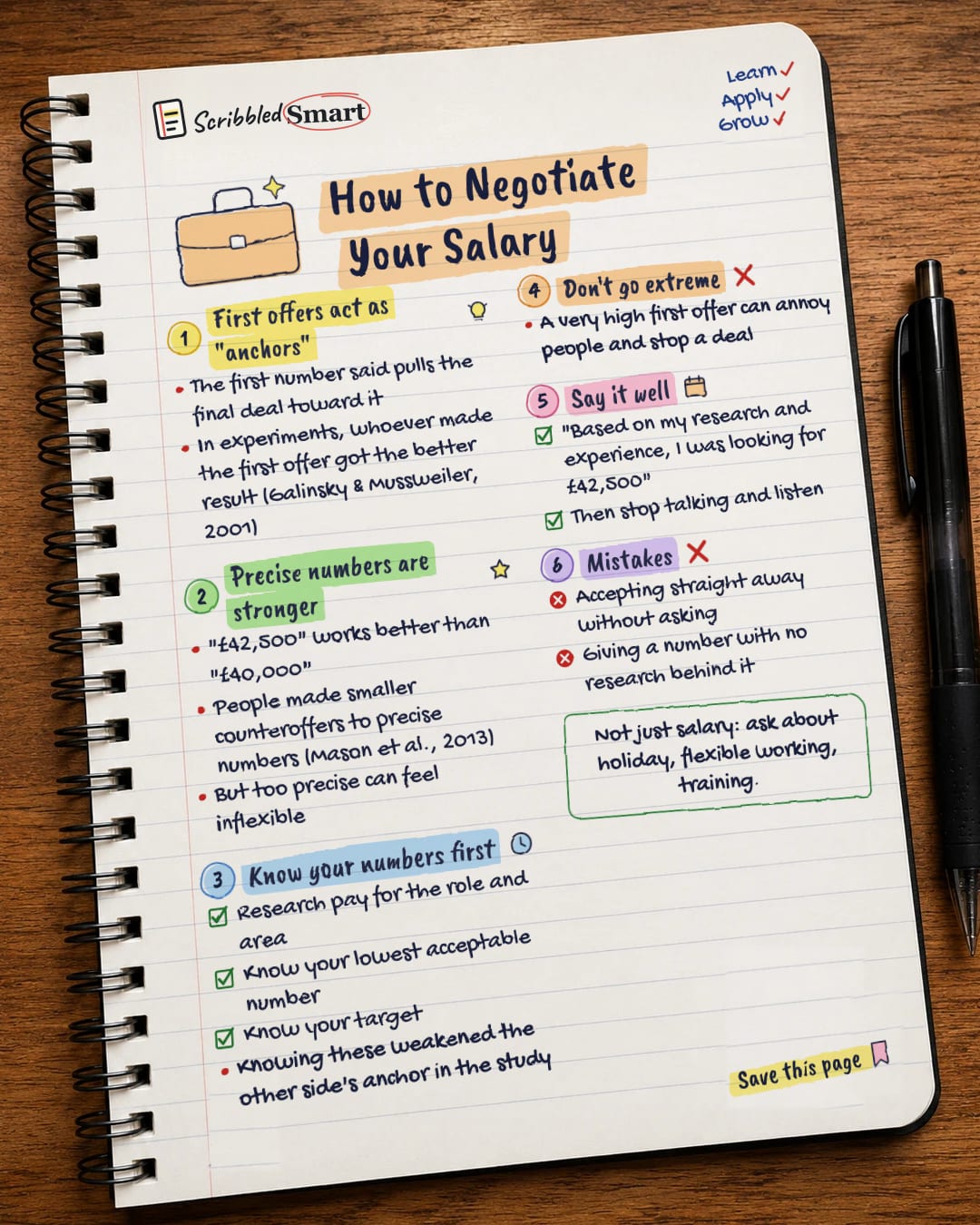
The first number mentioned in a negotiation tends to pull the final agreement towards it. Researchers call this an "anchor".
In a well-known 2001 paper, "First offers as anchors", Galinsky and Mussweiler reported three experiments. They found that whoever made the first offer, buyer or seller, got the better outcome. The first offer strongly predicted where the deal ended up.
Should you make the first offer?
It depends on how much you know. Galinsky's own commentary (published by Harvard Business School Working Knowledge) suggests that if you haven't done your research, letting the other side go first may be safer. Naming a number first only helps if that number is well informed. So the honest answer is: go first when you've done your homework, and be more careful when you haven't.
Lesson 2: Is a precise number better than a round one?
A precise figure tends to draw a counteroffer that stays closer to it than a round figure does. In a 2013 study, "Precise offers are potent anchors", Mason, Lee, Wiley and Ames found that when people received a precise first offer, they made smaller adjustments in their counteroffers than when they received a round number.
In salary terms, the research suggests that asking for "£42,500" may draw a counteroffer that stays closer to your figure than asking for "£40,000". (These figures are an illustration, not a pay benchmark.)
Don't go too precise
There's a limit. Later research by Lee and colleagues (2018), titled "Too precise to pursue", suggests that an offer can be so precise that it feels inflexible and puts people off negotiating at all. The studies don't set an exact cut-off, so our suggestion is a middle ground: a figure like £42,500 rather than one with pennies.
Lesson 3: Know your numbers before you talk
Before any pay conversation, work out three things: what the role usually pays, your target and the lowest figure you'd accept. Part of this comes straight from the research.
In Galinsky and Mussweiler's experiments, the first-offer effect was cancelled out when the person receiving the offer focused on their own target, the other side's alternatives, or the lowest price the other side would accept. Knowing the numbers protected people from being pulled along by the other side's anchor.
To prepare:
- Research pay for the role and area. Look at what similar jobs in your location are advertised for.
- Set your target. The figure you'd be genuinely pleased with.
- Set your lowest acceptable number. Below this, you'd rather say no or look elsewhere.
- Think about your alternatives. Other offers, or staying where you are.
Lesson 4: Can asking for too much backfire?
Aim high, but keep it believable: a first offer that seems unreasonable can backfire. In his Harvard Business School commentary, Galinsky notes that an unreasonably high starting offer may make a deal less likely, because it can anger or discourage the other side.
Your research is what keeps you on the right side of that line. A number you can explain is ambitious. A number you can't explain looks like a guess.
How to negotiate your salary out loud: a simple script
Keep the ask short and calm, then stop talking. For example:
"Based on my research and experience, I was looking for £42,500."
Then pause and listen. Silence can feel awkward, but it gives the other person room to respond. You don't need to fill it with reasons or apologies.
Think beyond salary
Pay isn't the only thing you can ask about. You could also discuss holiday, flexible working or training. If the salary can't move, one of these might. And before you agree a figure, it helps to know how to read your UK payslip, so you understand what lands in your account.
Salary negotiation mistakes to avoid
- ✗ Accepting straight away without asking. It's fine to say thank you and ask if there's any room to move.
- ✗ Giving a number with no research behind it. It's easy to anchor yourself too low, or to look unrealistic.
- ✗ Opening with an extreme figure. It can sour the conversation.
- ✗ Talking yourself down after you've asked. Say your number, then listen.
A word on the evidence
The studies above were laboratory negotiation experiments. They weren't real salary negotiations with real employers. Several sources agree on what they found, but a real pay conversation with a real employer may not play out the same way. Treat these as useful principles, not promises.
Related reading
- How to read your payslip (UK): see what a new salary actually means after deductions.
- Cognitive biases: the thinking traps, like anchoring, that shape everyday decisions.
- How to prepare for a job interview: the steps that come before the offer.
- Your basic rights at work (UK): the legal minimum pay and holiday you're entitled to.
Sources
- PubMed: Galinsky & Mussweiler (2001), First offers as anchors (abstract) (original pages, no longer online: Kellogg https://www.kellogg.northwestern.edu/faculty/research/detail/2001/first-offers-as-anchors-the-role-of-perspective-taking; London Business School https://www.london.edu/faculty-and-research/academic-research/f/first-offers-as-anchors-the-role-of-perspective-taking-and-negotiator-focus)
- HBS Working Knowledge: When to make the first offer in negotiations
- Columbia Business School: Asking for a precise, not round, number
- Mason et al. (2013): Precise offers are potent anchors (Journal of Experimental Social Psychology) (original manuscript PDF, no longer online: https://drupalgsb-test.paas.cc.columbia.edu/sites/default/files-efs/pubfiles/5957/precise_offers.pdf)
- Lee et al. (2018): Too precise to pursue (IDEAS/RePEc)
How we checked this
Every fact in this article comes from the 5 sources listed above, checked against official or peer-reviewed sources where possible. AI tools help with drafting; a person checks every fact against the sources. How we research
- Published and checked
General info, not financial advice.
Spotted a mistake? Tell us and we'll fix it and log it on the corrections page.


