
General knowledge One-page note
How Evolution Works
No, we didn't come from monkeys. How evolution really works, in one page. Save this page.
Good to know
Matches GCSE Biology (Evolution). Checked November 2026.
What's on the page
The note as text, so you can read it, copy it or use a screen reader.
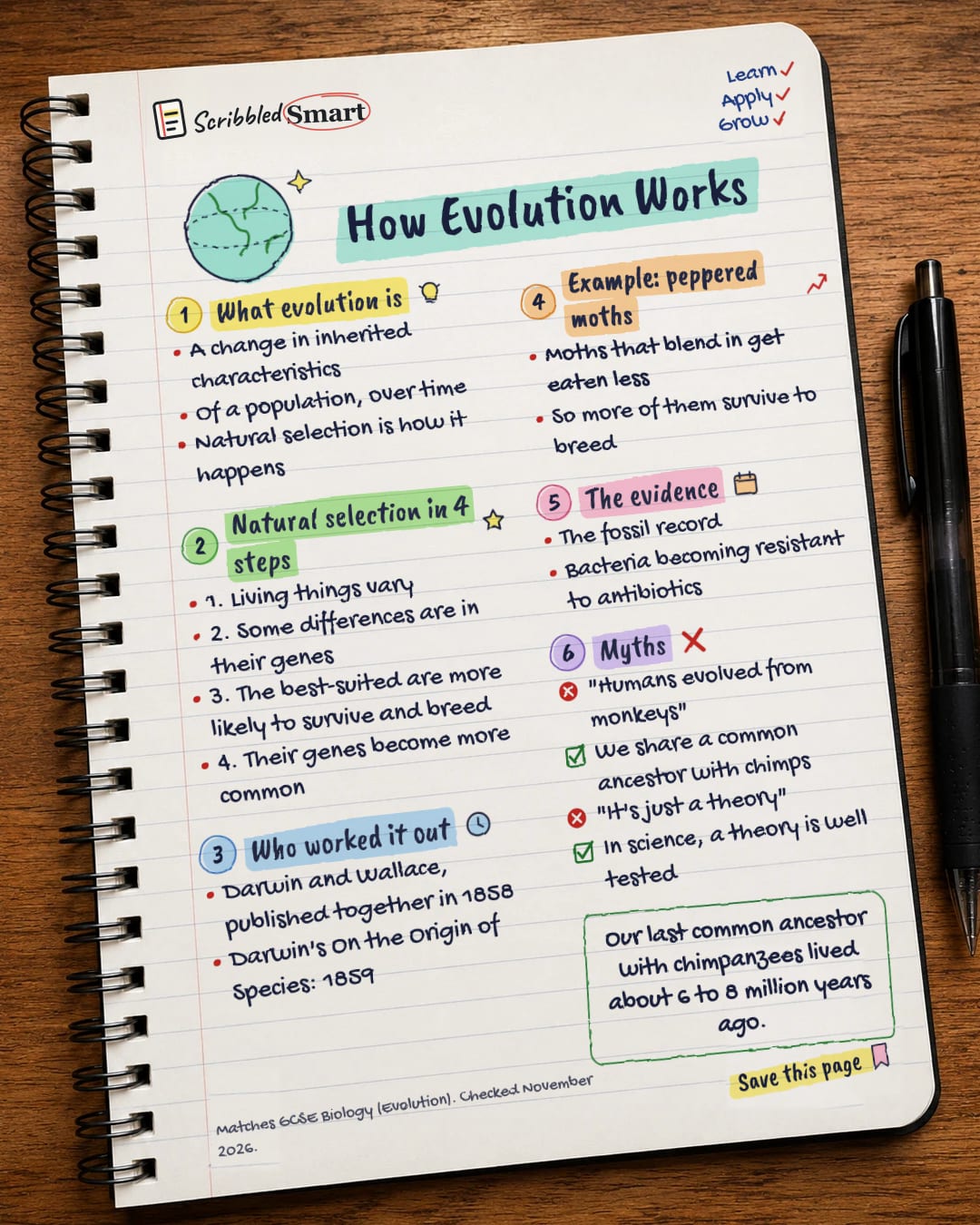
What evolution is
- A change in inherited characteristics
- Of a population, over time
- Natural selection is how it happens
Natural selection in 4 steps
- 1. Living things vary
- 2. Some differences are in their genes
- 3. The best-suited are more likely to survive and breed
- 4. Their genes become more common
Who worked it out
- Darwin and Wallace, published together in 1858
- Darwin's On the Origin of Species: 1859
Example: peppered moths
- Moths that blend in get eaten less
- So more of them survive to breed
The evidence
- The fossil record
- Bacteria becoming resistant to antibiotics
Myths
- "Humans evolved from monkeys"
- We share a common ancestor with chimps
- "It's just a theory"
- In science, a theory is well tested
Sources
- Natural History Museum: What is natural selection?
- Natural History Museum: Human evolution
- Smithsonian National Museum of Natural History: Human Origins – Frequently asked questions
- AQA: GCSE Biology (8461) specification, 4.6 Inheritance, variation and evolution
- Linnean Society: Alfred Russel Wallace (1823–1913)
- Darwin Correspondence Project: Natural selection
- UC Berkeley Understanding Evolution: Trees, not ladders
How we checked this
Every fact on this note comes from the 7 sources listed here, checked against official or peer-reviewed sources where possible. AI tools help with drafting; a person checks every fact against the sources. How we research
Spotted a mistake? Tell us and we'll fix it and log it on the corrections page.


