
General knowledge One-page note
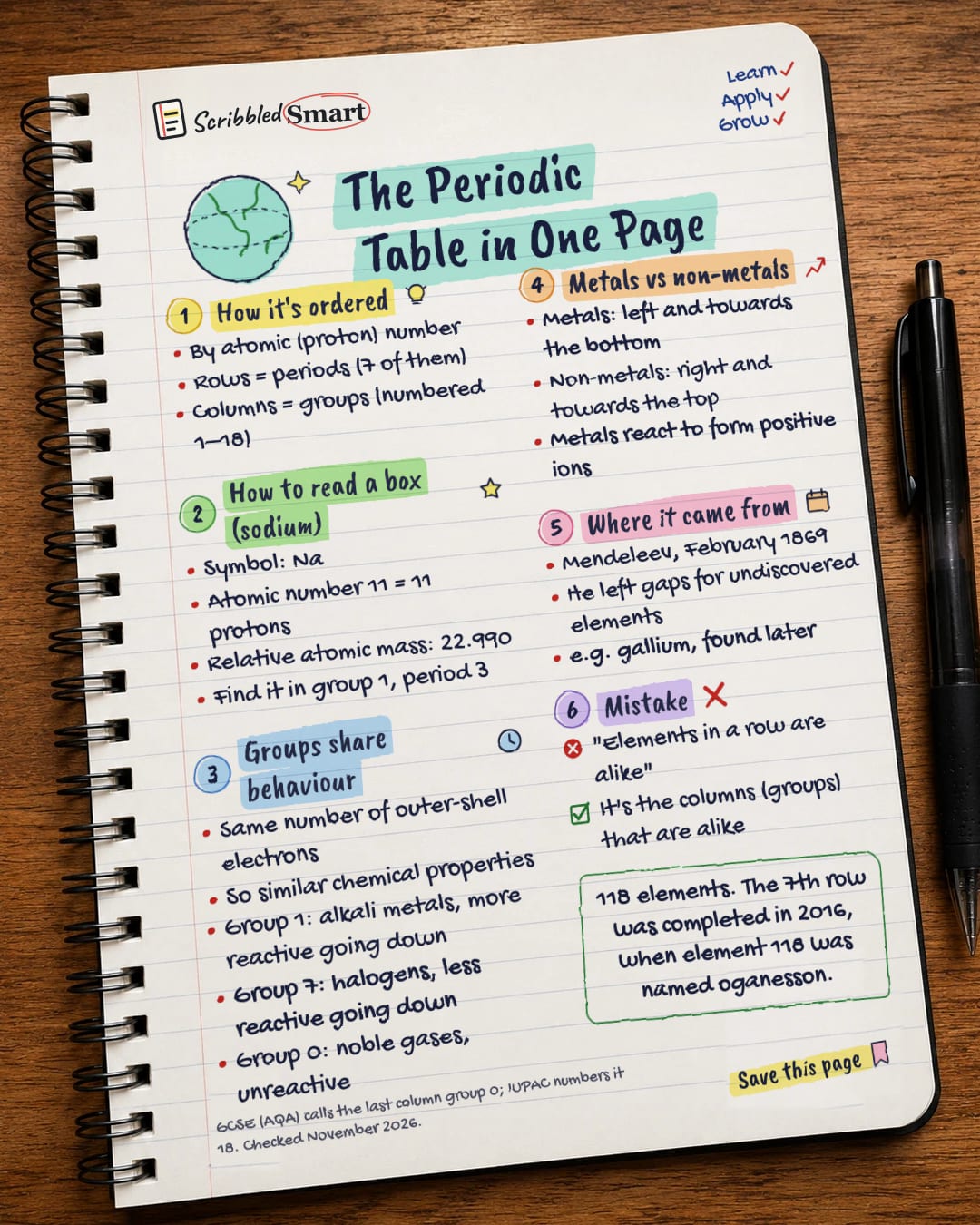
The Periodic Table in One Page
118 elements, one chart. How to actually read the periodic table, in one page. Save this page.
Good to know
GCSE (AQA) calls the last column group 0; IUPAC numbers it 18. Checked November 2026.
What's on the page
The note as text, so you can read it, copy it or use a screen reader.
How it's ordered
- By atomic (proton) number
- Rows = periods (7 of them)
- Columns = groups (numbered 1–18)
How to read a box (sodium)
- Symbol: Na
- Atomic number 11 = 11 protons
- Relative atomic mass: 22.990
- Find it in group 1, period 3
Groups share behaviour
- Same number of outer-shell electrons
- So similar chemical properties
- Group 1: alkali metals, more reactive going down
- Group 7: halogens, less reactive going down
- Group 0: noble gases, unreactive
Metals vs non-metals
- Metals: left and towards the bottom
- Non-metals: right and towards the top
- Metals react to form positive ions
Where it came from
- Mendeleev, February 1869
- He left gaps for undiscovered elements
- e.g. gallium, found later
Mistake
- "Elements in a row are alike"
- It's the columns (groups) that are alike
Sources
- AQA: GCSE Chemistry (8462) specification, 4.1 Atomic structure and the periodic table
- IUPAC: Periodic table of elements
- IUPAC: IUPAC announces the names of the elements 113, 115, 117 and 118 (press release, 30 November 2016)
- Royal Society of Chemistry: Periodic Table – Sodium
- Royal Society of Chemistry: Development of the periodic table
- Royal Society of Chemistry: Finding the periodic table (2019)
How we checked this
Every fact on this note comes from the 6 sources listed here, checked against official or peer-reviewed sources where possible. AI tools help with drafting; a person checks every fact against the sources. How we research
Spotted a mistake? Tell us and we'll fix it and log it on the corrections page.


