
General knowledge One-page note UK only
How the Northern Lights Work
Why did the whole UK see the northern lights in 2024? The science of the aurora, in one page. Save this page.
Good to know
🇬🇧 UK viewing advice. Checked November 2026.
What's on the page
The note as text, so you can read it, copy it or use a screen reader.
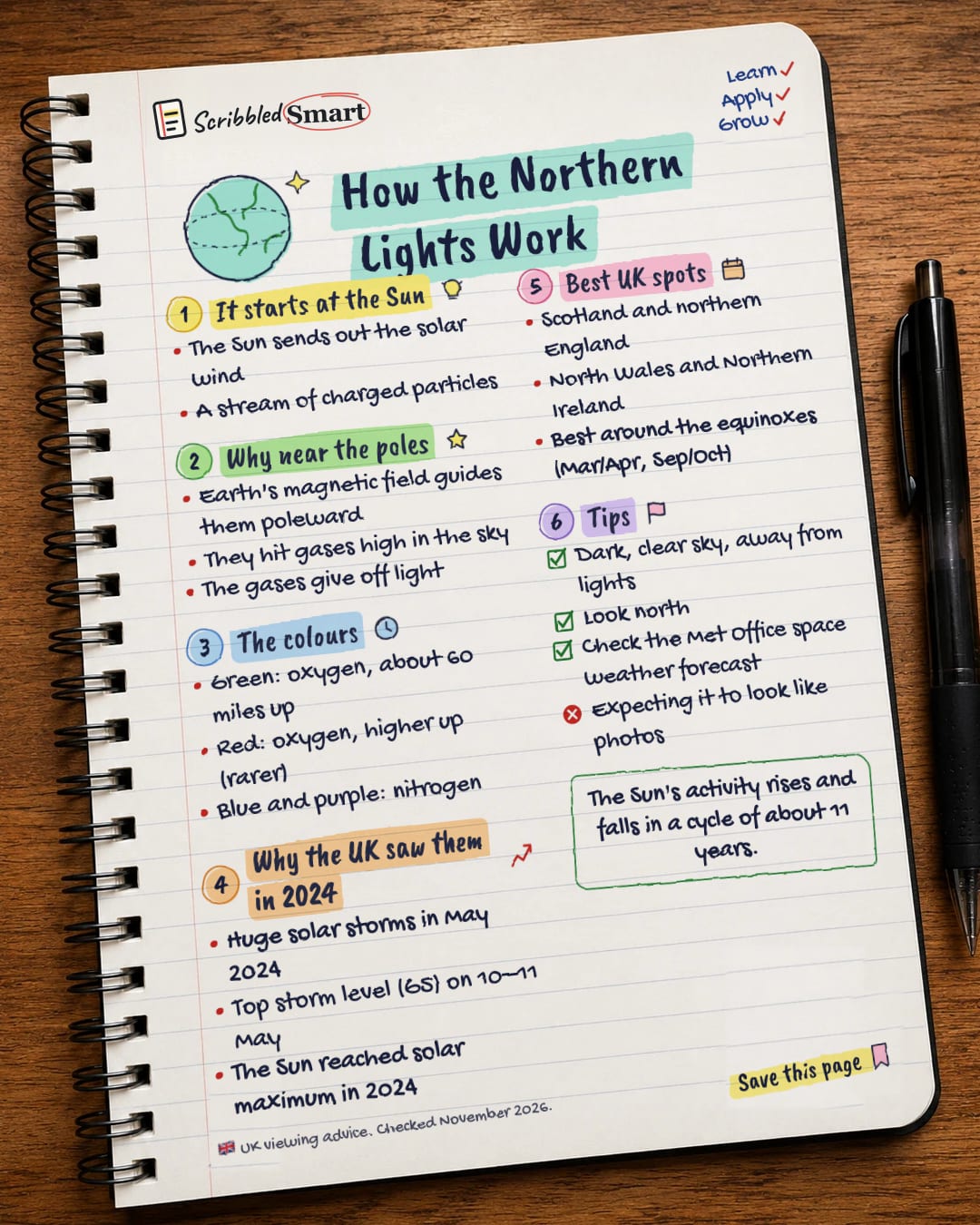
It starts at the Sun
- The Sun sends out the solar wind
- A stream of charged particles
Why near the poles
- Earth's magnetic field guides them poleward
- They hit gases high in the sky
- The gases give off light
The colours
- Green: oxygen, about 60 miles up
- Red: oxygen, higher up (rarer)
- Blue and purple: nitrogen
Why the UK saw them in 2024
- Huge solar storms in May 2024
- Top storm level (G5) on 10–11 May
- The Sun reached solar maximum in 2024
Best UK spots
- Scotland and northern England
- North Wales and Northern Ireland
- Best around the equinoxes (Mar/Apr, Sep/Oct)
Tips
- Dark, clear sky, away from lights
- Look north
- Check the Met Office space weather forecast
- Expecting it to look like photos
Sources
- Met Office: What causes the northern lights? (2025)
- Met Office: Northern lights
- Met Office: Auroras (space weather)
- British Geological Survey: Space weather update 13 May 2024
- NASA: NASA, NOAA: Sun reaches maximum phase in 11-year solar cycle (15 October 2024)
- Frontiers in Astronomy and Space Sciences (2025): The geomagnetic and geoelectric response to the May 2024 geomagnetic storm in the United Kingdom
How we checked this
Every fact on this note comes from the 6 sources listed here, checked against official or peer-reviewed sources where possible. AI tools help with drafting; a person checks every fact against the sources. How we research
Spotted a mistake? Tell us and we'll fix it and log it on the corrections page.


