
General knowledge One-page note
Inside the Earth: Its Layers
Nobody has been to Earth's core, so how do we know what's down there? Earthquakes. Save this page.
Good to know
Depths are approximate.
What's on the page
The note as text, so you can read it, copy it or use a screen reader.
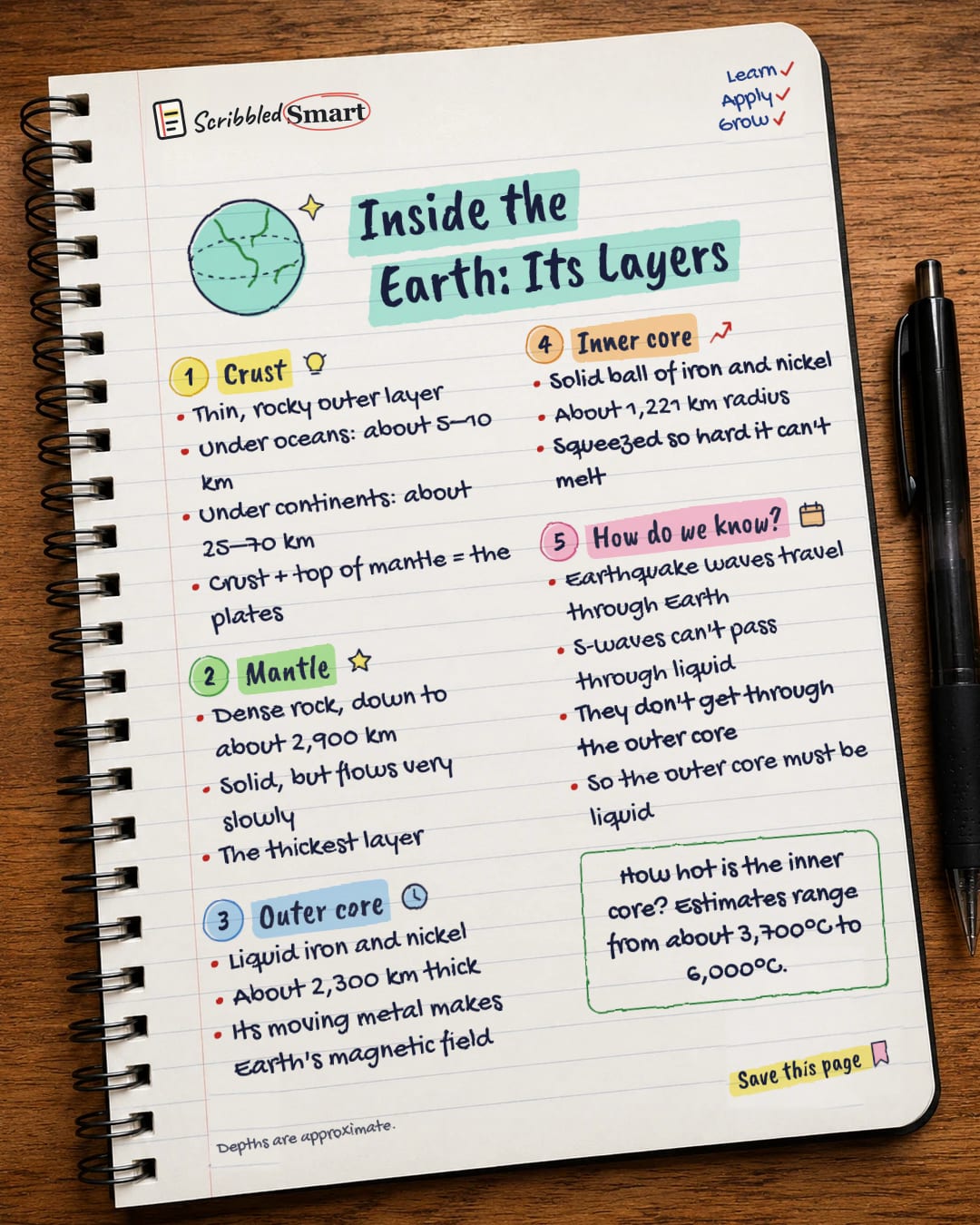
Crust
- Thin, rocky outer layer
- Under oceans: about 5–10 km
- Under continents: about 25–70 km
- Crust + top of mantle = the plates
Mantle
- Dense rock, down to about 2,900 km
- Solid, but flows very slowly
- The thickest layer
Outer core
- Liquid iron and nickel
- About 2,300 km thick
- Its moving metal makes Earth's magnetic field
Inner core
- Solid ball of iron and nickel
- About 1,221 km radius
- Squeezed so hard it can't melt
How do we know?
- Earthquake waves travel through Earth
- S-waves can't pass through liquid
- They don't get through the outer core
- So the outer core must be liquid
Sources
How we checked this
Every fact on this note comes from the 4 sources listed here, checked against official or peer-reviewed sources where possible. AI tools help with drafting; a person checks every fact against the sources. How we research
Spotted a mistake? Tell us and we'll fix it and log it on the corrections page.


