
General knowledge One-page note
How Stars Are Born and Die
Stars are born, live for billions of years and die, and some leave black holes behind. Save this page.
Good to know
Matches GCSE Physics (Space, separate science). Mass limits are approximate.
What's on the page
The note as text, so you can read it, copy it or use a screen reader.
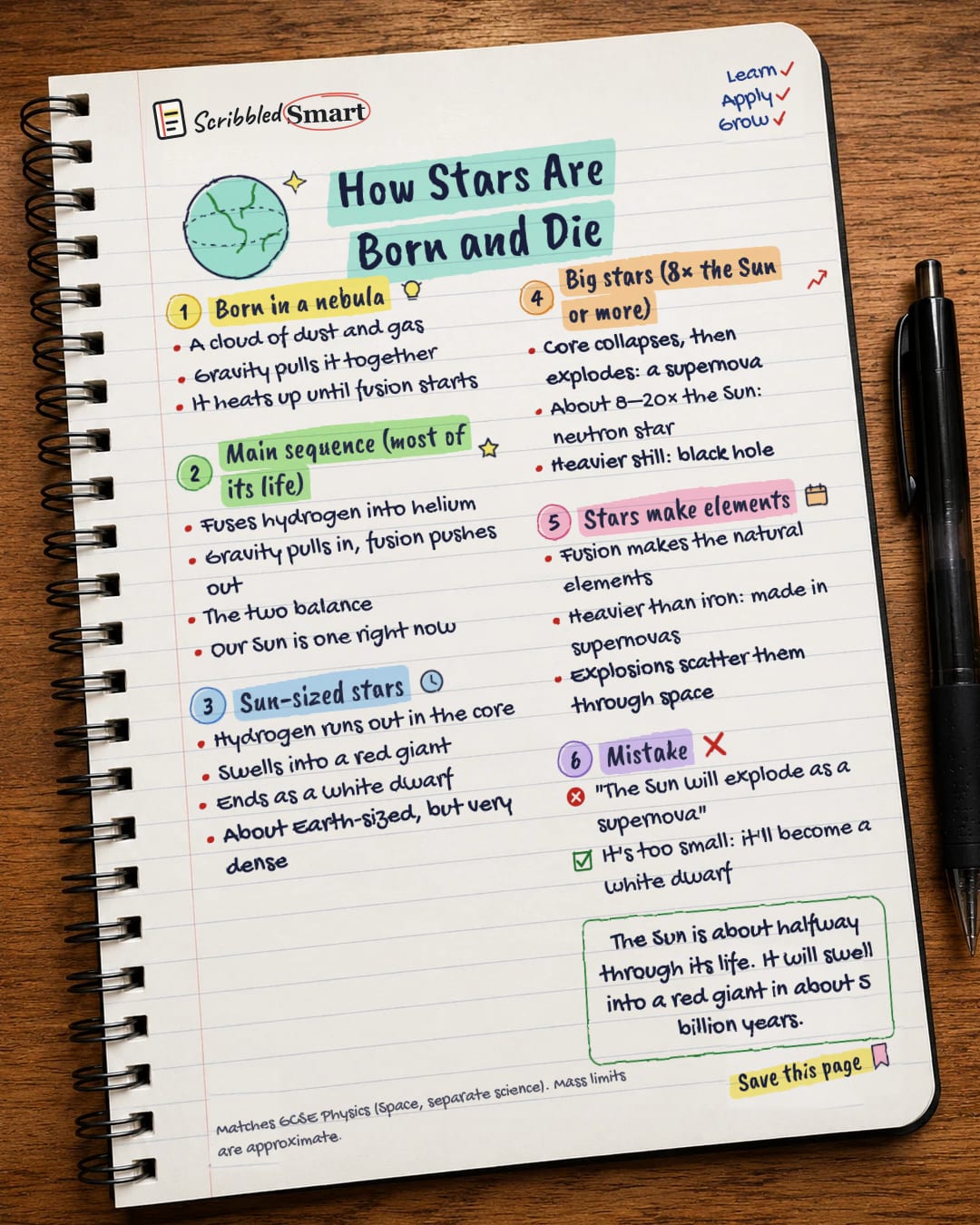
Born in a nebula
- A cloud of dust and gas
- Gravity pulls it together
- It heats up until fusion starts
Main sequence (most of its life)
- Fuses hydrogen into helium
- Gravity pulls in, fusion pushes out
- The two balance
- Our Sun is one right now
Sun-sized stars
- Hydrogen runs out in the core
- Swells into a red giant
- Ends as a white dwarf
- About Earth-sized, but very dense
Big stars (8× the Sun or more)
- Core collapses, then explodes: a supernova
- About 8–20× the Sun: neutron star
- Heavier still: black hole
Stars make elements
- Fusion makes the natural elements
- Heavier than iron: made in supernovas
- Explosions scatter them through space
Mistake
- "The Sun will explode as a supernova"
- It's too small: it'll become a white dwarf
Sources
How we checked this
Every fact on this note comes from the 3 sources listed here, checked against official or peer-reviewed sources where possible. AI tools help with drafting; a person checks every fact against the sources. How we research
Spotted a mistake? Tell us and we'll fix it and log it on the corrections page.


