
General knowledge One-page note
The Cold War Explained
Forty-plus years, two superpowers and one wall. The Cold War in one page. Save this page.
Good to know
Dates from the US State Department's Office of the Historian and the Berlin Wall Foundation. Checked Nov 2026.
What's on the page
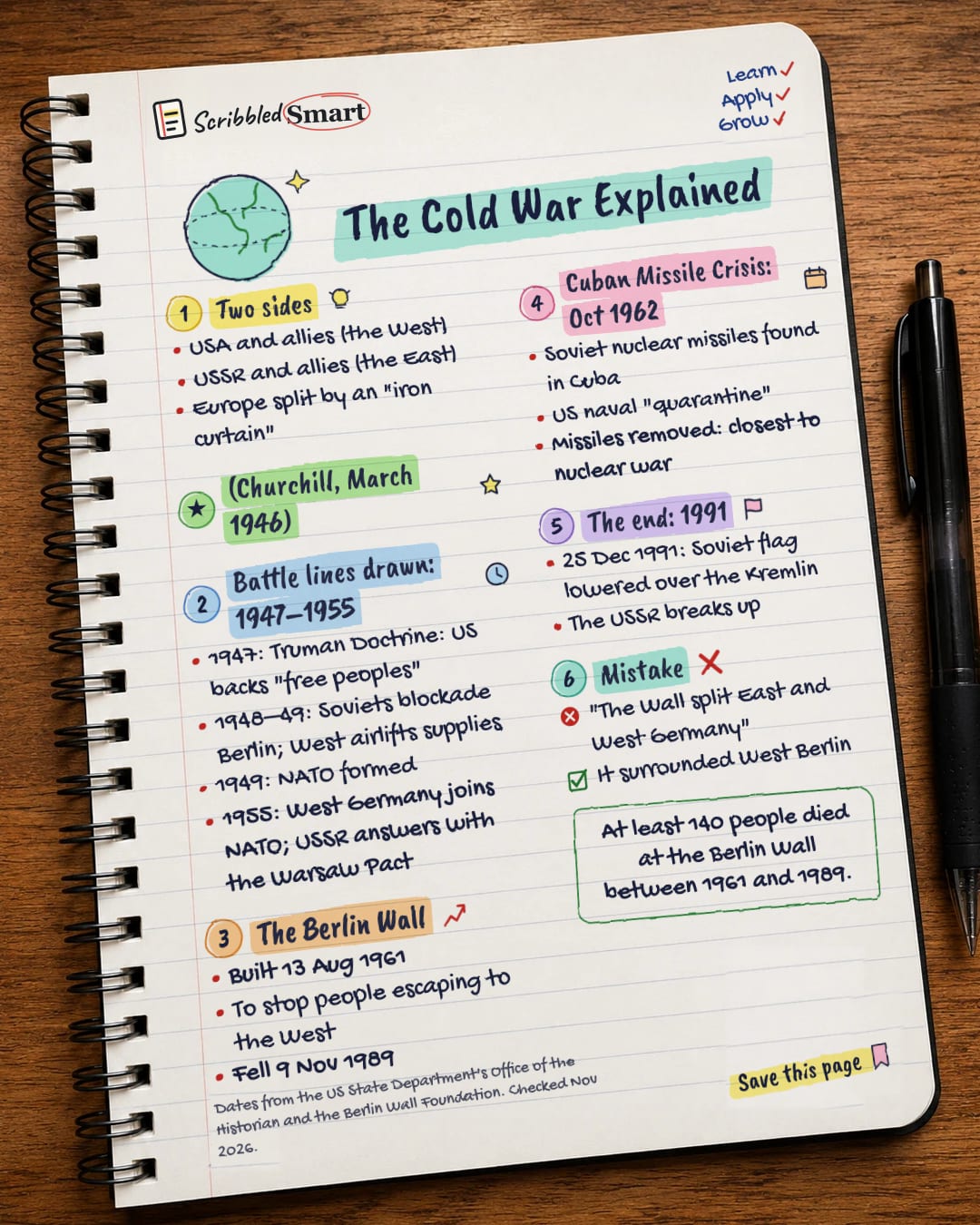
The note as text, so you can read it, copy it or use a screen reader.
Two sides
- USA and allies (the West)
- USSR and allies (the East)
- Europe split by an "iron curtain" (Churchill, March 1946)
Battle lines drawn: 1947–1955
- 1947: Truman Doctrine: US backs "free peoples"
- 1948–49: Soviets blockade Berlin; West airlifts supplies
- 1949: NATO formed
- 1955: West Germany joins NATO; USSR answers with the Warsaw Pact
The Berlin Wall
- Built 13 Aug 1961
- To stop people escaping to the West
- Fell 9 Nov 1989
Cuban Missile Crisis: Oct 1962
- Soviet nuclear missiles found in Cuba
- US naval "quarantine"
- Missiles removed: closest to nuclear war
The end: 1991
- 25 Dec 1991: Soviet flag lowered over the Kremlin
- The USSR breaks up
Mistake
- "The Wall split East and West Germany"
- It surrounded West Berlin
Sources
- Office of the Historian, US Department of State: The Truman Doctrine, 1947
- Office of the Historian: The Berlin Airlift, 1948–1949
- Office of the Historian: North Atlantic Treaty Organization (NATO), 1949
- Office of the Historian: The Cuban Missile Crisis, October 1962
- Office of the Historian: The Collapse of the Soviet Union
- Berlin Wall Foundation (Stiftung Berliner Mauer): The Berlin Wall
- The National WWII Museum: Winston Churchill's Iron Curtain Speech – March 5, 1946
- The National Archives: 'Iron curtain' speech (Cold War on file)
How we checked this
Every fact on this note comes from the 8 sources listed here, checked against official or peer-reviewed sources where possible. AI tools help with drafting; a person checks every fact against the sources. How we research
Spotted a mistake? Tell us and we'll fix it and log it on the corrections page.


