
Language One-page note UK only
Contractions: When They're OK in Writing
Can you use "don't" in an essay? Here's when contractions are fine, when to write them out, and what GOV.UK says. Save this page.
Good to know
From GOV.UK style guide (UK), Sheffield Hallam and Sussex university guides, VOA Learning English, Longman.
What's on the page
The note as text, so you can read it, copy it or use a screen reader.
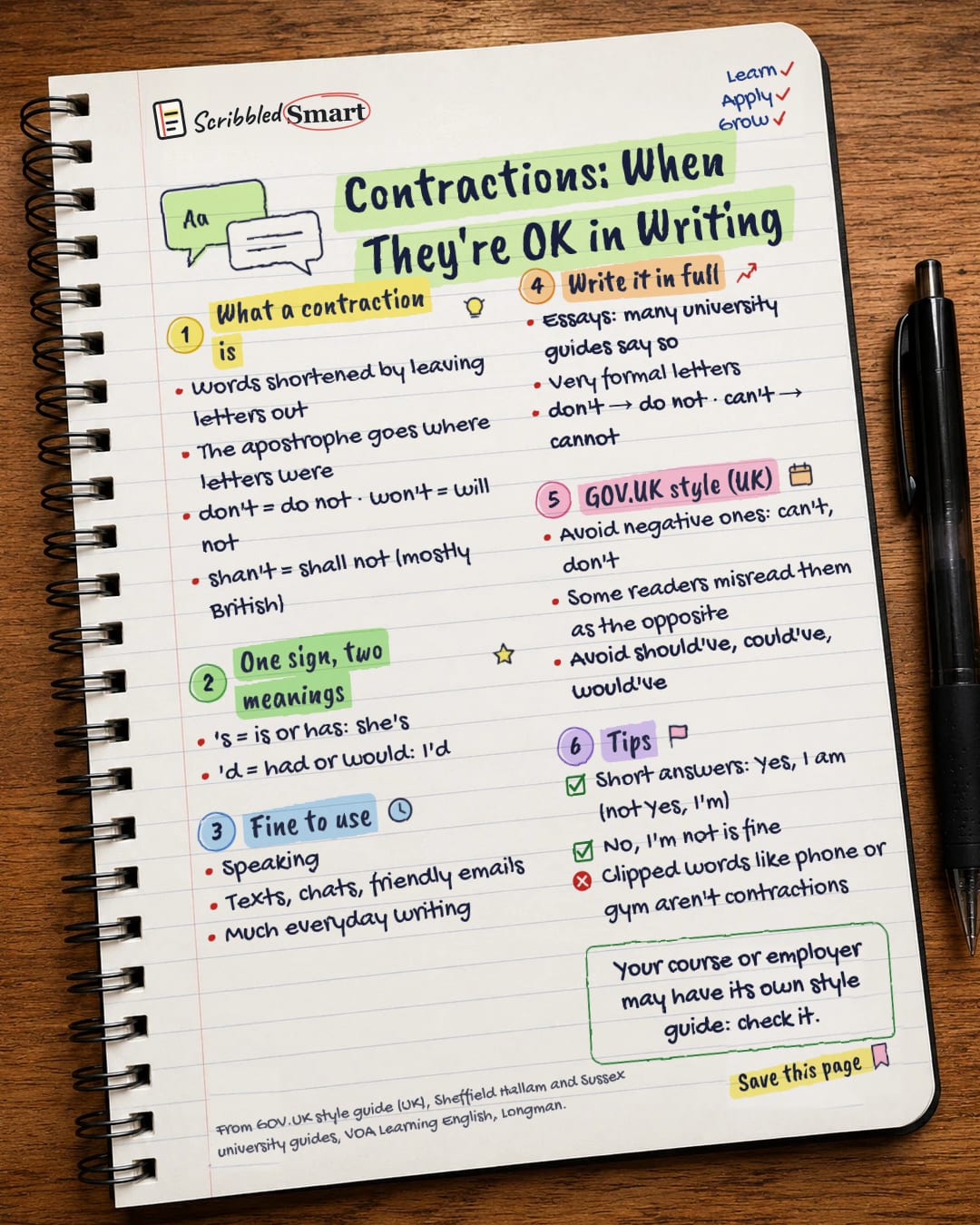
What a contraction is
- Words shortened by leaving letters out
- The apostrophe goes where letters were
- don't = do not · won't = will not
- shan't = shall not (mostly British)
One sign, two meanings
- 's = is or has: she's
- 'd = had or would: I'd
Fine to use
- Speaking
- Texts, chats, friendly emails
- Much everyday writing
Write it in full
- Essays: many university guides say so
- Very formal letters
- don't → do not · can't → cannot
GOV.UK style (UK)
- Avoid negative ones: can't, don't
- Some readers misread them as the opposite
- Avoid should've, could've, would've
Tips
- Short answers: Yes, I am (not Yes, I'm)
- No, I'm not is fine
- Clipped words like phone or gym aren't contractions
Sources
- GOV.UK: A to Z style guide (Contractions)
- University of Sussex: Guide to Punctuation, Contractions (Larry Trask)
- Sheffield Hallam University Library: Academic writing conventions
- VOA Learning English: Don't Be Afraid of Contractions
- VOA Learning English: Say 'Yes, I am' not 'Yes I'm'
- Longman Dictionary of Contemporary English: won't; shan't
- Deakin University: Academic style (search summary only; page 403)
How we checked this
Every fact on this note comes from the 7 sources listed here, checked against official or peer-reviewed sources where possible. AI tools help with drafting; a person checks every fact against the sources. How we research
Spotted a mistake? Tell us and we'll fix it and log it on the corrections page.


