
Language One-page note
Why English Spelling Is So Weird
Why is there a k in knight and a b in doubt? Blame printing, borrowing and a vowel shift. Save this page.
Good to know
Sources: national curriculum in England spelling guidance (DfE), University of Kansas Libraries, Dictionary.com.
What's on the page
The note as text, so you can read it, copy it or use a screen reader.
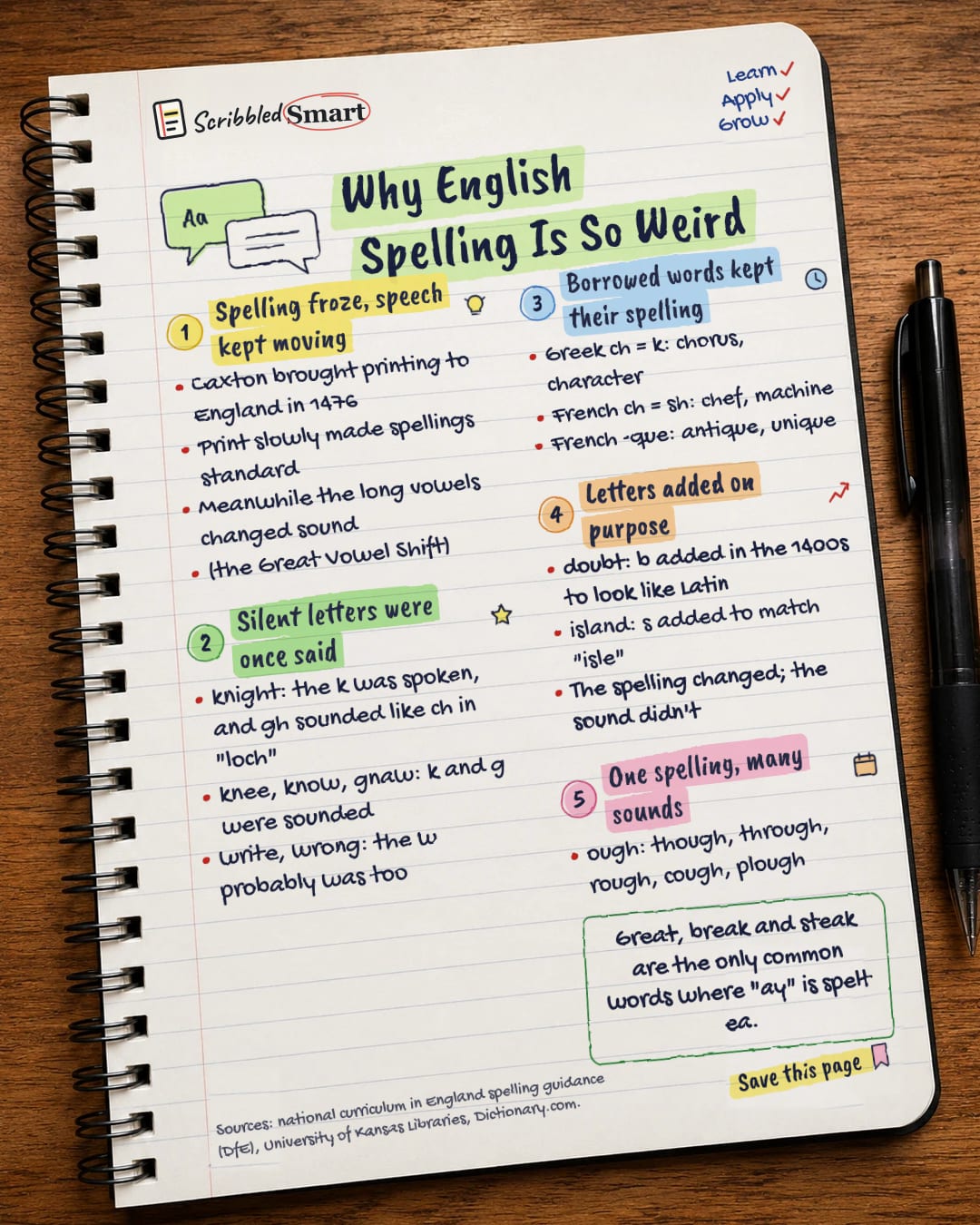
Spelling froze, speech kept moving
- Caxton brought printing to England in 1476
- Print slowly made spellings standard
- Meanwhile the long vowels changed sound
- (the Great Vowel Shift)
Silent letters were once said
- knight: the k was spoken, and gh sounded like ch in "loch"
- knee, know, gnaw: k and g were sounded
- write, wrong: the w probably was too
Borrowed words kept their spelling
- Greek ch = k: chorus, character
- French ch = sh: chef, machine
- French -que: antique, unique
Letters added on purpose
- doubt: b added in the 1400s to look like Latin
- island: s added to match "isle"
- The spelling changed; the sound didn't
One spelling, many sounds
- ough: though, through, rough, cough, plough
Sources
- Department for Education: National curriculum in England – English Appendix 1: Spelling
- University of Kansas Libraries: Middle and Early Modern English: From Chaucer to Milton
- University of Kansas Libraries: Codifying English
- Dictionary.com: Who's to Blame for Weird English Spellings? (2017)
- Dictionary.com: doubt
- Dictionary.com: island
How we checked this
Every fact on this note comes from the 6 sources listed here, checked against official or peer-reviewed sources where possible. AI tools help with drafting; a person checks every fact against the sources. How we research
Spotted a mistake? Tell us and we'll fix it and log it on the corrections page.


