
Money One-page note UK only
How Banks Make Money
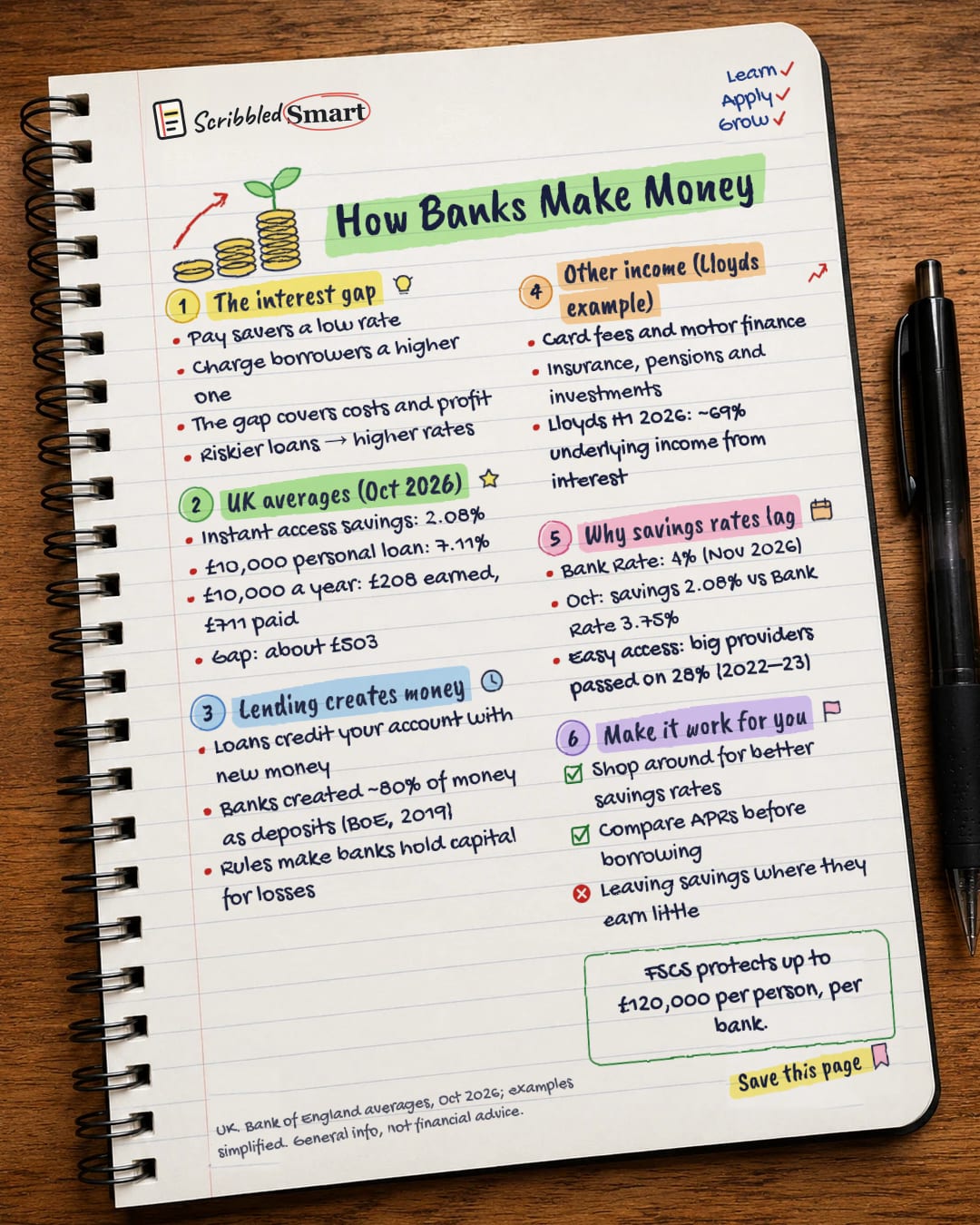
In Oct 2026, UK banks paid about 2% on instant access savings and charged about 7% on a £10,000 personal loan, on average. That gap is the business. Save this page.
Good to know
UK. Bank of England averages, Oct 2026; examples simplified. General info, not financial advice.
What's on the page
The note as text, so you can read it, copy it or use a screen reader.
The interest gap
- Pay savers a low rate
- Charge borrowers a higher one
- The gap covers costs and profit
- Riskier loans → higher rates
UK averages (Oct 2026)
- Instant access savings: 2.08%
- £10,000 personal loan: 7.11%
- £10,000 a year: £208 earned, £711 paid
- Gap: about £503
Lending creates money
- Loans credit your account with new money
- Banks created ~80% of money as deposits (BoE, 2019)
- Rules make banks hold capital for losses
Other income (Lloyds example)
- Card fees and motor finance
- Insurance, pensions and investments
- Lloyds H1 2026: ~69% underlying income from interest
Why savings rates lag
- Bank Rate: 4% (Nov 2026)
- Oct: savings 2.08% vs Bank Rate 3.75%
- Easy access: big providers passed on 28% (2022–23)
Make it work for you
- Shop around for better savings rates
- Compare APRs before borrowing
- Leaving savings where they earn little
Sources
- Bank of England: What do banks do? (updated 2 Dec 2025)
- Bank of England: How is money created? (updated 1 Oct 2019)
- Bank of England: Money creation in the modern economy, Quarterly Bulletin 2014 Q1 (search summary)
- Bank of England: Database (IUMB6VJ, IUMHPTL, IUMODTL), Oct 2026
- Bank of England: Database, series table IUMB6VJ, IUMHPTL, IUMODTL, IUMCCTL (Aug–Oct 2026, read 2026-11-17)
- Bank of England: Effective interest rates, September 2026 (published 29 Oct 2026; different measure, Caution only)
- Bank of England: Database, Official Bank Rate history (read 2026-11-17)
- FSCS: Banks, building societies and credit unions (read 2026-11-17)
- Bank of England: Interest rates and Bank Rate (5 Nov 2026)
- FCA: FCA sets out 14-point action plan on cash savings (31 Jul 2023)
- FCA: Cash Savings Market Review 2023 (search summary)
- Lloyds Banking Group: 2026 half-year results (30 Jul 2026), FCA National Storage Mechanism
How we checked this
Every fact on this note comes from the 12 sources listed here, checked against official or peer-reviewed sources where possible. AI tools help with drafting; a person checks every fact against the sources. How we research
Spotted a mistake? Tell us and we'll fix it and log it on the corrections page.


