
Productivity One-page note UK only
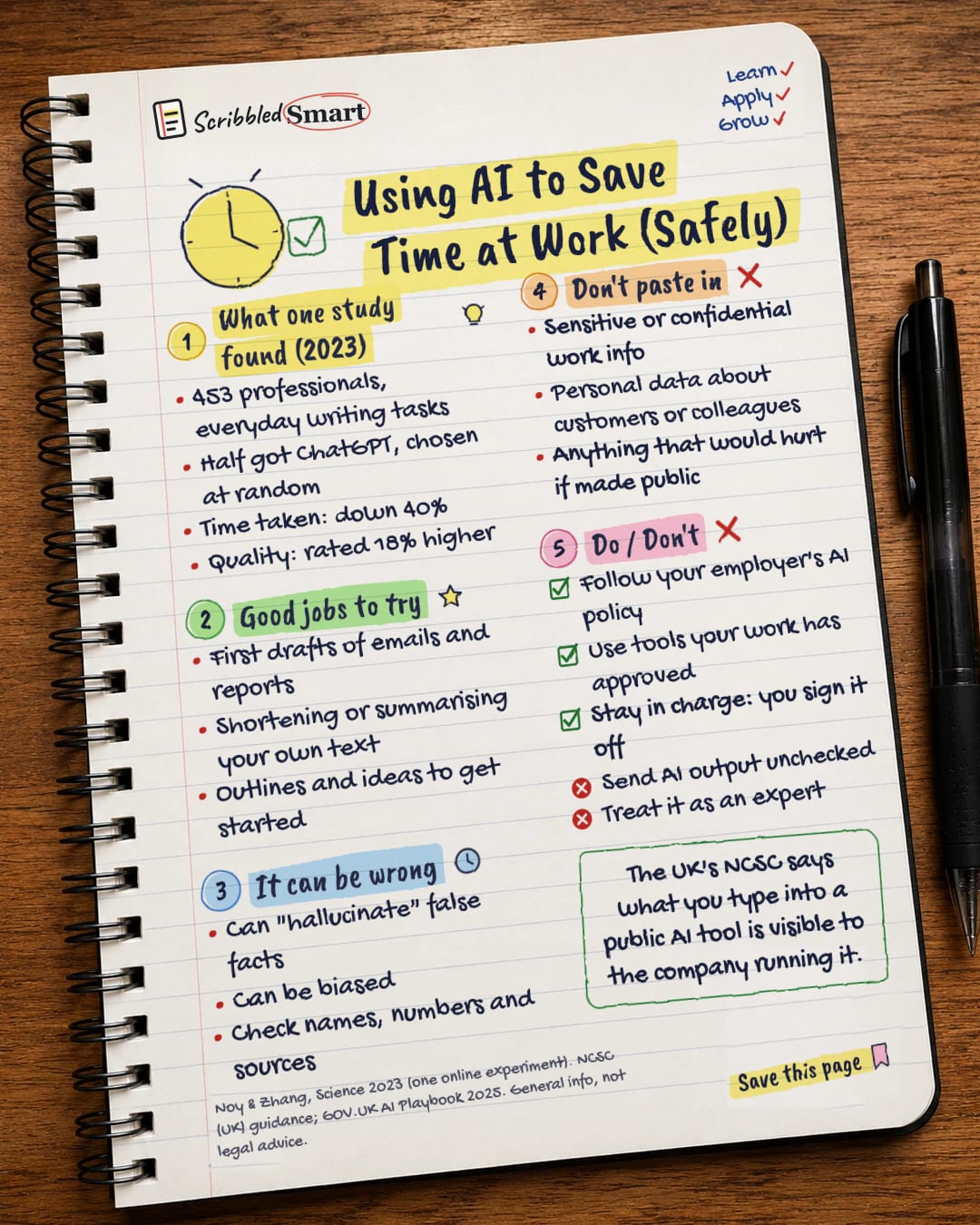
Using AI to Save Time at Work (Safely)
AI can cut writing time a lot, but only if you check it and keep private data out. Here's how to use it safely at work. Save this page.
Good to know
Noy & Zhang, Science 2023 (one online experiment). NCSC (UK) guidance; GOV.UK AI Playbook 2025. General info, not legal advice.
What's on the page
The note as text, so you can read it, copy it or use a screen reader.
What one study found (2023)
- 453 professionals, everyday writing tasks
- Half got ChatGPT, chosen at random
- Time taken: down 40%
- Quality: rated 18% higher
Good jobs to try
- First drafts of emails and reports
- Shortening or summarising your own text
- Outlines and ideas to get started
It can be wrong
- Can "hallucinate" false facts
- Can be biased
- Check names, numbers and sources
Don't paste in
- Sensitive or confidential work info
- Personal data about customers or colleagues
- Anything that would hurt if made public
Do / Don't
- Follow your employer's AI policy
- Use tools your work has approved
- Stay in charge: you sign it off
- Send AI output unchecked
- Treat it as an expert
Sources
- Noy S, Zhang W (2023): Experimental evidence on the productivity effects of generative artificial intelligence. Science 381:187–192
- NCSC: ChatGPT and large language models: what's the risk?
- GOV.UK (2025): Artificial Intelligence Playbook for the UK Government
- GOV.UK: Microsoft 365 Copilot Experiment: Cross-Government Findings Report
How we checked this
Every fact on this note comes from the 4 sources listed here, checked against official or peer-reviewed sources where possible. AI tools help with drafting; a person checks every fact against the sources. How we research
Spotted a mistake? Tell us and we'll fix it and log it on the corrections page.


