
Productivity One-page note
Do Self-Set Deadlines Work?
One of the most quoted procrastination studies was retracted in 2026. Here's what we actually know about self-set deadlines. Save this page.
Good to know
Research summary, checked Nov 2026.
What's on the page
The note as text, so you can read it, copy it or use a screen reader.
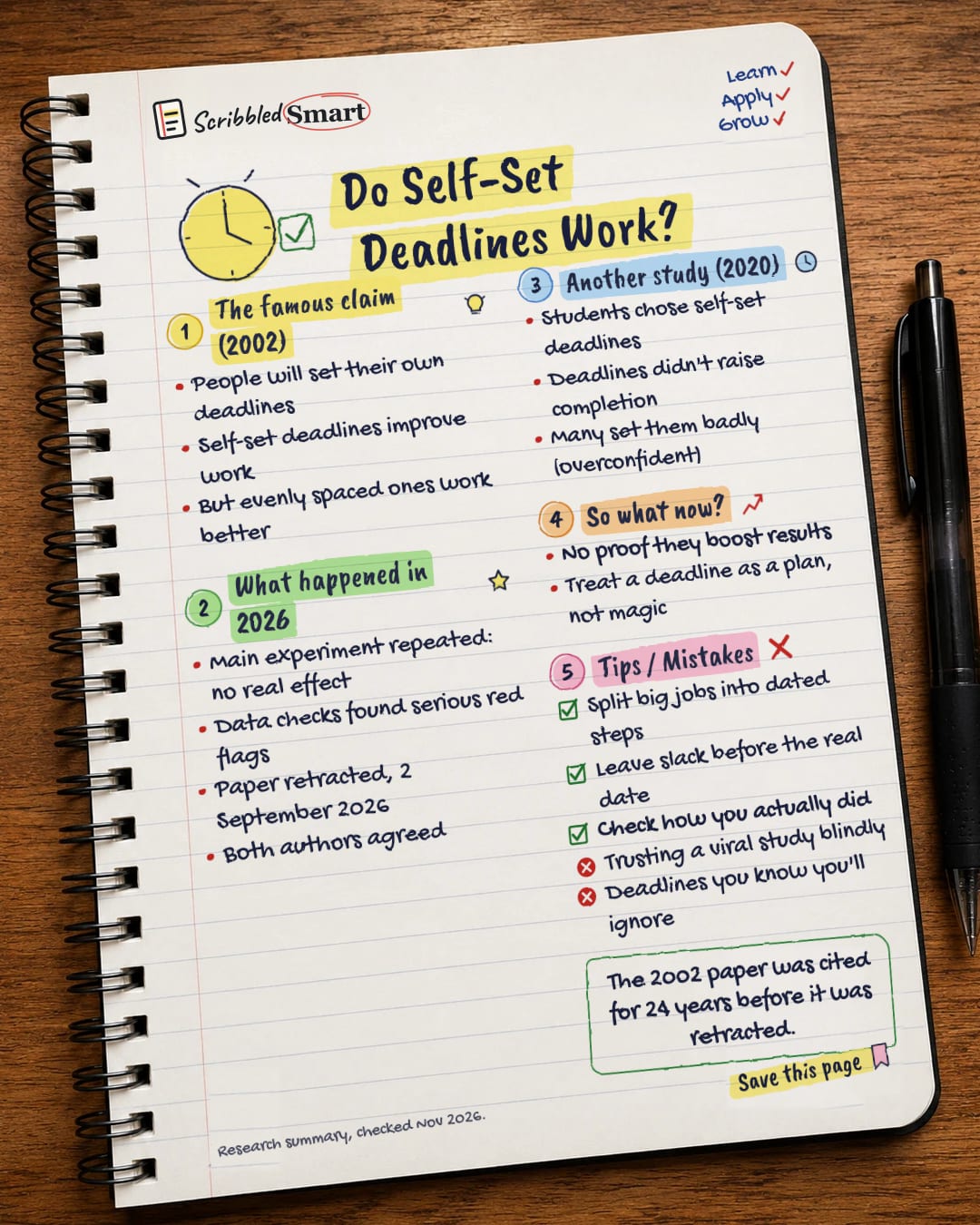
The famous claim (2002)
- People will set their own deadlines
- Self-set deadlines improve work
- But evenly spaced ones work better
What happened in 2026
- Main experiment repeated: no real effect
- Data checks found serious red flags
- Paper retracted, 2 September 2026
- Both authors agreed
Another study (2020)
- Students chose self-set deadlines
- Deadlines didn't raise completion
- Many set them badly (overconfident)
So what now?
- No proof they boost results
- Treat a deadline as a plan, not magic
Tips / Mistakes
- Split big jobs into dated steps
- Leave slack before the real date
- Check how you actually did
- Trusting a viral study blindly
- Deadlines you know you'll ignore
Sources
- Psychological Science: Ariely & Wertenbroch (2002) (retracted)
- Psychological Science: Hyndman & Bisin (2026), Replication
- Psychological Science: Retraction notice (2026)
- Retraction Watch: Procrastination study by Duke's Dan Ariely retracted after sleuths find signs of data tampering (3 Sep 2026)
- Ynetnews: Influential Dan Ariely study retracted (2026)
- Games and Economic Behavior: Bisin & Hyndman (2020)
- Data Colada: posts 138 and 139
How we checked this
Every fact on this note comes from the 7 sources listed here, checked against official or peer-reviewed sources where possible. AI tools help with drafting; a person checks every fact against the sources. How we research
Spotted a mistake? Tell us and we'll fix it and log it on the corrections page.


