
Productivity One-page note
The Zeigarnik Effect: Myth vs Facts
"Your brain remembers unfinished tasks better." A 2025 review says not really. But here's what is true. Save this page.
Good to know
General info. Based on lab studies; results depend on the situation.
What's on the page
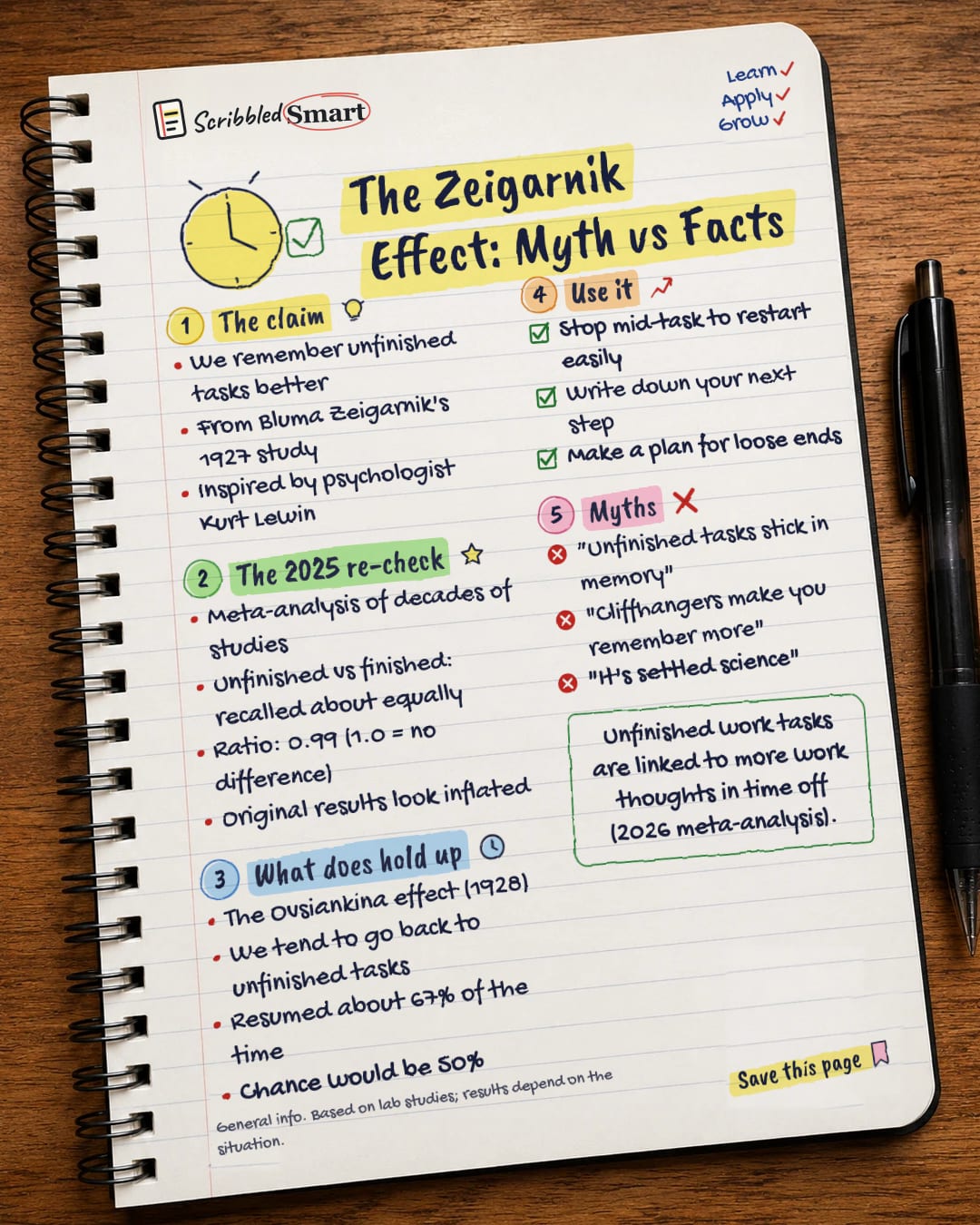
The note as text, so you can read it, copy it or use a screen reader.
The claim
- We remember unfinished tasks better
- From Bluma Zeigarnik's 1927 study
- Inspired by psychologist Kurt Lewin
The 2025 re-check
- Meta-analysis of decades of studies
- Unfinished vs finished: recalled about equally
- Ratio: 0.99 (1.0 = no difference)
- Original results look inflated
What does hold up
- The Ovsiankina effect (1928)
- We tend to go back to unfinished tasks
- Resumed about 67% of the time
- Chance would be 50%
Use it
- Stop mid-task to restart easily
- Write down your next step
- Make a plan for loose ends
Myths
- "Unfinished tasks stick in memory"
- "Cliffhangers make you remember more"
- "It's settled science"
Sources
- Humanities and Social Sciences Communications: Ghibellini & Meier (2025)
- IDEAS/RePEc: abstract of Ghibellini & Meier (2025)
- Anxiety, Stress, & Coping: Wendsche, Weigelt & Syrek (2026)
- Journal of Personality and Social Psychology: Masicampo & Baumeister (2011)
- Psychologische Forschung: Zeigarnik (1927)
How we checked this
Every fact on this note comes from the 5 sources listed here, checked against official or peer-reviewed sources where possible. AI tools help with drafting; a person checks every fact against the sources. How we research
Spotted a mistake? Tell us and we'll fix it and log it on the corrections page.


