
Productivity One-page note
Checklists: Why They Work
A one-page checklist was linked to fewer deaths in surgery. Here's why it works, and how to make your own. Save this page.
Good to know
Studies of surgery, not office work. Figures: Haynes et al. 2009; Urbach et al. 2014 (NEJM).
What's on the page
The note as text, so you can read it, copy it or use a screen reader.
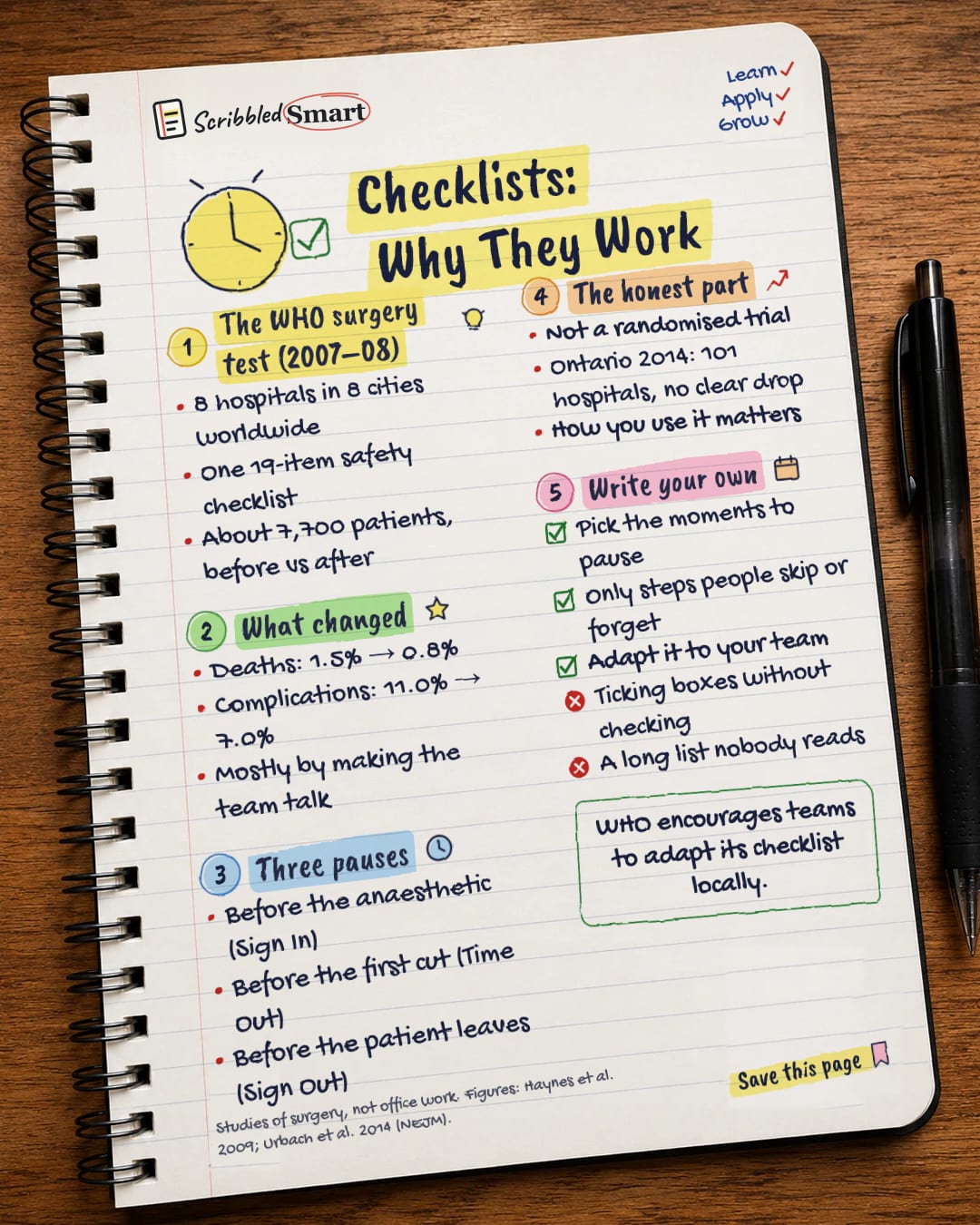
The WHO surgery test (2007–08)
- 8 hospitals in 8 cities worldwide
- One 19-item safety checklist
- About 7,700 patients, before vs after
What changed
- Deaths: 1.5% → 0.8%
- Complications: 11.0% → 7.0%
- Mostly by making the team talk
Three pauses
- Before the anaesthetic (Sign In)
- Before the first cut (Time Out)
- Before the patient leaves (Sign Out)
The honest part
- Not a randomised trial
- Ontario 2014: 101 hospitals, no clear drop
- How you use it matters
Write your own
- Pick the moments to pause
- Only steps people skip or forget
- Adapt it to your team
- Ticking boxes without checking
- A long list nobody reads
Sources
- NEJM: Haynes et al. (2009), A surgical safety checklist to reduce morbidity and mortality in a global population
- NEJM: Urbach et al. (2014), Introduction of surgical safety checklists in Ontario, Canada
- WHO: Safe surgery tools and resources
- WHO: Implementation manual WHO surgical safety checklist 2009
- Medical Journal of Australia (2010): The WHO Surgical Safety Checklist
How we checked this
Every fact on this note comes from the 5 sources listed here, checked against official or peer-reviewed sources where possible. AI tools help with drafting; a person checks every fact against the sources. How we research
Spotted a mistake? Tell us and we'll fix it and log it on the corrections page.


