
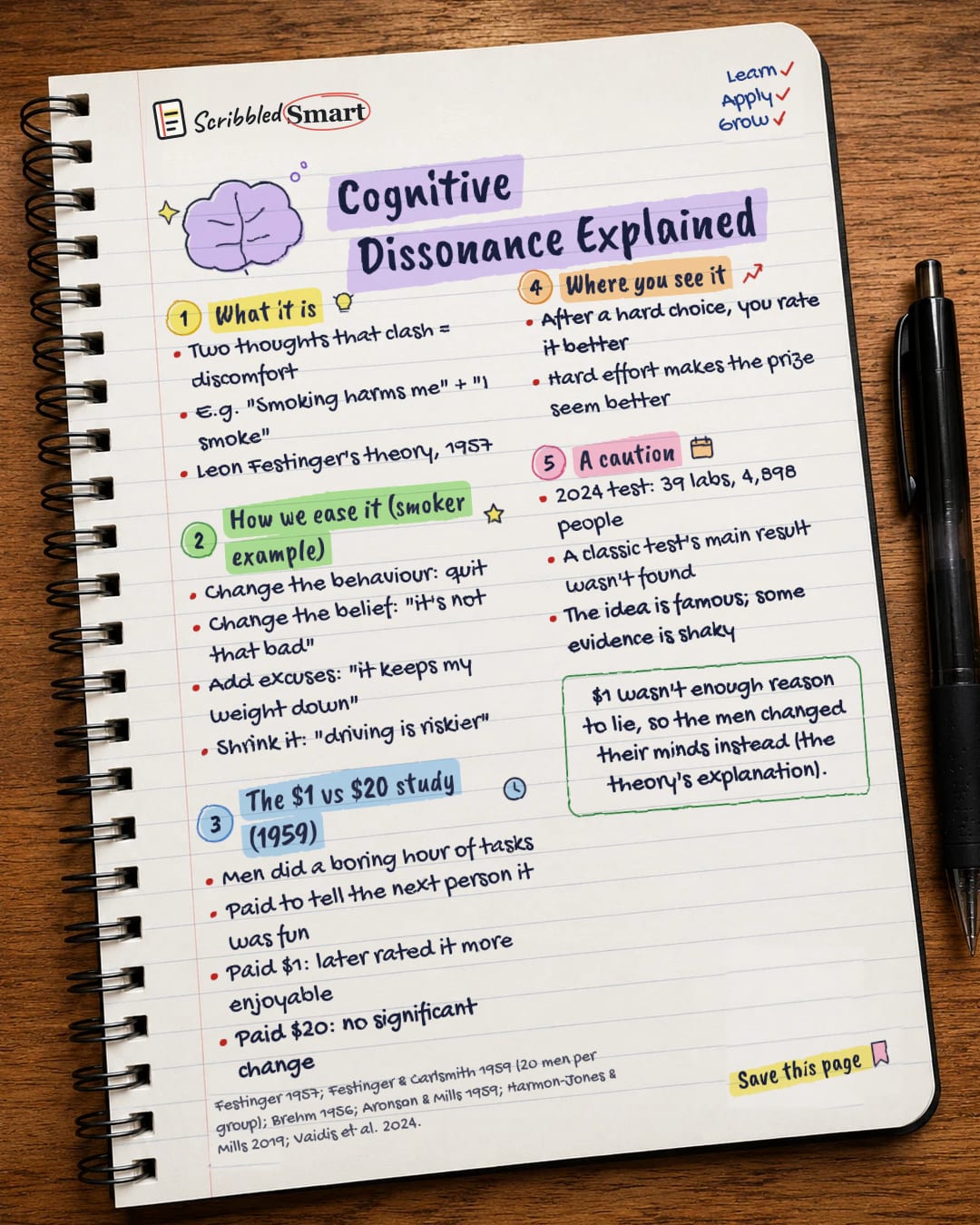
Psychology One-page note
Cognitive Dissonance Explained
Ever defended a choice harder because part of you doubted it? That's cognitive dissonance. Save this page.
Good to know
Festinger 1957; Festinger & Carlsmith 1959 (20 men per group); Brehm 1956; Aronson & Mills 1959; Harmon-Jones & Mills 2019; Vaidis et al. 2024.
What's on the page
The note as text, so you can read it, copy it or use a screen reader.
What it is
- Two thoughts that clash = discomfort
- E.g. "Smoking harms me" + "I smoke"
- Leon Festinger's theory, 1957
How we ease it (smoker example)
- Change the behaviour: quit
- Change the belief: "it's not that bad"
- Add excuses: "it keeps my weight down"
- Shrink it: "driving is riskier"
The $1 vs $20 study (1959)
- Men did a boring hour of tasks
- Paid to tell the next person it was fun
- Paid $1: later rated it more enjoyable
- Paid $20: no significant change
Where you see it
- After a hard choice, you rate it better
- Hard effort makes the prize seem better
A caution
- 2024 test: 39 labs, 4,898 people
- A classic test's main result wasn't found
- The idea is famous; some evidence is shaky
Sources
- Harmon-Jones, E. & Mills, J. (2019): An introduction to cognitive dissonance theory and an overview of current perspectives on the theory. In Cognitive Dissonance (2nd ed.), APA
- Festinger, L. & Carlsmith, J. M. (1959): Cognitive consequences of forced compliance. Journal of Abnormal and Social Psychology 58, 203–210
- Vaidis, D. C. et al. (2024): A multilab replication of the induced-compliance paradigm of cognitive dissonance. AMPPS 7(1)
- Festinger, L. (1957): A Theory of Cognitive Dissonance. Stanford University Press.
How we checked this
Every fact on this note comes from the 4 sources listed here, checked against official or peer-reviewed sources where possible. AI tools help with drafting; a person checks every fact against the sources. How we research
Spotted a mistake? Tell us and we'll fix it and log it on the corrections page.


