
Psychology One-page note
False Memories: How Memory Gets It Wrong
One word in a question changed what people "remembered" seeing. Here's how memory gets it wrong. Save this page.
Good to know
Loftus & Palmer 1974; Loftus & Pickrell 1995; Murphy et al. 2023; Innocence Project (US). AQA A-level: eyewitness testimony.
What's on the page
The note as text, so you can read it, copy it or use a screen reader.
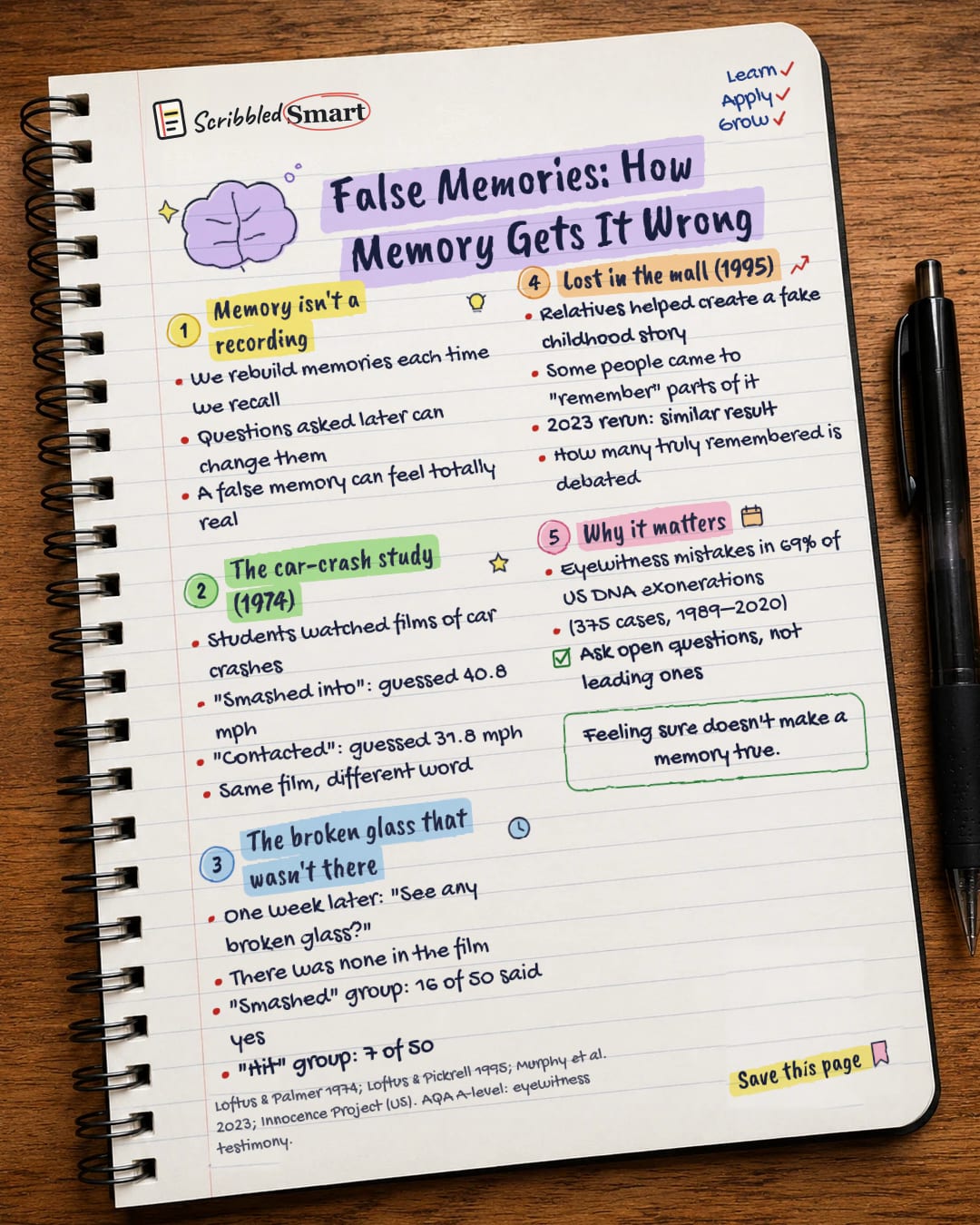
Memory isn't a recording
- We rebuild memories each time we recall
- Questions asked later can change them
- A false memory can feel totally real
The car-crash study (1974)
- Students watched films of car crashes
- "Smashed into": guessed 40.8 mph
- "Contacted": guessed 31.8 mph
- Same film, different word
The broken glass that wasn't there
- One week later: "See any broken glass?"
- There was none in the film
- "Smashed" group: 16 of 50 said yes
- "Hit" group: 7 of 50
Lost in the mall (1995)
- Relatives helped create a fake childhood story
- Some people came to "remember" parts of it
- 2023 rerun: similar result
- How many truly remembered is debated
Why it matters
- Eyewitness mistakes in 69% of US DNA exonerations
- (375 cases, 1989–2020)
- Ask open questions, not leading ones
Sources
- Loftus, E. F. & Palmer, J. C. (1974): Reconstruction of automobile destruction. JVLVB 13, 585–589
- Loftus, E. F. & Pickrell, J. E. (1995): The formation of false memories. Psychiatric Annals 25(12), 720–725
- Murphy, G. et al. (2023): Lost in the mall again: a preregistered replication and extension of Loftus & Pickrell (1995). Memory
- Scientific American (8 April 2025): People likely aren't as susceptible to false memories as researchers thought
- Innocence Project: DNA exonerations in the United States (1989–2020)
- AQA: A-level Psychology 7182 specification
How we checked this
Every fact on this note comes from the 6 sources listed here, checked against official or peer-reviewed sources where possible. AI tools help with drafting; a person checks every fact against the sources. How we research
Spotted a mistake? Tell us and we'll fix it and log it on the corrections page.


