
Psychology One-page note
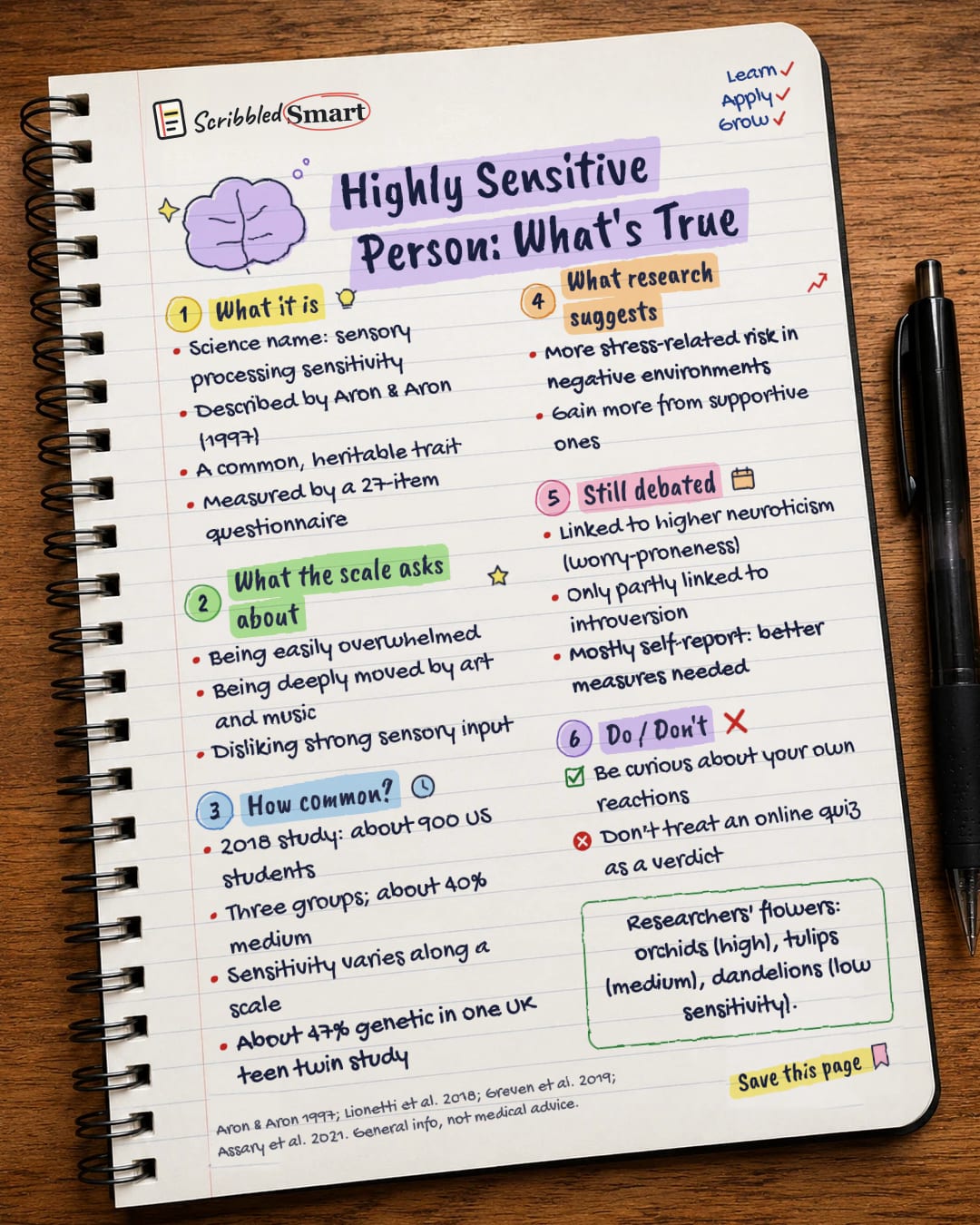
Highly Sensitive Person: What's True
"Highly sensitive person" is a real research trait, but some claims go further than the science. Here's what's true. Save this page.
Good to know
Aron & Aron 1997; Lionetti et al. 2018; Greven et al. 2019; Assary et al. 2021. General info, not medical advice.
What's on the page
The note as text, so you can read it, copy it or use a screen reader.
What it is
- Science name: sensory processing sensitivity
- Described by Aron & Aron (1997)
- A common, heritable trait
- Measured by a 27-item questionnaire
What the scale asks about
- Being easily overwhelmed
- Being deeply moved by art and music
- Disliking strong sensory input
How common?
- 2018 study: about 900 US students
- Three groups; about 40% medium
- Sensitivity varies along a scale
- About 47% genetic in one UK teen twin study
What research suggests
- More stress-related risk in negative environments
- Gain more from supportive ones
Still debated
- Linked to higher neuroticism (worry-proneness)
- Only partly linked to introversion
- Mostly self-report: better measures needed
Do / Don't
- Be curious about your own reactions
- Don't treat an online quiz as a verdict
Sources
- Aron, E. N. & Aron, A. (1997): Sensory-processing sensitivity and its relation to introversion and emotionality. JPSP
- Lionetti, F. et al. (2018): Dandelions, tulips and orchids: evidence for the existence of low-sensitive, medium-sensitive and high-sensitive individuals. Translational Psychiatry
- Greven, C. U. et al. (2019): Sensory processing sensitivity in the context of environmental sensitivity: a critical review and development of research agenda. Neuroscience & Biobehavioral Reviews
- Assary, E., Zavos, H. M. S., Krapohl, E., Keers, R. & Pluess, M. (2021): Genetic architecture of Environmental Sensitivity reflects multiple heritable components: a twin study with adolescents. Molecular Psychiatry
How we checked this
Every fact on this note comes from the 4 sources listed here, checked against official or peer-reviewed sources where possible. AI tools help with drafting; a person checks every fact against the sources. How we research
Spotted a mistake? Tell us and we'll fix it and log it on the corrections page.


