
Psychology One-page note
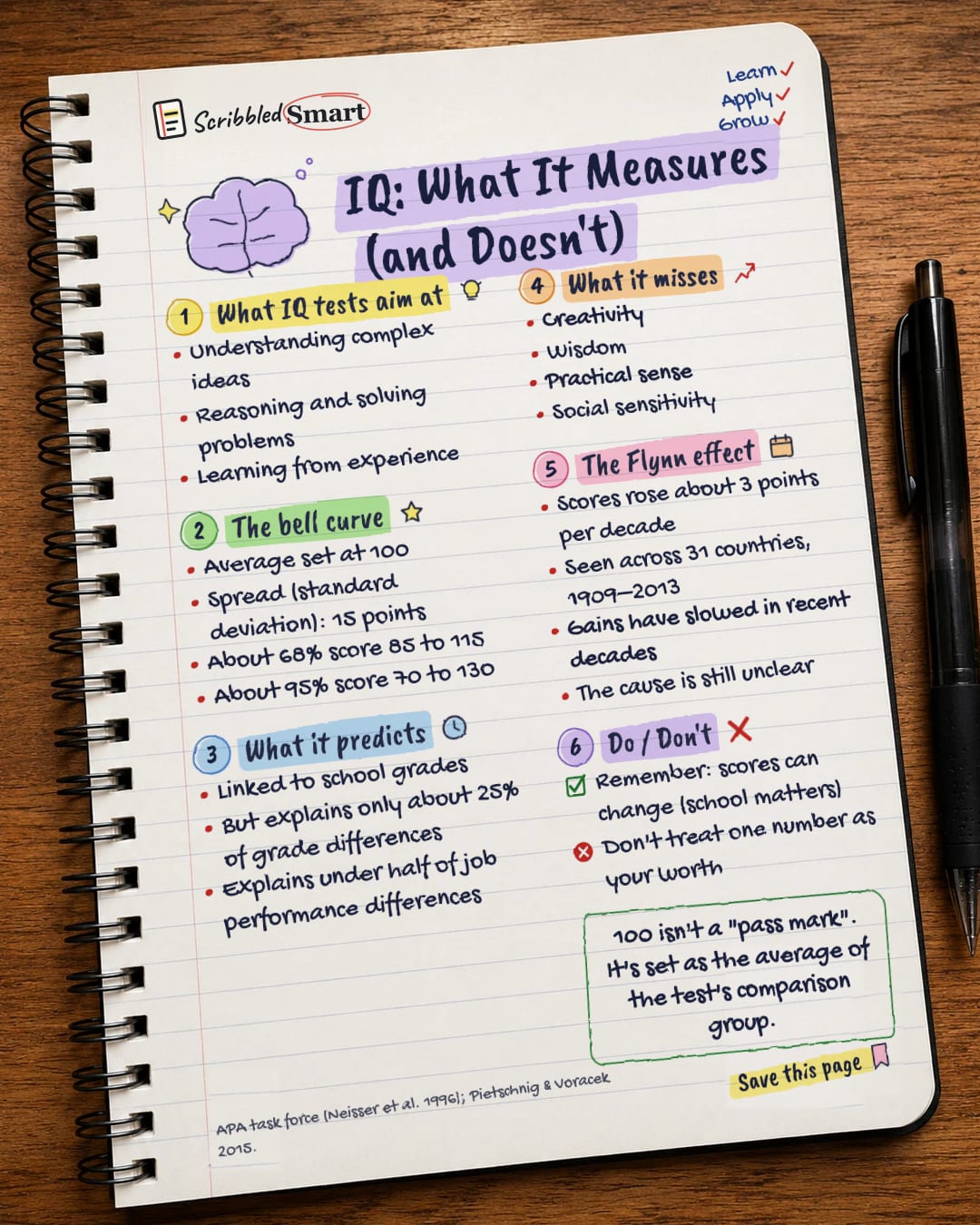
IQ: What It Measures (and Doesn't)
IQ tests measure some things well and miss a lot. Here's what your score does and doesn't say. Save this page.
Good to know
APA task force (Neisser et al. 1996); Pietschnig & Voracek 2015.
What's on the page
The note as text, so you can read it, copy it or use a screen reader.
What IQ tests aim at
- Understanding complex ideas
- Reasoning and solving problems
- Learning from experience
The bell curve
- Average set at 100
- Spread (standard deviation): 15 points
- About 68% score 85 to 115
- About 95% score 70 to 130
What it predicts
- Linked to school grades
- But explains only about 25% of grade differences
- Less than half of job performance
What it misses
- Creativity
- Wisdom
- Practical sense
- Social sensitivity
The Flynn effect
- Scores rose about 3 points per decade
- Seen across 31 countries, 1909–2013
- Gains have slowed in recent decades
- The cause is still unclear
Do / Don't
- Remember: scores can change (school matters)
- Don't treat one number as your worth
Sources
How we checked this
Every fact on this note comes from the 2 sources listed here, checked against official or peer-reviewed sources where possible. AI tools help with drafting; a person checks every fact against the sources. How we research
Spotted a mistake? Tell us and we'll fix it and log it on the corrections page.


