
Study One-page note
GCSE Grades 9 to 1 Explained
Is a 4 a pass? What's a 7 in old money? GCSE grades on one page. Save this page.
Good to know
England only. Wales and Northern Ireland mostly use A* to G letters. Checked Nov 2026.
What's on the page
The note as text, so you can read it, copy it or use a screen reader.
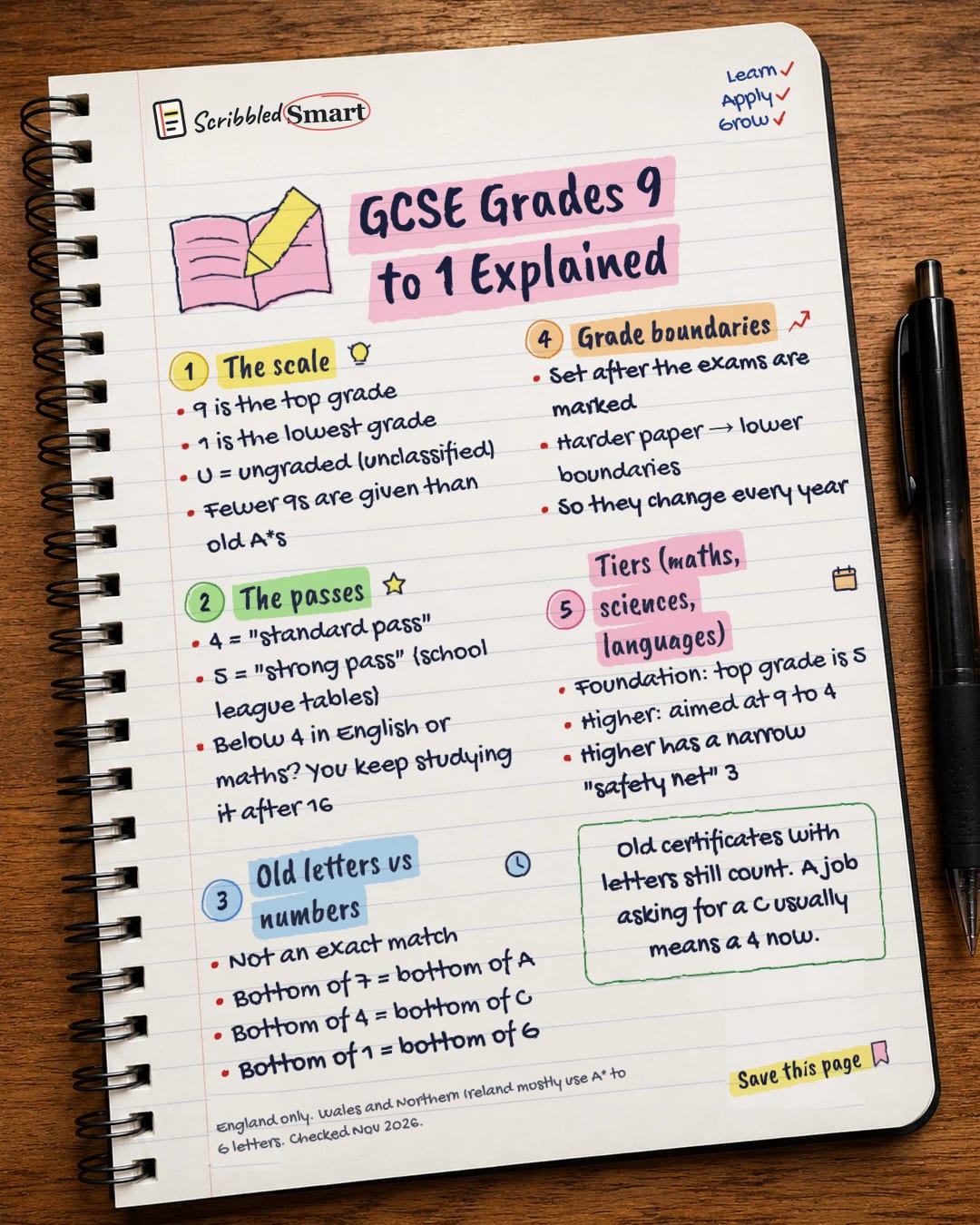
The scale
- 9 is the top grade
- 1 is the lowest grade
- U = ungraded (unclassified)
- Fewer 9s are given than old A*s
The passes
- 4 = "standard pass"
- 5 = "strong pass" (school league tables)
- Below 4 in English or maths? You keep studying it after 16
Old letters vs numbers
- Not an exact match
- Bottom of 7 = bottom of A
- Bottom of 4 = bottom of C
- Bottom of 1 = bottom of G
Grade boundaries
- Set after the exams are marked
- Harder paper → lower boundaries
- So they change every year
Tiers (maths, sciences, languages)
- Foundation: top grade is 5
- Higher: aimed at 9 to 4
- Higher has a narrow "safety net" 3
Sources
- DfE: GCSE factsheet for parents (May 2019)
- DfE: GCSE factsheet for employers, FE and HE providers (May 2019)
- Ofqual: GCSE 9 to 1 grades
- Ofqual: Guide to GCSE results for England, 2019
- Ofqual blog: GCSE maths grade boundaries (2017)
- Ofqual blog: Setting GCSE grade boundaries this summer (2018)
- DfE: Secondary accountability measures 2026 guidance
- Alps: Hitting the Ground Running in September 2025 – Wales KS4
How we checked this
Every fact on this note comes from the 8 sources listed here, checked against official or peer-reviewed sources where possible. AI tools help with drafting; a person checks every fact against the sources. How we research
Spotted a mistake? Tell us and we'll fix it and log it on the corrections page.


