
General knowledge One-page note UK only
How Electricity Works
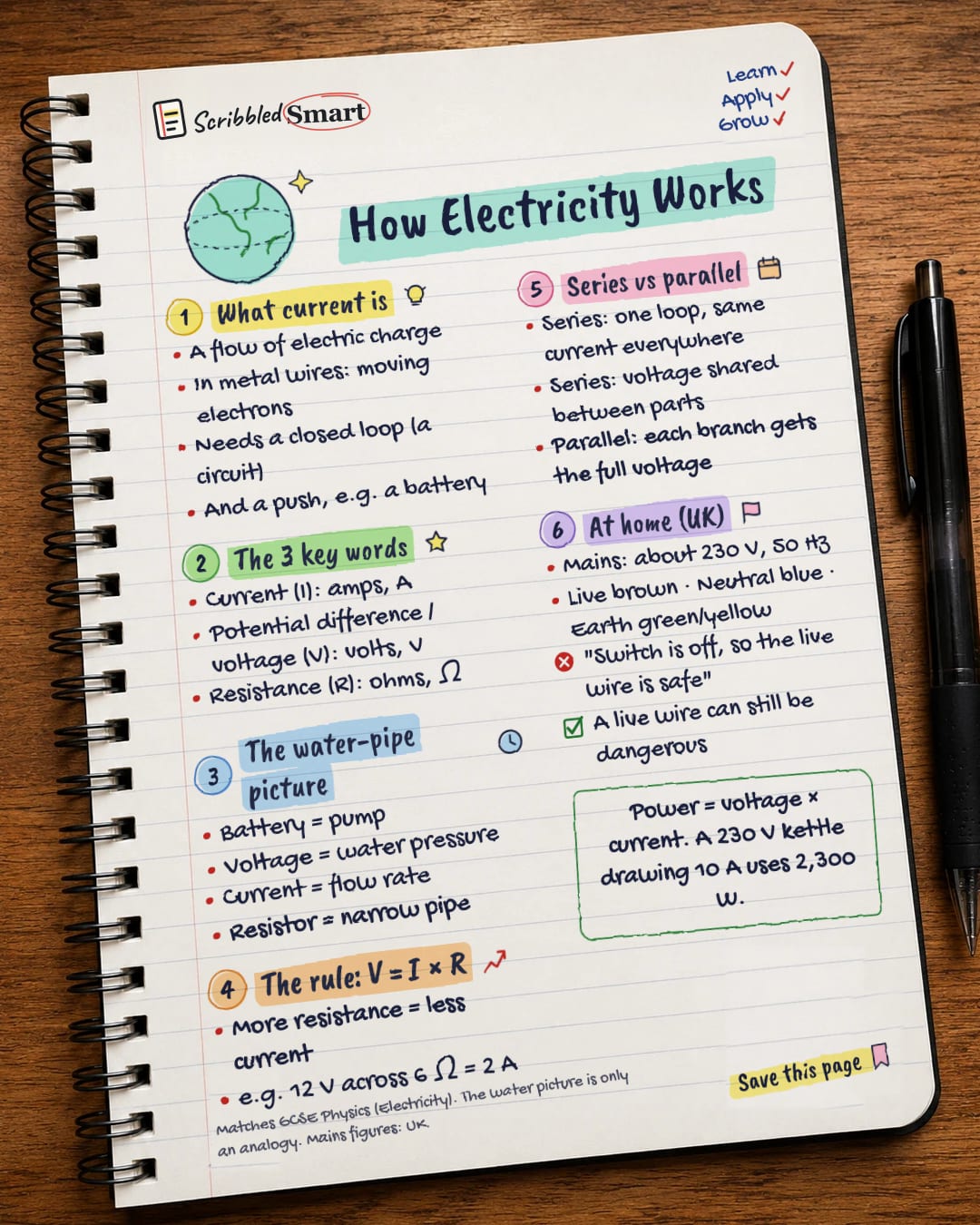
Volts, amps and ohms finally make sense with one picture: water in a pipe. Save this page.
Good to know
Matches GCSE Physics (Electricity). The water picture is only an analogy. Mains figures: UK.
What's on the page
The note as text, so you can read it, copy it or use a screen reader.
What current is
- A flow of electric charge
- In metal wires: moving electrons
- Needs a closed loop (a circuit)
- And a push, e.g. a battery
The 3 key words
- Current (I): amps, A
- Potential difference / voltage (V): volts, V
- Resistance (R): ohms, Ω
The water-pipe picture
- Battery = pump
- Voltage = water pressure
- Current = flow rate
- Resistor = narrow pipe
The rule: V = I × R
- More resistance = less current
- e.g. 12 V across 6 Ω = 2 A
Series vs parallel
- Series: one loop, same current everywhere
- Series: voltage shared between parts
- Parallel: each branch gets the full voltage
At home (UK)
- Mains: about 230 V, 50 Hz
- Live brown · Neutral blue · Earth green/yellow
- "Switch is off, so the live wire is safe"
- A live wire can still be dangerous
Sources
- AQA: GCSE Physics (8463) specification, 4.2 Electricity
- HyperPhysics (Georgia State University): DC circuit water analogy
- HyperPhysics: What's wrong with the water circuit analogy? (search summary)
- Physics Lens: Conventional current and electron flow (search summary)
- control.com: Electrical current (textbook, search summary)
How we checked this
Every fact on this note comes from the 5 sources listed here, checked against official or peer-reviewed sources where possible. AI tools help with drafting; a person checks every fact against the sources. How we research
Spotted a mistake? Tell us and we'll fix it and log it on the corrections page.


