
General knowledge One-page note
How Magnets Work
Why do magnets stick, and why does a compass point north? Magnets in one page. Save this page.
Good to know
Matches GCSE Physics (Magnetism). Pole speed: BGS, January 2025.
What's on the page
The note as text, so you can read it, copy it or use a screen reader.
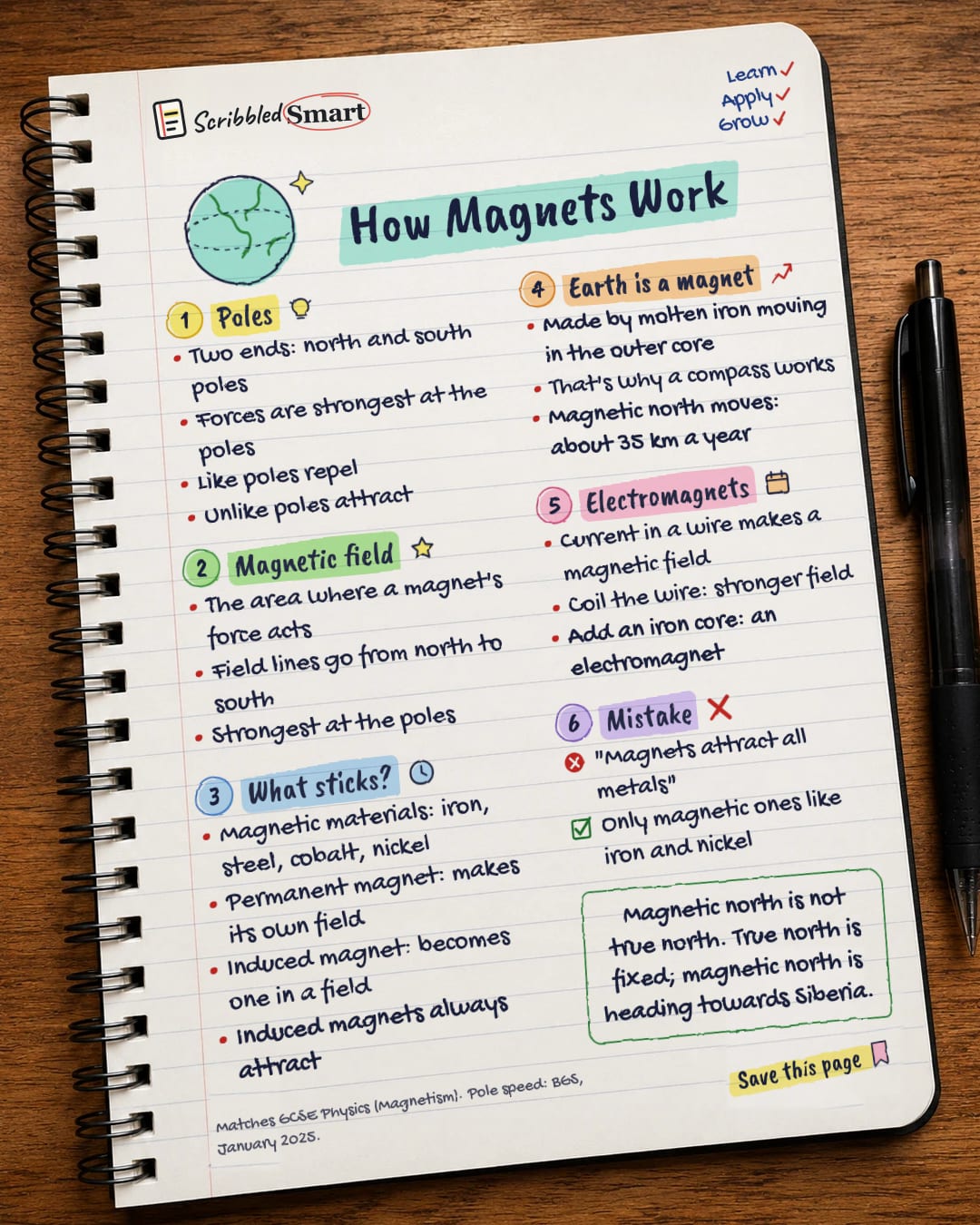
Poles
- Two ends: north and south poles
- Forces are strongest at the poles
- Like poles repel
- Unlike poles attract
Magnetic field
- The area where a magnet's force acts
- Field lines go from north to south
- Strongest at the poles
What sticks?
- Magnetic materials: iron, steel, cobalt, nickel
- Permanent magnet: makes its own field
- Induced magnet: becomes one in a field
- Induced magnets always attract
Earth is a magnet
- Made by molten iron moving in the outer core
- That's why a compass works
- Magnetic north moves: about 35 km a year
Electromagnets
- Current in a wire makes a magnetic field
- Coil the wire: stronger field
- Add an iron core: an electromagnet
Mistake
- "Magnets attract all metals"
- Only magnetic ones like iron and nickel
Sources
How we checked this
Every fact on this note comes from the 3 sources listed here, checked against official or peer-reviewed sources where possible. AI tools help with drafting; a person checks every fact against the sources. How we research
Spotted a mistake? Tell us and we'll fix it and log it on the corrections page.


