
General knowledge One-page note
How Photosynthesis Works
Every leaf is a tiny food factory. Photosynthesis in one page. Save this page.
Good to know
Matches AQA GCSE Biology (Bioenergetics). Checked November 2026.
What's on the page
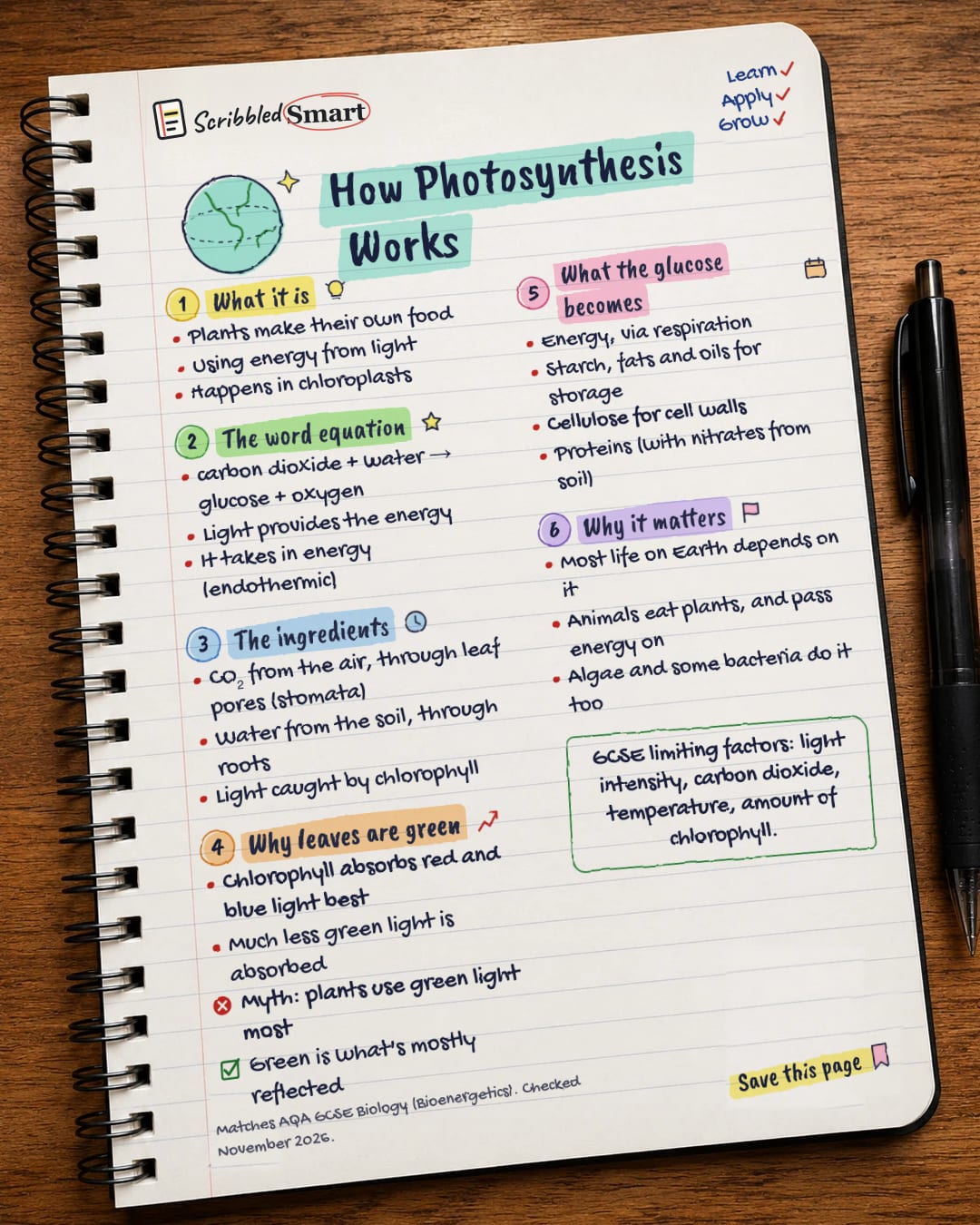
The note as text, so you can read it, copy it or use a screen reader.
What it is
- Plants make their own food
- Using energy from light
- Happens in chloroplasts
The word equation
- carbon dioxide + water → glucose + oxygen
- Light provides the energy
- It takes in energy (endothermic)
The ingredients
- CO₂ from the air, through leaf pores (stomata)
- Water from the soil, through roots
- Light caught by chlorophyll
Why leaves are green
- Chlorophyll absorbs red and blue light best
- Much less green light is absorbed
- Myth: plants use green light most
- Green is what's mostly reflected
What the glucose becomes
- Energy, via respiration
- Starch, fats and oils for storage
- Cellulose for cell walls
- Proteins (with nitrates from soil)
Why it matters
- Most life on Earth depends on it
- Animals eat plants, and pass energy on
- Algae and some bacteria do it too
Sources
- AQA: GCSE Biology (8461) specification, 4.4 Bioenergetics
- National Geographic Education: Photosynthesis
- Royal Horticultural Society: How plants use light to grow
- Khan Academy: An introduction to photosynthesis
- Khan Academy: Photosynthesis review
- Britannica: Algae – photosynthesis and light-absorbing pigments
- PubMed Central (2021): Photosynthetic physiology of blue, green, and red light
How we checked this
Every fact on this note comes from the 7 sources listed here, checked against official or peer-reviewed sources where possible. AI tools help with drafting; a person checks every fact against the sources. How we research
Spotted a mistake? Tell us and we'll fix it and log it on the corrections page.


