
Language One-page note UK only
British Sign Language: The Basics
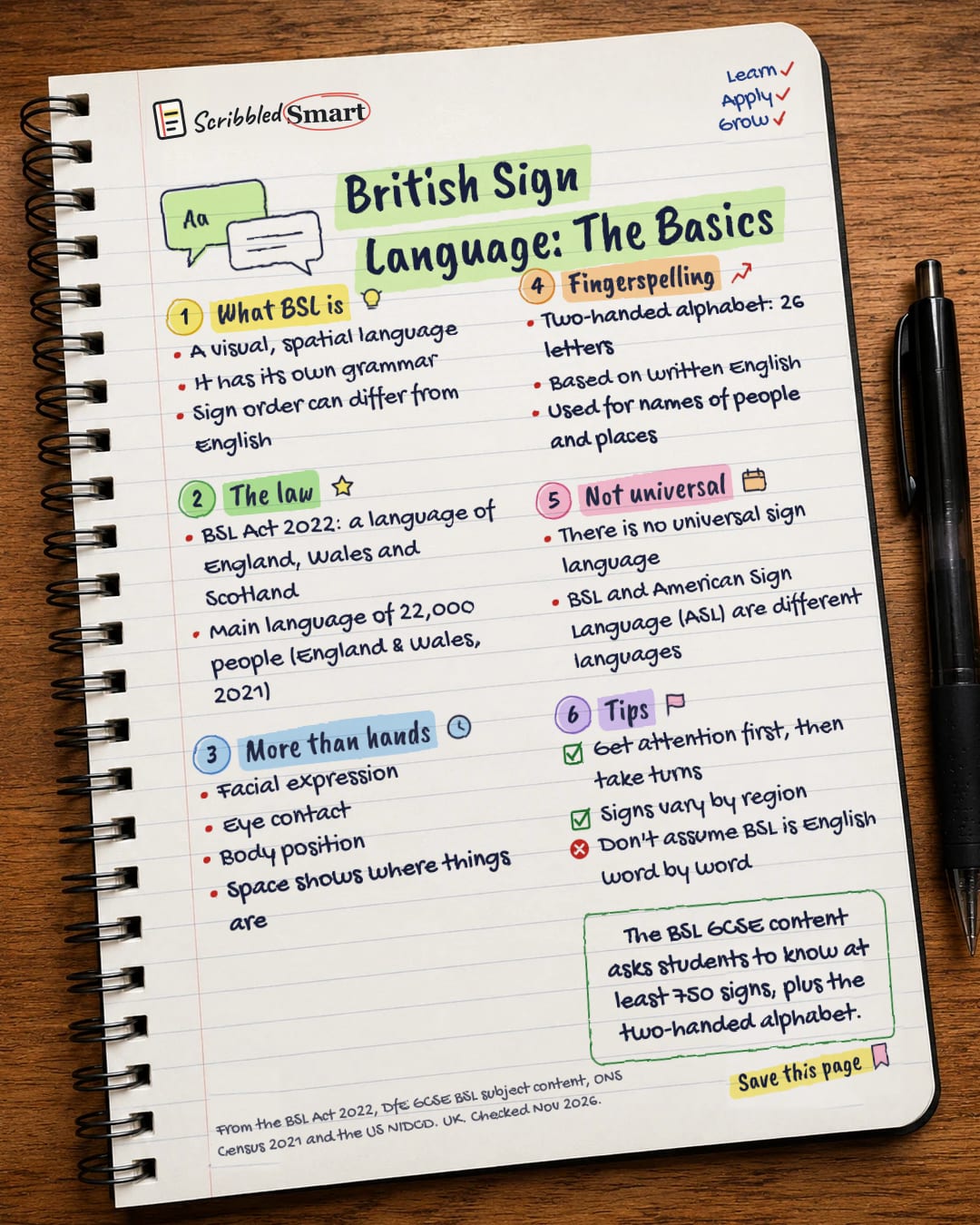
BSL isn't English on your hands: it has its own grammar, uses your face and the space around you, and has a two-handed alphabet. Save this page.
Good to know
From the BSL Act 2022, DfE GCSE BSL subject content, ONS Census 2021 and the US NIDCD. UK. Checked Nov 2026.
What's on the page
The note as text, so you can read it, copy it or use a screen reader.
What BSL is
- A visual, spatial language
- It has its own grammar
- Sign order can differ from English
The law
- BSL Act 2022: a language of England, Wales and Scotland
- Main language of 22,000 people (England & Wales, 2021)
More than hands
- Facial expression
- Eye contact
- Body position
- Space shows where things are
Fingerspelling
- Two-handed alphabet: 26 letters
- Based on written English
- Used for names of people and places
Not universal
- There is no universal sign language
- BSL and American Sign Language (ASL) are different languages
Tips
- Get attention first, then take turns
- Signs vary by region
- Don't assume BSL is English word by word
Sources
- Department for Education: British Sign Language GCSE subject content (2023)
- legislation.gov.uk: British Sign Language Act 2022, section 1
- ONS: Language, England and Wales: Census 2021
- NIDCD (National Institutes of Health): American Sign Language
- Schools Week: British Sign Language GCSE (timing; search summary only)
How we checked this
Every fact on this note comes from the 5 sources listed here, checked against official or peer-reviewed sources where possible. AI tools help with drafting; a person checks every fact against the sources. How we research
Spotted a mistake? Tell us and we'll fix it and log it on the corrections page.


