
Language One-page note
Persuasive Techniques (GCSE Writing)
Rhetorical questions, the rule of three, emotive language… six persuasive techniques for GCSE writing. Save this page.
Good to know
AQA GCSE English Language (8700), England. Definitions from Longman and Silva Rhetoricae (BYU).
What's on the page
The note as text, so you can read it, copy it or use a screen reader.
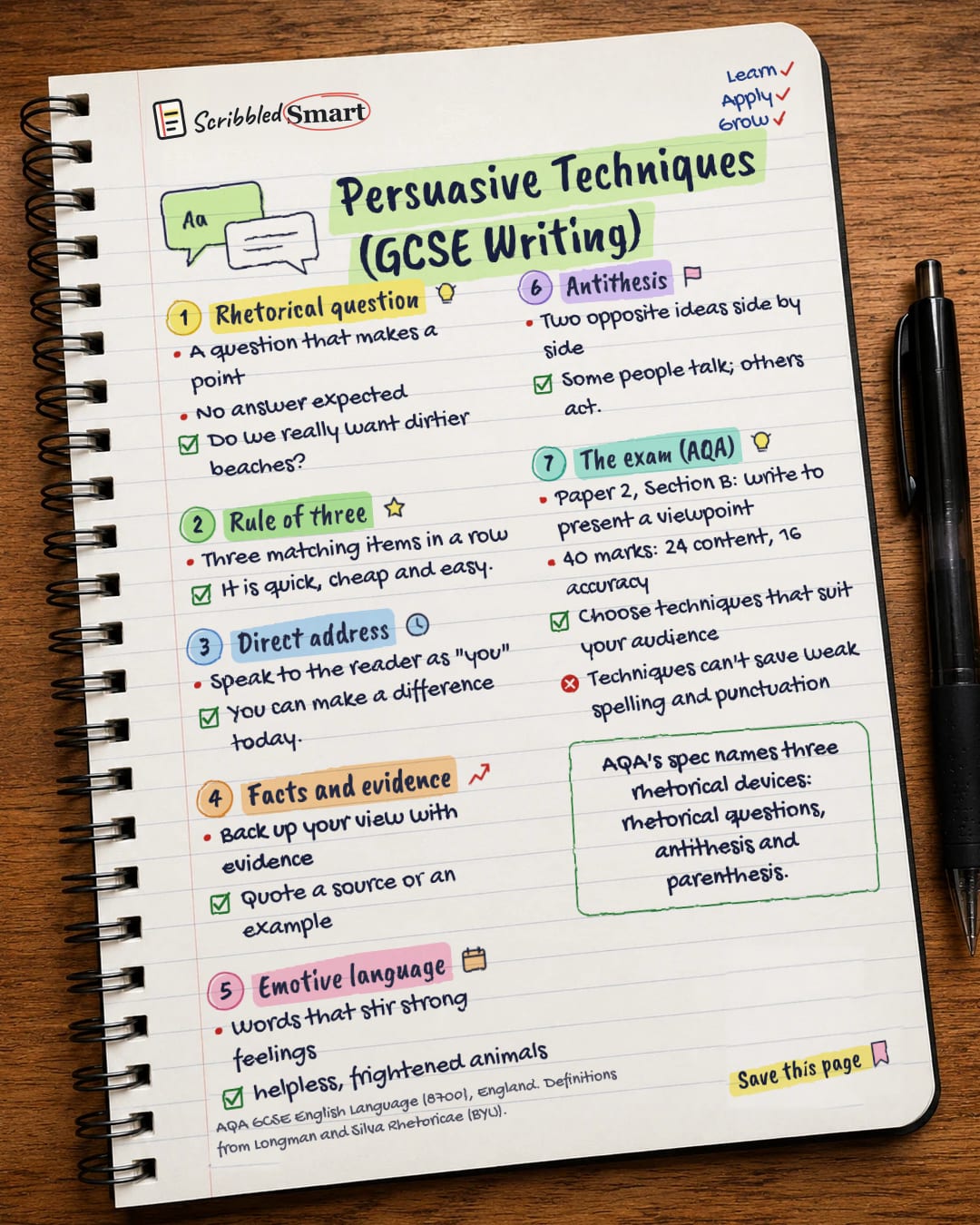
Rhetorical question
- A question that makes a point
- No answer expected
- Do we really want dirtier beaches?
Rule of three
- Three matching items in a row
- It is quick, cheap and easy.
Direct address
- Speak to the reader as "you"
- You can make a difference today.
Facts and evidence
- Back up your view with evidence
- Quote a source or an example
Emotive language
- Words that stir strong feelings
- helpless, frightened animals
Antithesis
- Two opposite ideas side by side
- Some people talk; others act.
The exam (AQA)
- Paper 2, Section B: write to present a viewpoint
- 40 marks: 24 content, 16 accuracy
- Choose techniques that suit your audience
- Techniques can't save weak spelling and punctuation
Sources
- AQA: GCSE English Language (8700) – specification at a glance
- AQA: GCSE English Language (8700) – scope of study
- AQA: GCSE English Language (8700) – scheme of assessment
- Longman Dictionary of Contemporary English: rhetorical question; emotive; antithesis
- Silva Rhetoricae (Brigham Young University): tricolon; antithesis; erotema
- GOV.UK: Use the right tone
How we checked this
Every fact on this note comes from the 6 sources listed here, checked against official or peer-reviewed sources where possible. AI tools help with drafting; a person checks every fact against the sources. How we research
Spotted a mistake? Tell us and we'll fix it and log it on the corrections page.


