
Productivity One-page note UK only
Dopamine Detox: What's True
Avoiding overstimulating activities doesn't lower your dopamine. But cutting easy distractions can still help. Save this page.
Good to know
General info, not medical advice. Struggling with an addiction? Talk to a doctor (UK: your GP).
What's on the page
The note as text, so you can read it, copy it or use a screen reader.
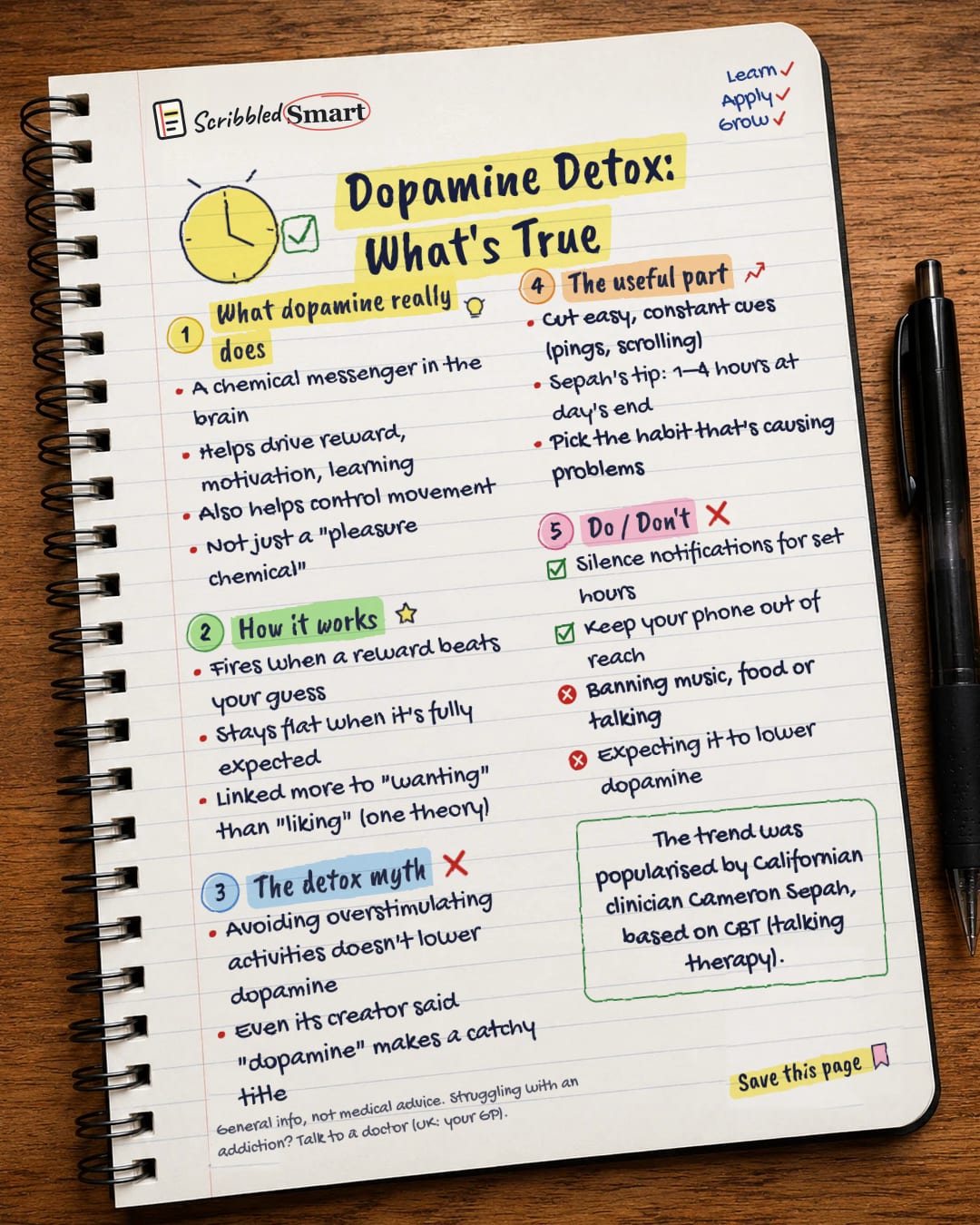
What dopamine really does
- A chemical messenger in the brain
- Helps drive reward, motivation, learning
- Also helps control movement
- Not just a "pleasure chemical"
How it works
- Fires when a reward beats your guess
- Stays flat when it's fully expected
- Linked more to "wanting" than "liking" (one theory)
The detox myth
- Avoiding overstimulating activities doesn't lower dopamine
- Even its creator said "dopamine" makes a catchy title
The useful part
- Cut easy, constant cues (pings, scrolling)
- Sepah's tip: 1–4 hours at day's end
- Pick the habit that's causing problems
Do / Don't
- Silence notifications for set hours
- Keep your phone out of reach
- Banning music, food or talking
- Expecting it to lower dopamine
Sources
- Harvard Health Publishing: "Dopamine fasting: Misunderstanding science spawns a maladaptive fad" (2020)
- Dialogues in Clinical Neuroscience: Schultz (2016), "Dopamine reward prediction error coding"
- American Psychologist: Berridge & Robinson (2016), "Liking, wanting, and the incentive-sensitization theory of addiction", 71(8), 670–679
- NHS: Parkinson's disease, causes
- UCSF News: "Silicon Valley takes on 'Dopamine Fasting 2.0'" (2019)
How we checked this
Every fact on this note comes from the 5 sources listed here, checked against official or peer-reviewed sources where possible. AI tools help with drafting; a person checks every fact against the sources. How we research
Spotted a mistake? Tell us and we'll fix it and log it on the corrections page.


