
Productivity One-page note
Attention Span: The Goldfish Myth
"Your attention span is shorter than a goldfish's." It's a myth, and here's where it came from. Save this page.
Good to know
Checked Nov 2026. Sources: BBC More or Less, WSJ, UC Irvine.
What's on the page
The note as text, so you can read it, copy it or use a screen reader.
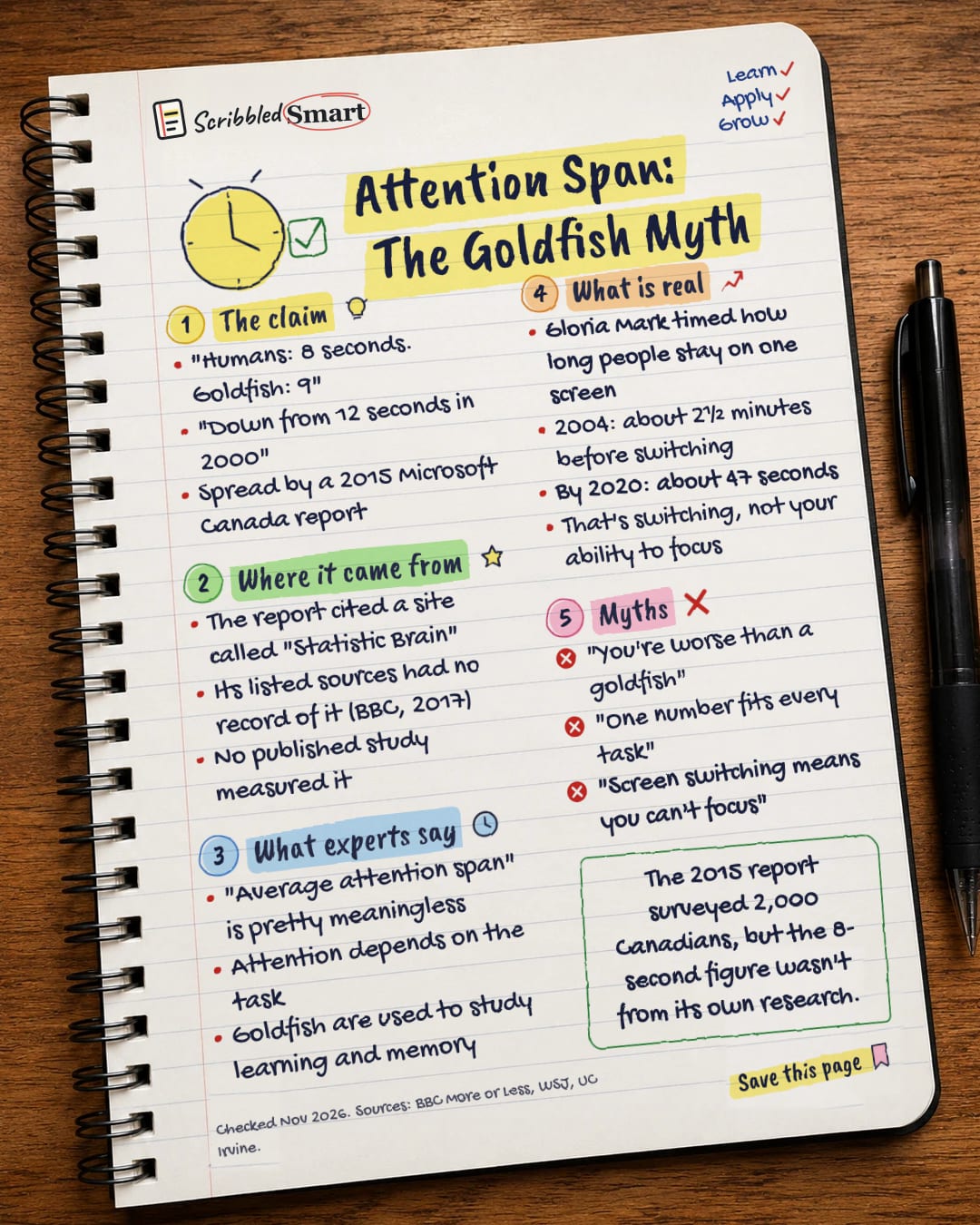
The claim
- "Humans: 8 seconds. Goldfish: 9"
- "Down from 12 seconds in 2000"
- Spread by a 2015 Microsoft Canada report
Where it came from
- The report cited a site called "Statistic Brain"
- Its listed sources had no record of it (BBC, 2017)
- No published study measured it
What experts say
- "Average attention span" is pretty meaningless
- Attention depends on the task
- Goldfish are used to study learning and memory
What is real
- Gloria Mark timed how long people stay on one screen
- 2004: about 2½ minutes before switching
- By 2020: about 47 seconds
- That's switching, not your ability to focus
Myths
- "You're worse than a goldfish"
- "One number fits every task"
- "Screen switching means you can't focus"
Sources
How we checked this
Every fact on this note comes from the 4 sources listed here, checked against official or peer-reviewed sources where possible. AI tools help with drafting; a person checks every fact against the sources. How we research
Spotted a mistake? Tell us and we'll fix it and log it on the corrections page.


