
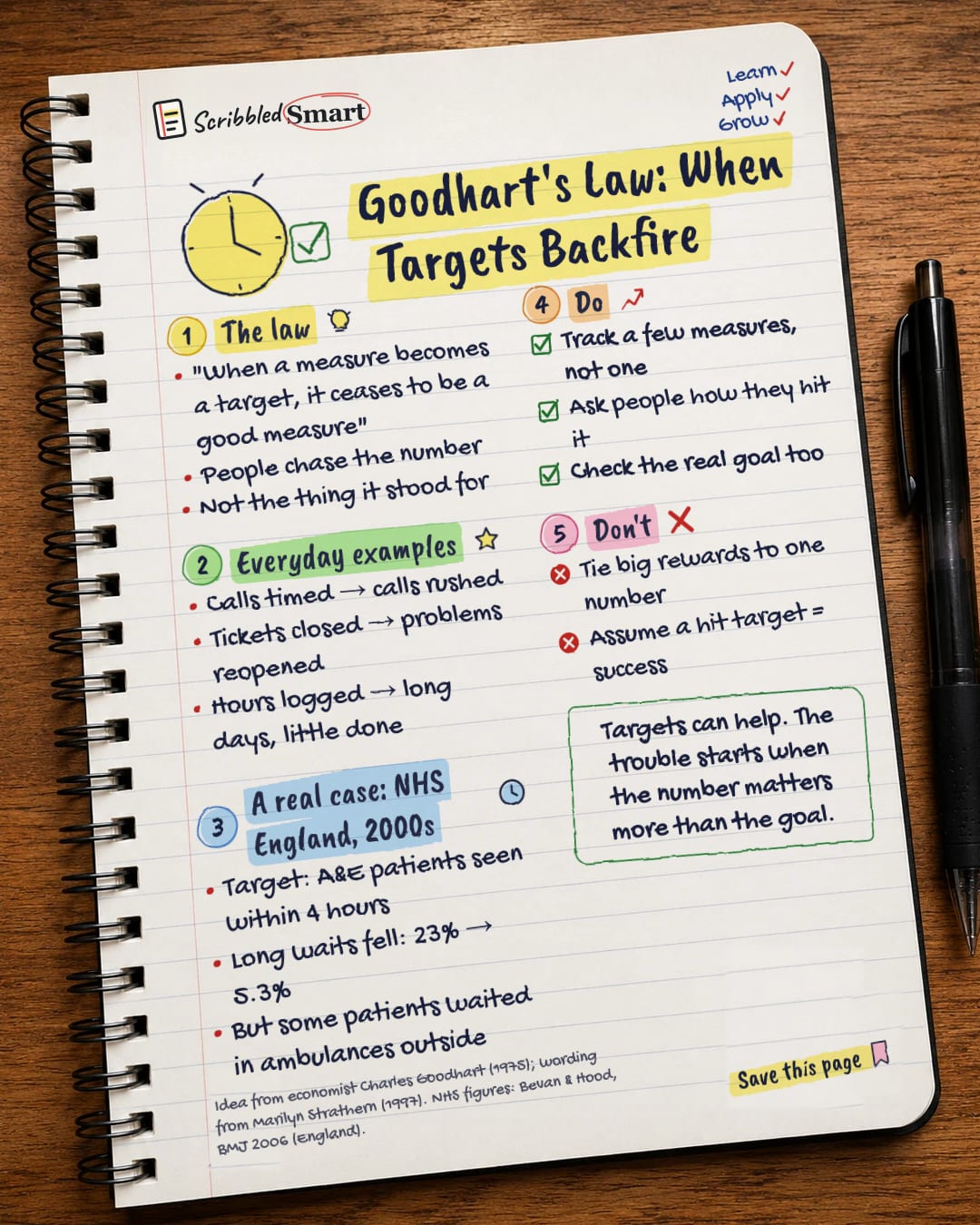
Productivity One-page note
Goodhart's Law: When Targets Backfire
Hit the target, miss the point? That's Goodhart's Law. Save this page.
Good to know
Idea from economist Charles Goodhart (1975); wording from Marilyn Strathern (1997). NHS figures: Bevan & Hood, BMJ 2006 (England).
What's on the page
The note as text, so you can read it, copy it or use a screen reader.
The law
- "When a measure becomes a target, it ceases to be a good measure"
- People chase the number
- Not the thing it stood for
Everyday examples
- Calls timed → calls rushed
- Tickets closed → problems reopened
- Hours logged → long days, little done
A real case: NHS England, 2000s
- Target: A&E patients seen within 4 hours
- Long waits fell: 23% → 5.3%
- But some patients waited in ambulances outside
Do
- Track a few measures, not one
- Ask people how they hit it
- Check the real goal too
Don't
- Tie big rewards to one number
- Assume a hit target = success
Sources
- Bevan G, Hood C (2006): Have targets improved performance in the English NHS? BMJ 332:419–422
- Bevan G, Hood C (2006): What's measured is what matters: targets and gaming in the English public health care system. Public Administration 84(3):517–538
- Strathern M (1997): 'Improving ratings': audit in the British University system. European Review 5(3):305–321
- Chrystal KA, Mizen PD (2003): Goodhart's Law: its origins, meaning and implications for monetary policy
- Bevan G, Hamblin R (2009): Hitting and missing targets by ambulance services for emergency calls. JRSS A
How we checked this
Every fact on this note comes from the 5 sources listed here, checked against official or peer-reviewed sources where possible. AI tools help with drafting; a person checks every fact against the sources. How we research
Spotted a mistake? Tell us and we'll fix it and log it on the corrections page.


