
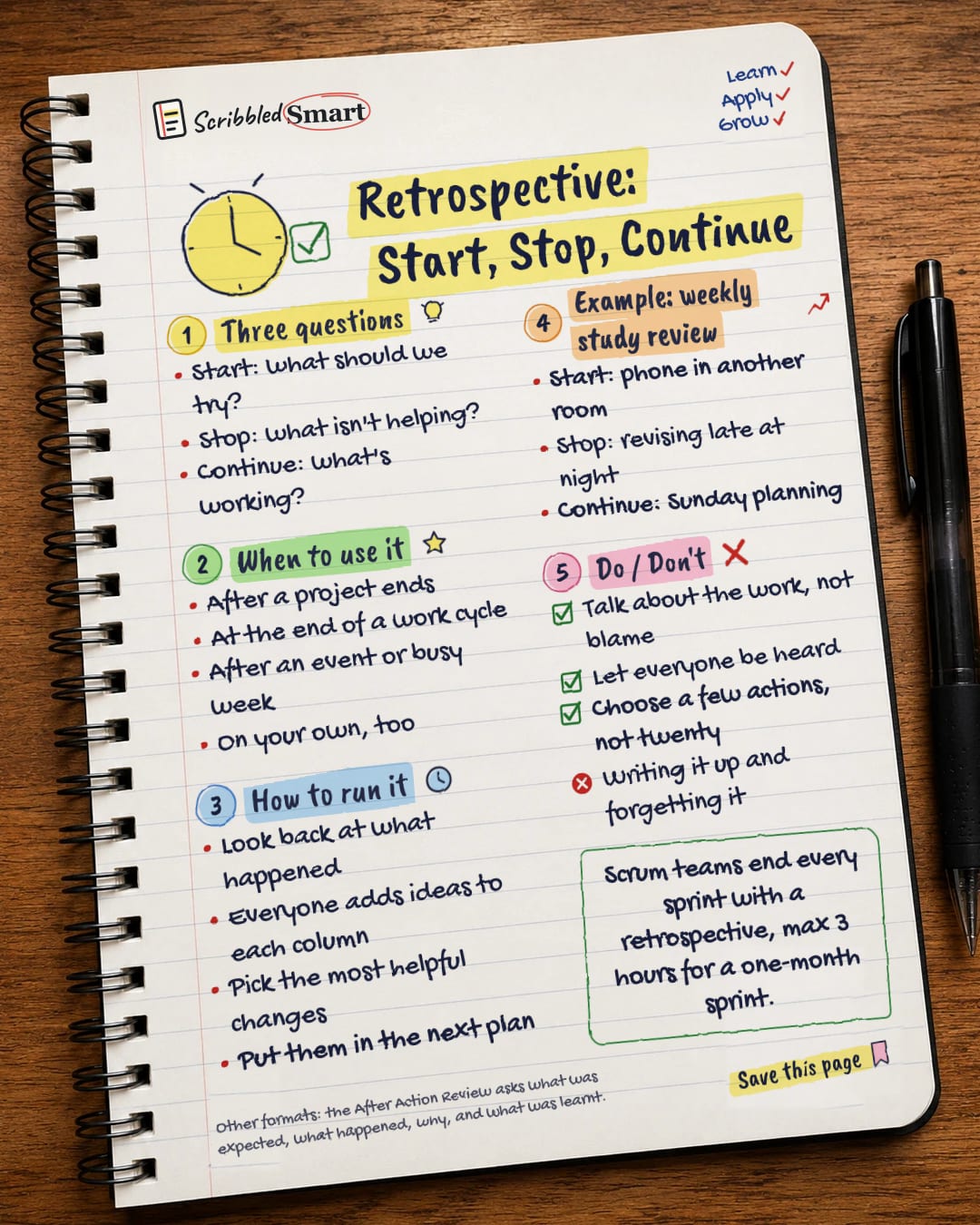
Productivity One-page note
Retrospective: Start, Stop, Continue
Finished a project? Ask three questions before you start the next one. Save this page.
Good to know
Other formats: the After Action Review asks what was expected, what happened, why, and what was learnt.
What's on the page
The note as text, so you can read it, copy it or use a screen reader.
Three questions
- Start: what should we try?
- Stop: what isn't helping?
- Continue: what's working?
When to use it
- After a project ends
- At the end of a work cycle
- After an event or busy week
- On your own, too
How to run it
- Look back at what happened
- Everyone adds ideas to each column
- Pick the most helpful changes
- Put them in the next plan
Example: weekly study review
- Start: phone in another room
- Stop: revising late at night
- Continue: Sunday planning
Do / Don't
- Talk about the work, not blame
- Let everyone be heard
- Choose a few actions, not twenty
- Writing it up and forgetting it
Sources
- Scrum Guides (Schwaber & Sutherland): The 2020 Scrum Guide, Sprint Retrospective
- NHS England: After Action Review (AAR) summary report, learning response tool (August 2024)
- Hoon A, Oliver E, Szpakowska K, Newton P (2015): Use of the 'Stop, Start, Continue' method is associated with the production of constructive qualitative feedback by students in higher education. Assessment & Evaluation in Higher Education
- University of South Carolina: Stop Start Continue (facilitation resource)
How we checked this
Every fact on this note comes from the 4 sources listed here, checked against official or peer-reviewed sources where possible. AI tools help with drafting; a person checks every fact against the sources. How we research
Spotted a mistake? Tell us and we'll fix it and log it on the corrections page.


