
Psychology One-page note
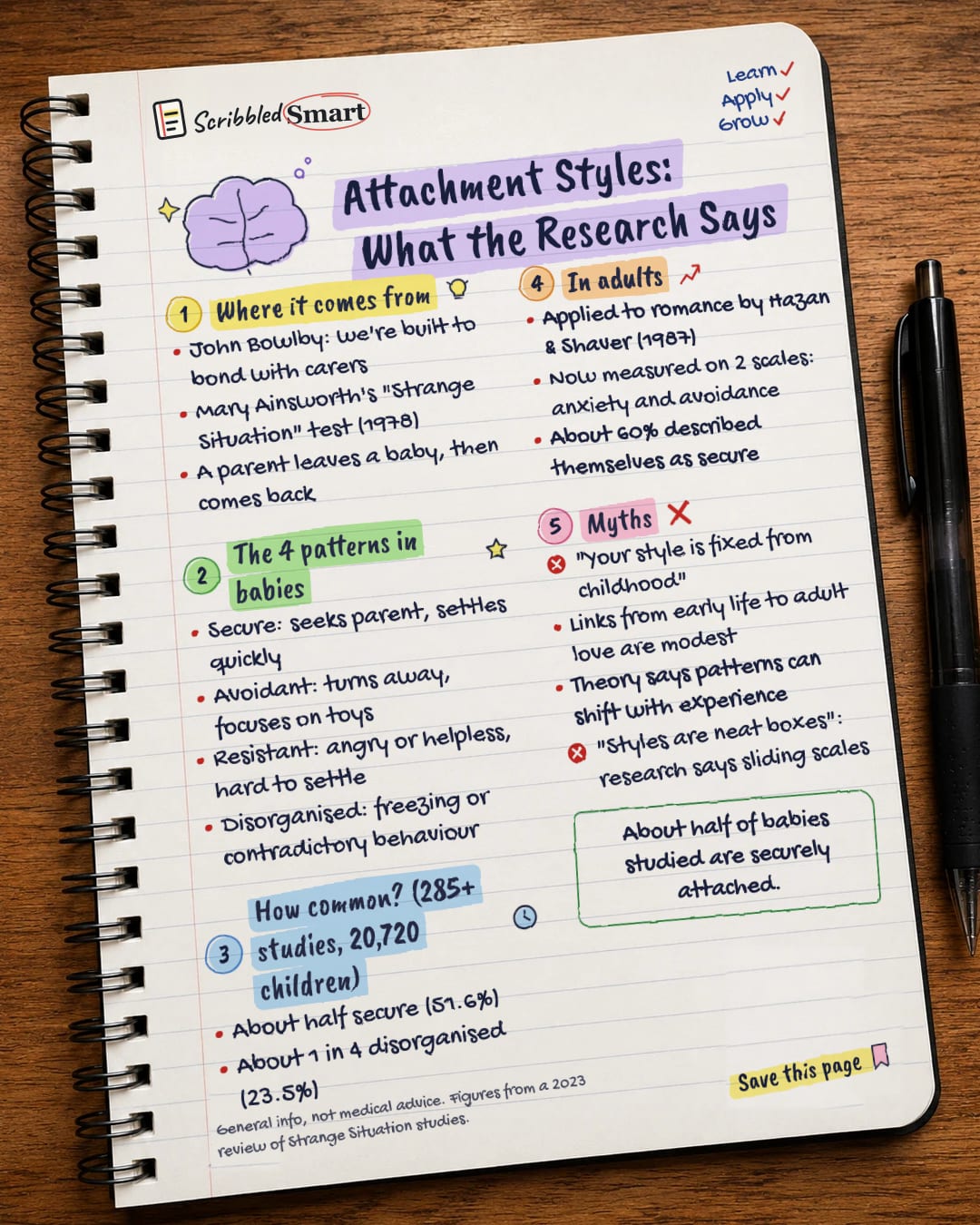
Attachment Styles: What the Research Says
Secure, avoidant, anxious... attachment styles are all over TikTok. Here's what the research actually says. Save this page.
Good to know
General info, not medical advice. Figures from a 2023 review of Strange Situation studies.
What's on the page
The note as text, so you can read it, copy it or use a screen reader.
Where it comes from
- John Bowlby: we're built to bond with carers
- Mary Ainsworth's "Strange Situation" test (1978)
- A parent leaves a baby, then comes back
The 4 patterns in babies
- Secure: seeks parent, settles quickly
- Avoidant: turns away, focuses on toys
- Resistant: angry or helpless, hard to settle
- Disorganised: freezing or contradictory behaviour
How common? (285+ studies, 20,720 children)
- About half secure (51.6%)
- About 1 in 4 disorganised (23.5%)
In adults
- Applied to romance by Hazan & Shaver (1987)
- Now measured on 2 scales: anxiety and avoidance
- About 60% described themselves as secure
Myths
- "Your style is fixed from childhood"
- Links from early life to adult love are modest
- Theory says patterns can shift with experience
- "Styles are neat boxes": research says sliding scales
Sources
- Fraley, R. C.: A Brief Overview of Adult Attachment Theory and Research
- Madigan, S. et al. (2023): The first 20,000 strange situation procedures: A meta-analytic review. Psychological Bulletin
- Duschinsky, R. & Solomon, J. (2017): Infant disorganized attachment: Clarifying levels of analysis
- van IJzendoorn, M. & Kroonenberg, P. (1988): Cross-cultural patterns of attachment: A meta-analysis of the Strange Situation. Child Development 59.
- Fraley, R. C. (2002): Attachment stability from infancy to adulthood. Personality and Social Psychology Review 6(2), 123–151
How we checked this
Every fact on this note comes from the 5 sources listed here, checked against official or peer-reviewed sources where possible. AI tools help with drafting; a person checks every fact against the sources. How we research
Spotted a mistake? Tell us and we'll fix it and log it on the corrections page.


