
Psychology One-page note UK only
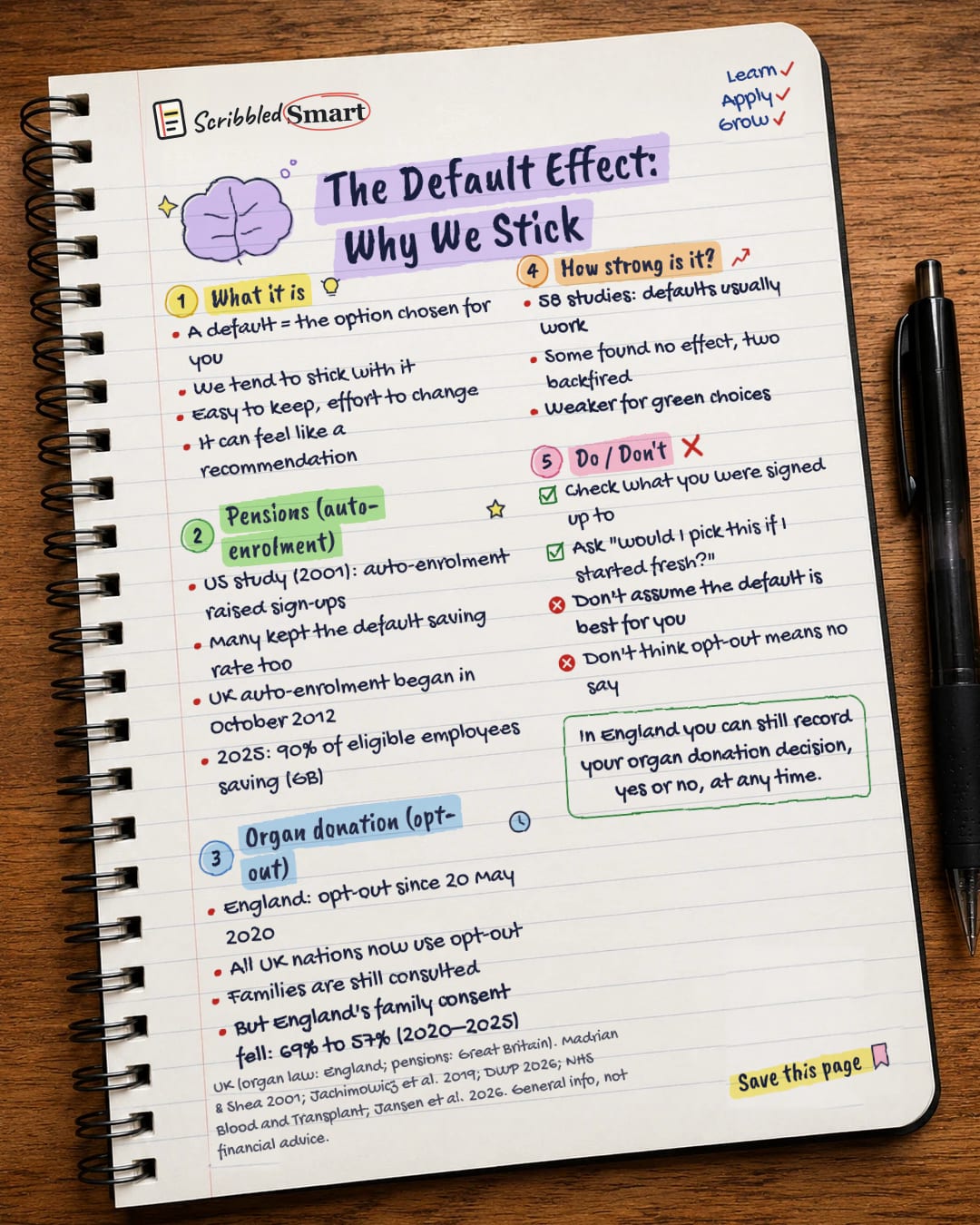
The Default Effect: Why We Stick
Most people never change the option picked for them. That's the default effect, and it shapes your pension and more. Save this page.
Good to know
UK (organ law: England; pensions: Great Britain). Madrian & Shea 2001; Jachimowicz et al. 2019; DWP 2026; NHS Blood and Transplant; Jansen et al. 2026. General info, not financial advice.
What's on the page
The note as text, so you can read it, copy it or use a screen reader.
What it is
- A default = the option chosen for you
- We tend to stick with it
- Easy to keep, effort to change
- It can feel like a recommendation
Pensions (auto-enrolment)
- US study (2001): auto-enrolment raised sign-ups
- Many kept the default saving rate too
- UK auto-enrolment began in October 2012
- 2025: 90% of eligible employees saving (GB)
Organ donation (opt-out)
- England: opt-out since 20 May 2020
- All UK nations now use opt-out
- Families are still consulted
- But England's family consent fell: 69% to 57% (2020–2025)
How strong is it?
- 58 studies: defaults usually work
- Some found no effect, two backfired
- Weaker for green choices
Do / Don't
- Check what you were signed up to
- Ask "would I pick this if I started fresh?"
- Don't assume the default is best for you
- Don't think opt-out means no say
Sources
- Madrian, B. C. & Shea, D. F. (2001): The power of suggestion: inertia in 401(k) participation and savings behavior. QJE 116(4), 1149–1187
- Jachimowicz, J. M., Duncan, S., Weber, E. U. & Johnson, E. J. (2019): When and why defaults influence decisions: a meta-analysis of default effects. Behavioural Public Policy 3(2)
- DWP (30 Jul 2026): Workplace pension participation and savings trends of employees: 2009 to 2025
- DWP (31 Jul 2025): Workplace pension participation and savings trends of eligible employees: 2009 to 2024
- DWP (26 Oct 2022): Ten years of Automatic Enrolment in workplace pensions: statistics and analysis
- NHS Blood and Transplant: Organ donation law in England
- NHS Blood and Transplant: UK laws
- Jansen, N. E. et al. (2026): Five years after introduction of an opt-out consent system for organ donation; lessons learned from England and the Netherlands. Transplant International
- O'Neill, S. et al. (2024): Trends in organ donation in England, Scotland and Wales in the context of the COVID-19 pandemic and 'opt-out' legislation. PLoS ONE
- Johnson, E. J. & Goldstein, D. (2003): Do defaults save lives? Science 302(5649), 1338–1339
How we checked this
Every fact on this note comes from the 10 sources listed here, checked against official or peer-reviewed sources where possible. AI tools help with drafting; a person checks every fact against the sources. How we research
Spotted a mistake? Tell us and we'll fix it and log it on the corrections page.


