
Psychology One-page note
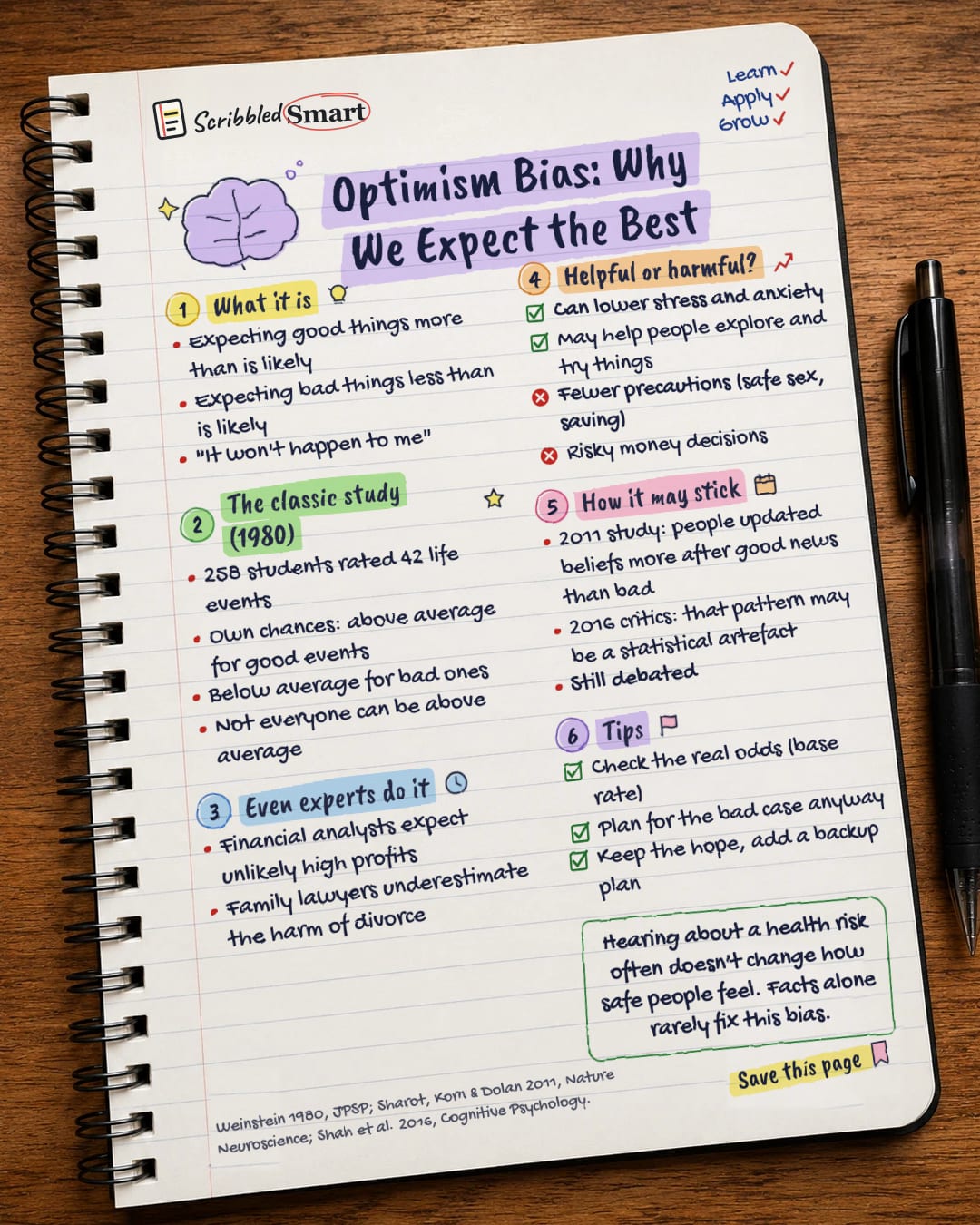
Optimism Bias: Why We Expect the Best
Most of us think bad things are more likely to happen to other people. That's optimism bias: here's when it helps and when it hurts. Save this page.
Good to know
Weinstein 1980, JPSP; Sharot, Korn & Dolan 2011, Nature Neuroscience; Shah et al. 2016, Cognitive Psychology.
What's on the page
The note as text, so you can read it, copy it or use a screen reader.
What it is
- Expecting good things more than is likely
- Expecting bad things less than is likely
- "It won't happen to me"
The classic study (1980)
- 258 students rated 42 life events
- Own chances: above average for good events
- Below average for bad ones
- Not everyone can be above average
Even experts do it
- Financial analysts expect unlikely high profits
- Family lawyers underestimate the harm of divorce
Helpful or harmful?
- Can lower stress and anxiety
- May help people explore and try things
- Fewer precautions (safe sex, saving)
- Risky money decisions
How it may stick
- 2011 study: people updated beliefs more after good news than bad
- 2016 critics: that pattern may be a statistical artefact
- Still debated
Tips
- Check the real odds (base rate)
- Plan for the bad case anyway
- Keep the hope, add a backup plan
Sources
- Weinstein, N. D. (1980): Unrealistic optimism about future life events. JPSP 39(5), 806–820
- Sharot, T., Korn, C. W. & Dolan, R. J. (2011): How unrealistic optimism is maintained in the face of reality. Nature Neuroscience 14
- Shah, P., Harris, A. J. L., Bird, G., Catmur, C. & Hahn, U. (2016): A pessimistic view of optimistic belief updating. Cognitive Psychology 90
- Dricu, M. et al. (2023): Asymmetrical update of beliefs about future outcomes is driven by outcome valence and social group membership. International Review of Social Psychology
- Sharot, T. (2011): The optimism bias. Current Biology 21(23)
How we checked this
Every fact on this note comes from the 5 sources listed here, checked against official or peer-reviewed sources where possible. AI tools help with drafting; a person checks every fact against the sources. How we research
Spotted a mistake? Tell us and we'll fix it and log it on the corrections page.


