
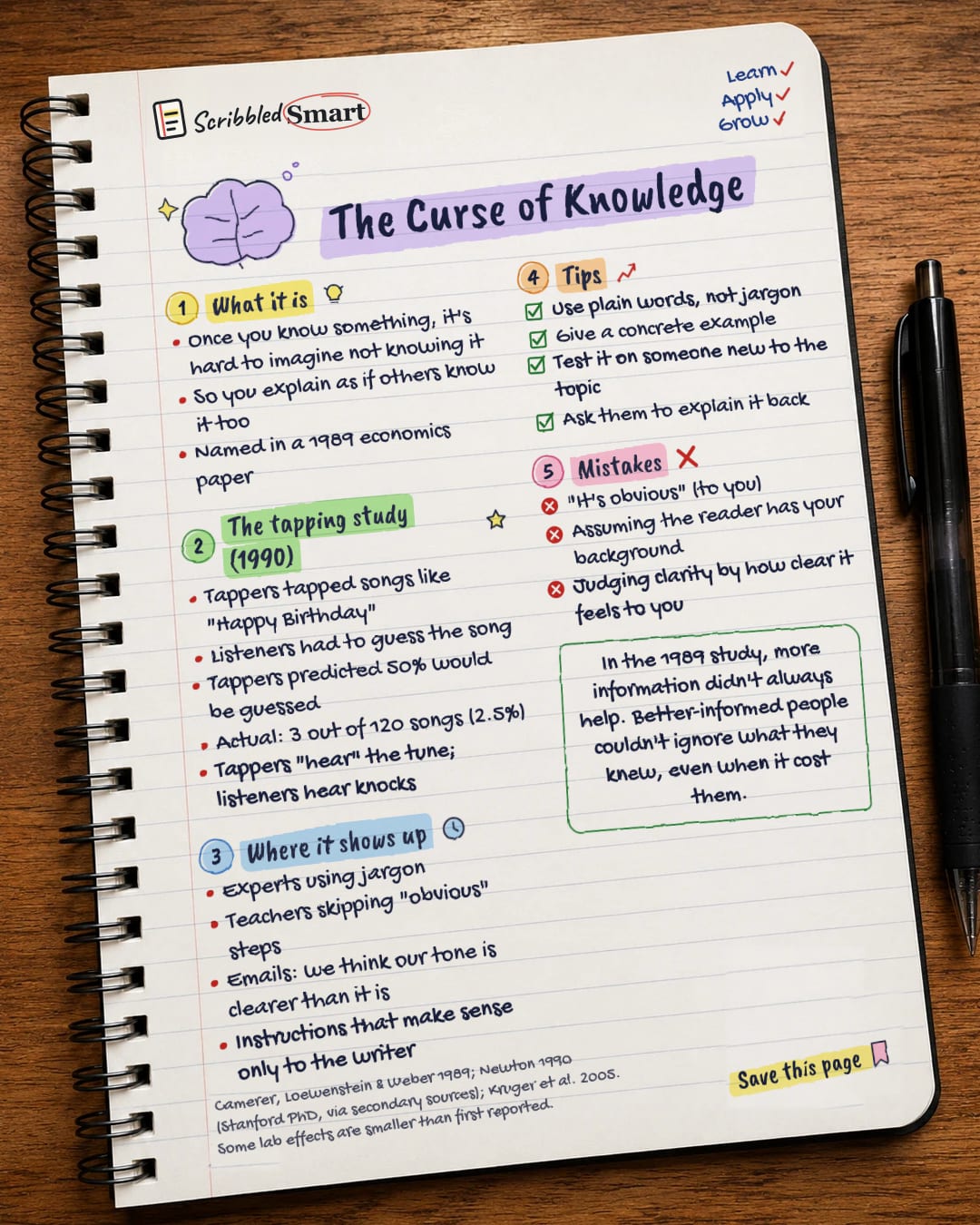
Psychology One-page note
The Curse of Knowledge
Ever explained something "simply" and got blank looks? That's the curse of knowledge. Here's how to beat it. Save this page.
Good to know
Camerer, Loewenstein & Weber 1989; Newton 1990 (Stanford PhD, via secondary sources); Kruger et al. 2005. Some lab effects are smaller than first reported.
What's on the page
The note as text, so you can read it, copy it or use a screen reader.
What it is
- Once you know something, it's hard to imagine not knowing it
- So you explain as if others know it too
- Named in a 1989 economics paper
The tapping study (1990)
- Tappers tapped songs like "Happy Birthday"
- Listeners had to guess the song
- Tappers predicted 50% would be guessed
- Actual: 3 out of 120 songs (2.5%)
- Tappers "hear" the tune; listeners hear knocks
Where it shows up
- Experts using jargon
- Teachers skipping "obvious" steps
- Emails: we think our tone is clearer than it is
- Instructions that make sense only to the writer
Tips
- Use plain words, not jargon
- Give a concrete example
- Test it on someone new to the topic
- Ask them to explain it back
Mistakes
- "It's obvious" (to you)
- Assuming the reader has your background
- Judging clarity by how clear it feels to you
Sources
- Camerer, C., Loewenstein, G. & Weber, M. (1989): The curse of knowledge in economic settings: an experimental analysis. Journal of Political Economy 97(5), 1232–1254
- University of Arizona UCATT (Naval, E., 15 Nov 2019): The Curse of Knowledge
- Temple University Beasley School of Law (Epstein, J. M.): Brain lessons: "Tappers" and the curse of knowledge
- Kruger, J., Epley, N., Parker, J. & Ng, Z.-W. (2005): Egocentrism over e-mail: can we communicate as well as we think? JPSP 89(6)
- Ryskin, R. A. & Brown-Schmidt, S. (2014): Do adults show a curse of knowledge in false-belief reasoning? PLoS ONE
- Frontiers in Psychology (2016): Outcome knowledge and false belief
How we checked this
Every fact on this note comes from the 6 sources listed here, checked against official or peer-reviewed sources where possible. AI tools help with drafting; a person checks every fact against the sources. How we research
Spotted a mistake? Tell us and we'll fix it and log it on the corrections page.


