
Psychology One-page note
Fundamental Attribution Error
Someone cuts in front of you in traffic: are they a terrible person, or rushing to an emergency? Your brain often picks the first. Save this page.
Good to know
Jones & Harris 1967; Ross 1977; Ross, Amabile & Steinmetz 1977; Morris & Peng 1994. Tips are general suggestions.
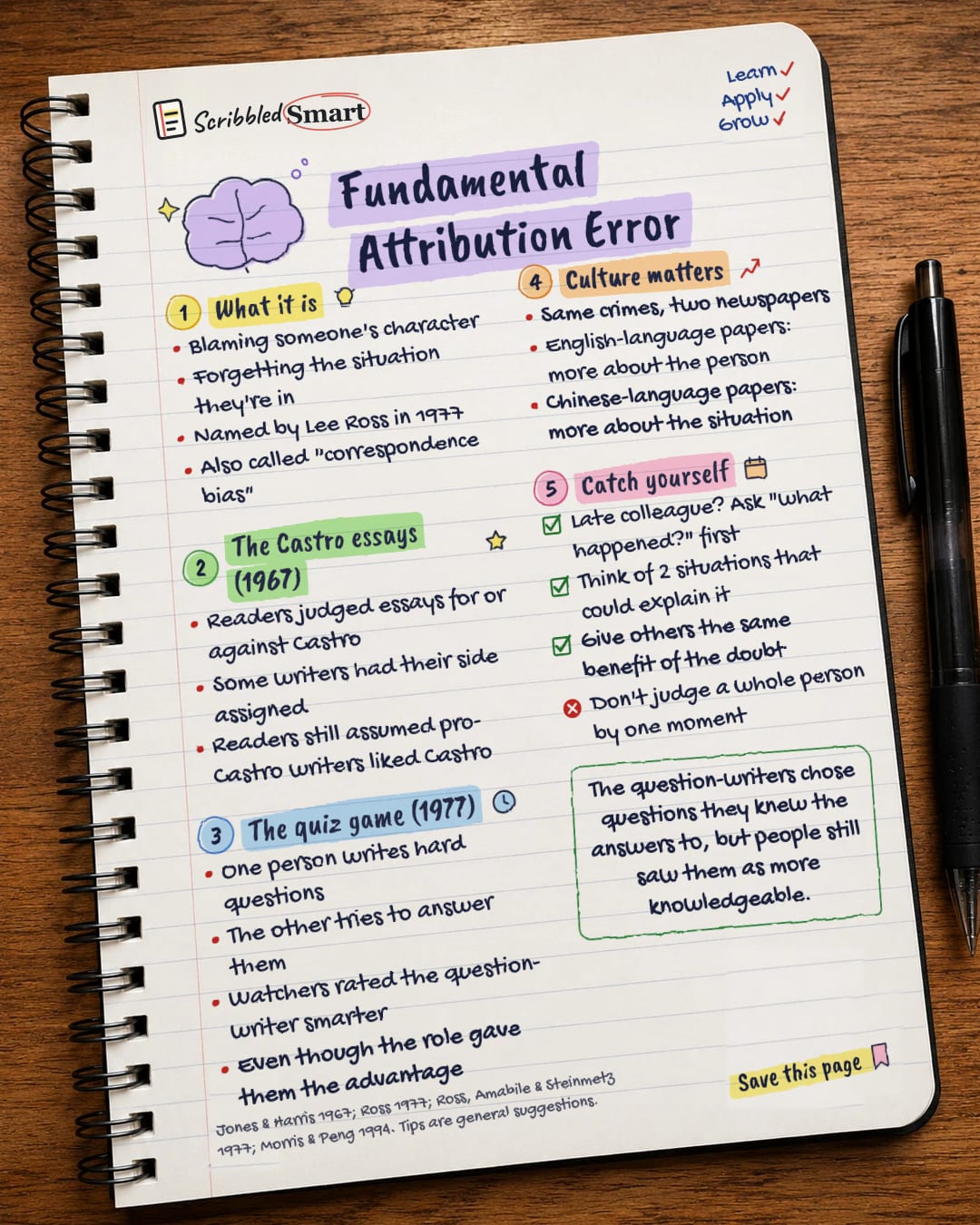
What's on the page
The note as text, so you can read it, copy it or use a screen reader.
What it is
- Blaming someone's character
- Forgetting the situation they're in
- Named by Lee Ross in 1977
- Also called "correspondence bias"
The Castro essays (1967)
- Readers judged essays for or against Castro
- Some writers had their side assigned
- Readers still assumed pro-Castro writers liked Castro
The quiz game (1977)
- One person writes hard questions
- The other tries to answer them
- Watchers rated the question-writer smarter
- Even though the role gave them the advantage
Culture matters
- Same crimes, two newspapers
- English-language papers: more about the person
- Chinese-language papers: more about the situation
Catch yourself
- Late colleague? Ask "what happened?" first
- Think of 2 situations that could explain it
- Give others the same benefit of the doubt
- Don't judge a whole person by one moment
Sources
- Jones, E. E. & Harris, V. A. (1967): The attribution of attitudes. Journal of Experimental Social Psychology
- Ross, L. (1977): The intuitive psychologist and his shortcomings. Advances in Experimental Social Psychology 10
- Ross, L., Amabile, T. M. & Steinmetz, J. L. (1977): Social roles, social control, and biases in social-perception processes. JPSP
- Gilbert, D. T. & Malone, P. S. (1995): The correspondence bias. Psychological Bulletin
- Morris, M. W. & Peng, K. (1994): Culture and cause. JPSP
- Malle, B. F. (2006): The actor-observer asymmetry in attribution: A (surprising) meta-analysis. Psychological Bulletin
- In-Mind (Moran, J., 2015): Why do we so often ignore the influence of situations on behavior?
How we checked this
Every fact on this note comes from the 7 sources listed here, checked against official or peer-reviewed sources where possible. AI tools help with drafting; a person checks every fact against the sources. How we research
Spotted a mistake? Tell us and we'll fix it and log it on the corrections page.


