
Psychology One-page note
Hindsight Bias: "I Knew It All Along"
The result's in and suddenly everyone "saw it coming". Here's why the past always looks obvious. Save this page.
Good to know
Fischhoff 1975; Guilbault et al. 2004; Roese & Vohs 2012. Tips are general suggestions.
What's on the page
The note as text, so you can read it, copy it or use a screen reader.
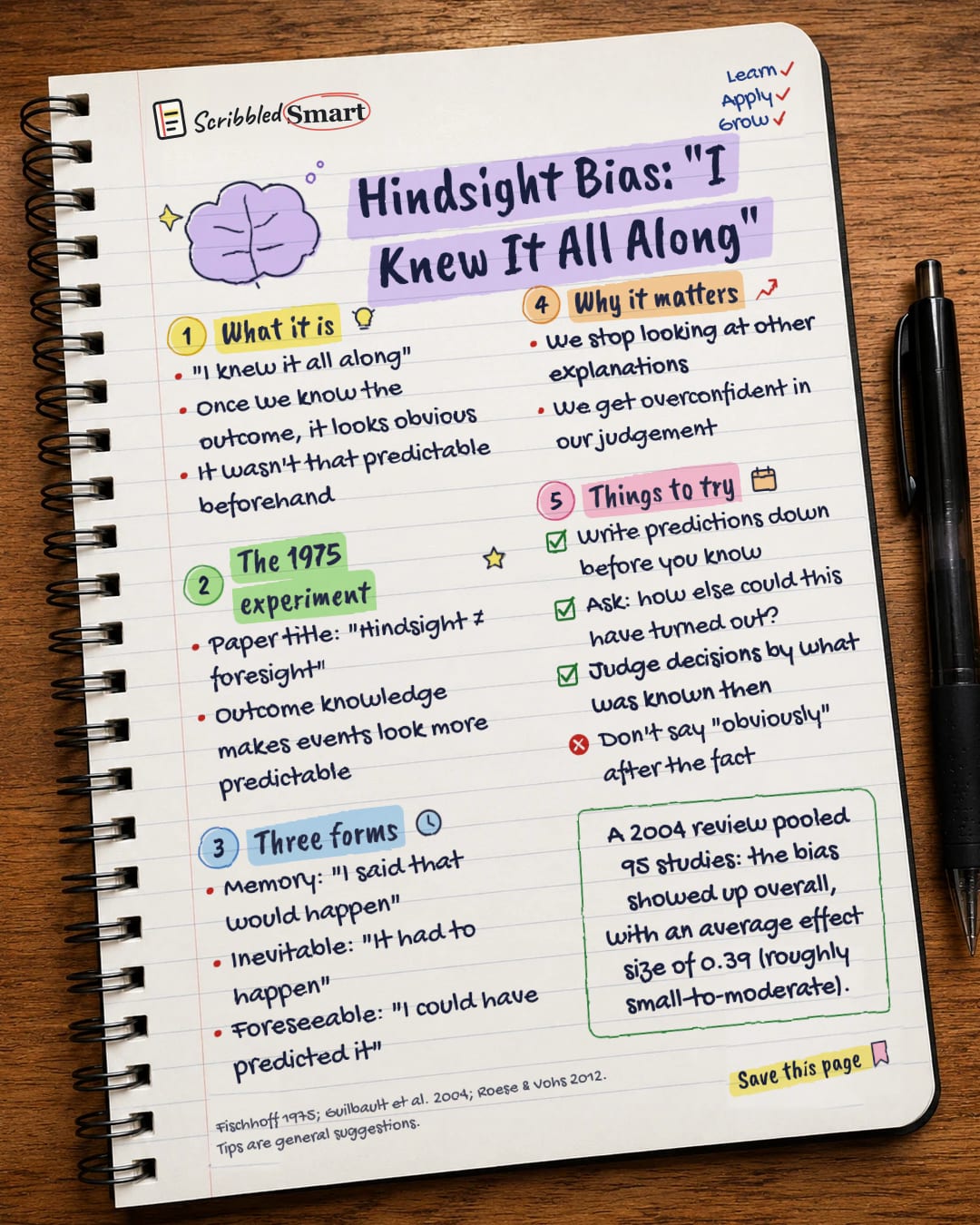
What it is
- "I knew it all along"
- Once we know the outcome, it looks obvious
- It wasn't that predictable beforehand
The 1975 experiment
- Paper title: "Hindsight ≠ foresight"
- Outcome knowledge makes events look more predictable
Three forms
- Memory: "I said that would happen"
- Inevitable: "It had to happen"
- Foreseeable: "I could have predicted it"
Why it matters
- We stop looking at other explanations
- We get overconfident in our judgement
Things to try
- Write predictions down before you know
- Ask: how else could this have turned out?
- Judge decisions by what was known then
- Don't say "obviously" after the fact
Sources
- Fischhoff, B. (1975): Hindsight ≠ foresight: The effect of outcome knowledge on judgment under uncertainty. JEP: HPP
- Fischhoff, B. & Beyth, R. (1975): "I knew it would happen". Organizational Behavior and Human Performance
- Roese, N. J. & Vohs, K. D. (2012): Hindsight bias. Perspectives on Psychological Science
- Guilbault, R. L. et al. (2004): A meta-analysis of research on hindsight bias. Basic and Applied Social Psychology
How we checked this
Every fact on this note comes from the 4 sources listed here, checked against official or peer-reviewed sources where possible. AI tools help with drafting; a person checks every fact against the sources. How we research
Spotted a mistake? Tell us and we'll fix it and log it on the corrections page.


