
Psychology One-page note
Social Comparison: Why We Compare
You were happy with your day until you opened social media. Here's the psychology of comparison. Save this page.
Good to know
Festinger 1954; Wills 1981; Vogel et al. 2014; Gerber, Wheeler & Suls 2018; Orben & Przybylski 2019. General info, not medical advice.
What's on the page
The note as text, so you can read it, copy it or use a screen reader.
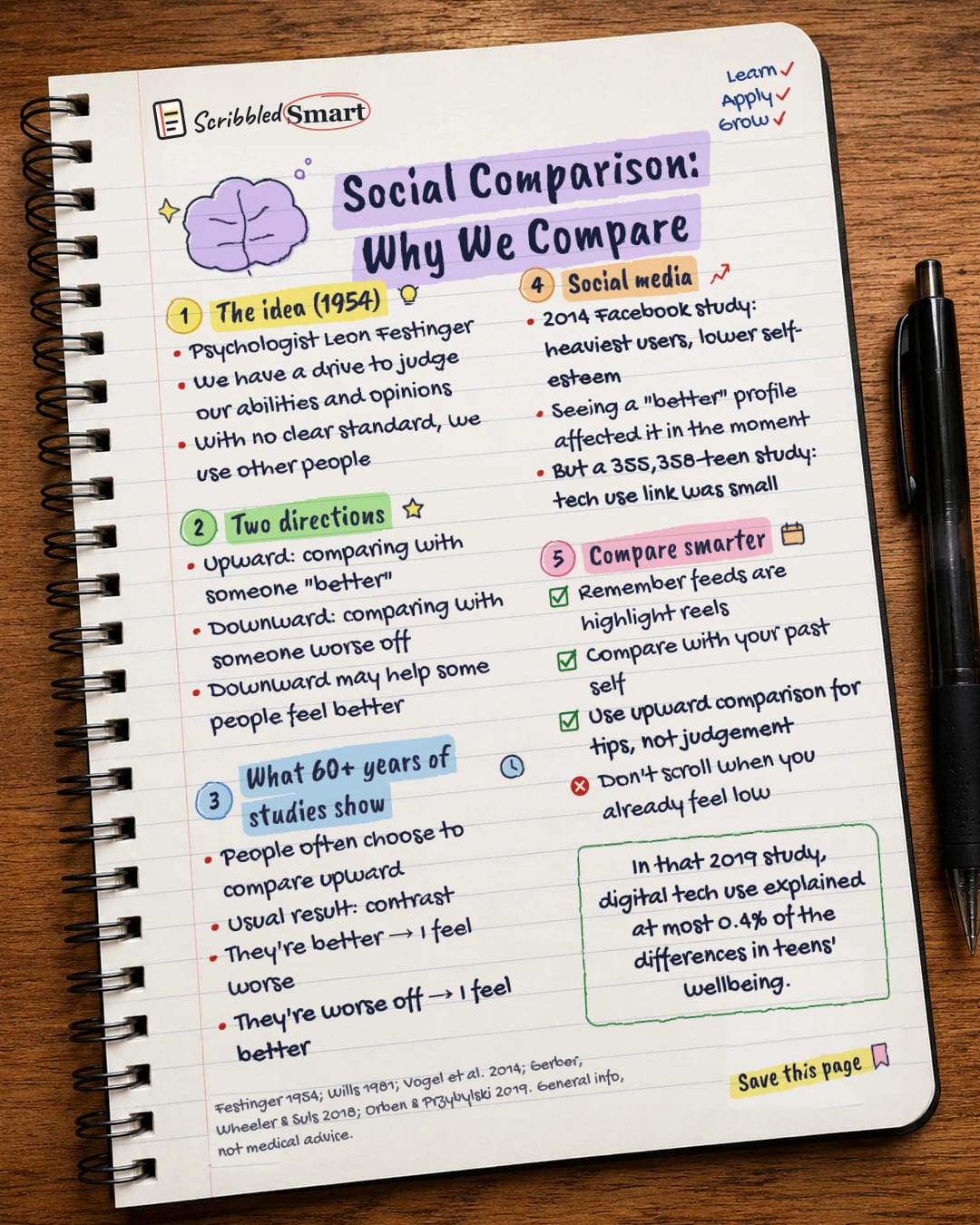
The idea (1954)
- Psychologist Leon Festinger
- We have a drive to judge our abilities and opinions
- With no clear standard, we use other people
Two directions
- Upward: comparing with someone "better"
- Downward: comparing with someone worse off
- Downward may help some people feel better
What 60+ years of studies show
- People often choose to compare upward
- Usual result: contrast
- They're better → I feel worse
- They're worse off → I feel better
Social media
- 2014 Facebook study: heaviest users, lower self-esteem
- Seeing a "better" profile affected it in the moment
- But a 355,358-teen study: tech use link was small
Compare smarter
- Remember feeds are highlight reels
- Compare with your past self
- Use upward comparison for tips, not judgement
- Don't scroll when you already feel low
Sources
- Festinger, L. (1954): A theory of social comparison processes. Human Relations
- Wills, T. A. (1981): Downward comparison principles in social psychology. Psychological Bulletin
- Gerber, J. P., Wheeler, L. & Suls, J. (2018): A social comparison theory meta-analysis 60+ years on. Psychological Bulletin
- Vogel, E. A. et al. (2014): Social comparison, social media, and self-esteem. Psychology of Popular Media Culture
- University of Toledo News (2015): Psychology graduate student publishes work on Facebook study
- Orben, A. & Przybylski, A. K. (2019): The association between adolescent well-being and digital technology use. Nature Human Behaviour
- Europe PMC record, Gerber et al. (2018), PMID 29144145
- Europe PMC record, Orben & Przybylski (2019), PMID 30944443
How we checked this
Every fact on this note comes from the 8 sources listed here, checked against official or peer-reviewed sources where possible. AI tools help with drafting; a person checks every fact against the sources. How we research
Spotted a mistake? Tell us and we'll fix it and log it on the corrections page.


