
Psychology One-page note
Imposter Syndrome Explained
Ever felt like you don't belong, even after doing well? You're far from alone. Save this page.
Good to know
General info, not medical advice.
What's on the page
The note as text, so you can read it, copy it or use a screen reader.
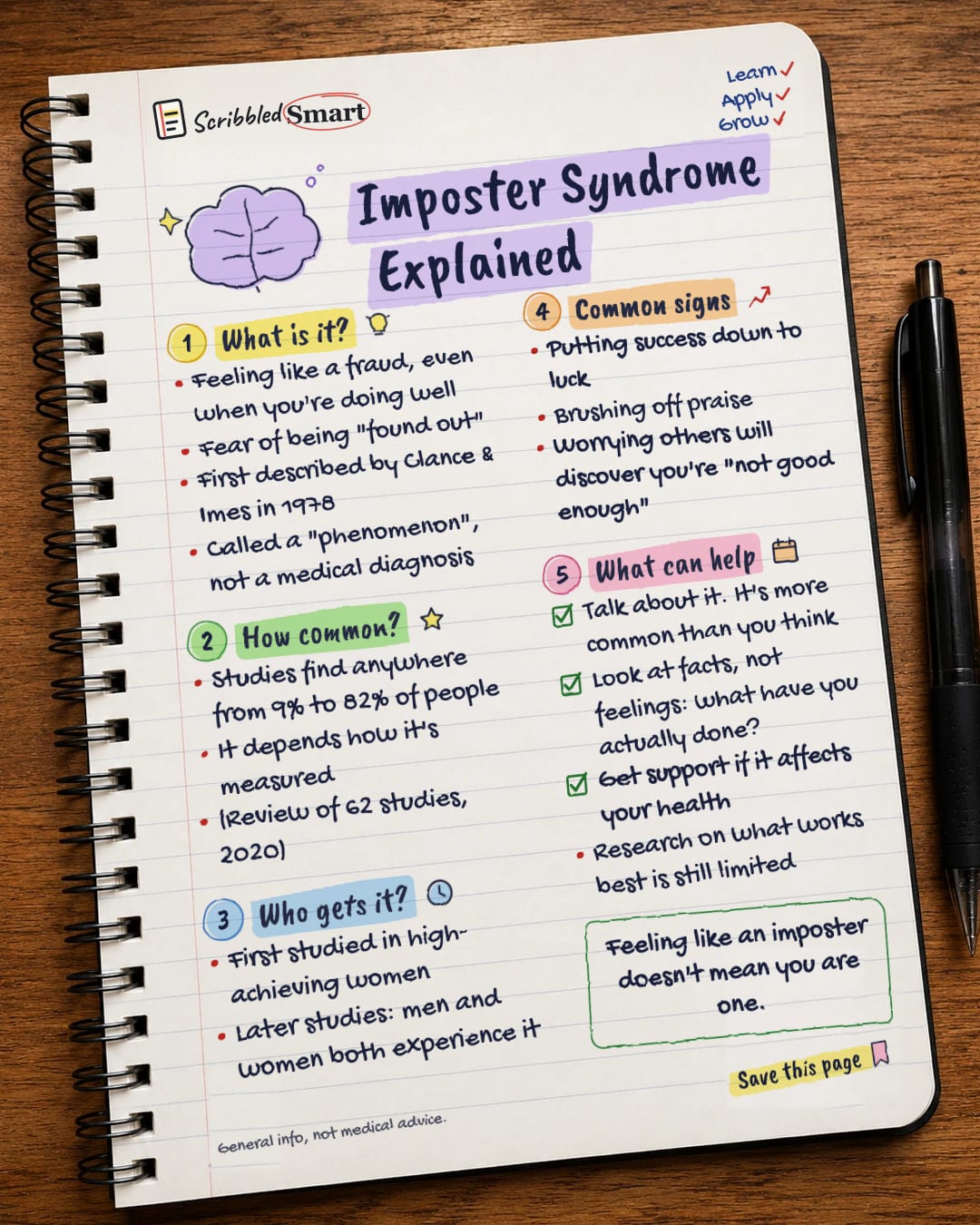
What is it?
- Feeling like a fraud, even when you're doing well
- Fear of being "found out"
- First described by Clance & Imes in 1978
- Called a "phenomenon", not a medical diagnosis
How common?
- Studies find anywhere from 9% to 82% of people
- It depends how it's measured
- (Review of 62 studies, 2020)
Who gets it?
- First studied in high-achieving women
- Later studies: men and women both experience it
Common signs
- Putting success down to luck
- Brushing off praise
- Worrying others will discover you're "not good enough"
What can help
- Talk about it. It's more common than you think
- Look at facts, not feelings: what have you actually done?
- Get support if it affects your health
- Research on what works best is still limited
Sources
- Simply Psychology: Imposter syndrome in high-achieving women
- Psychology Today: The history of imposter syndrome
- Frontiers in Psychology (2024): the impostor phenomenon
- PMC: article on the impostor phenomenon
- JobCannon: Why imposter syndrome is not a diagnosis
- Bravata et al. (2020): Prevalence, Predictors, and Treatment of Impostor Syndrome, a Systematic Review (PMC)
How we checked this
Every fact on this note comes from the 6 sources listed here, checked against official or peer-reviewed sources where possible. AI tools help with drafting; a person checks every fact against the sources. How we research
Spotted a mistake? Tell us and we'll fix it and log it on the corrections page.


