
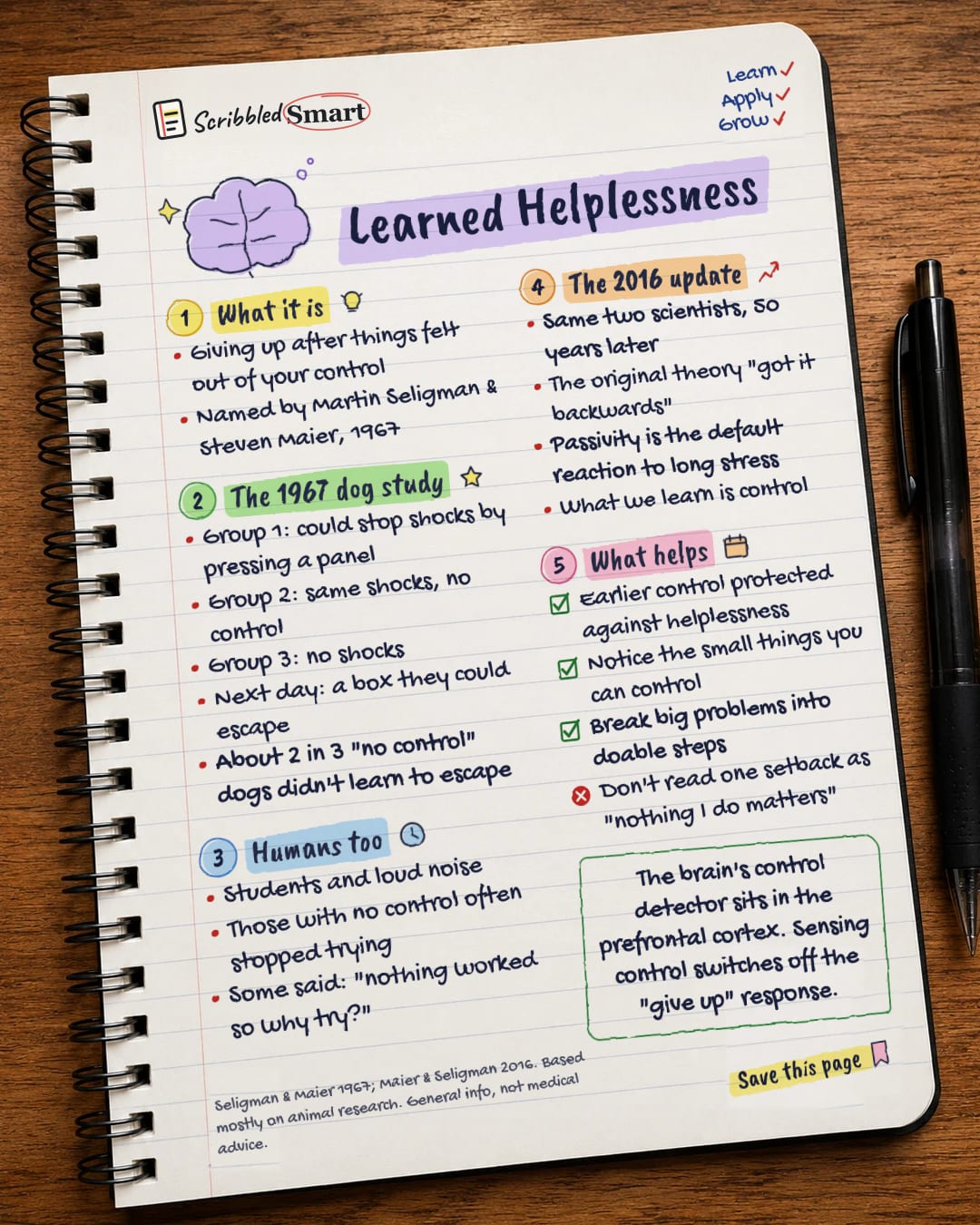
Psychology One-page note
Learned Helplessness
Ever felt like "why bother, nothing works"? The famous study behind that feeling was turned on its head 50 years later. Save this page.
Good to know
Seligman & Maier 1967; Maier & Seligman 2016. Based mostly on animal research. General info, not medical advice.
What's on the page
The note as text, so you can read it, copy it or use a screen reader.
What it is
- Giving up after things felt out of your control
- Named by Martin Seligman & Steven Maier, 1967
The 1967 dog study
- Group 1: could stop shocks by pressing a panel
- Group 2: same shocks, no control
- Group 3: no shocks
- Next day: a box they could escape
- About 2 in 3 "no control" dogs didn't learn to escape
Humans too
- Students and loud noise
- Those with no control often stopped trying
- Some said: "nothing worked so why try?"
The 2016 update
- Same two scientists, 50 years later
- The original theory "got it backwards"
- Passivity is the default reaction to long stress
- What we learn is control
What helps
- Earlier control protected against helplessness
- Notice the small things you can control
- Break big problems into doable steps
- Don't read one setback as "nothing I do matters"
Sources
- Seligman, M. E. P. & Maier, S. F. (1967): Failure to escape traumatic shock. Journal of Experimental Psychology
- Overmier, J. B. & Seligman, M. E. P. (1967): Effects of inescapable shock upon subsequent escape and avoidance responding. JCPP
- Maier, S. F. & Seligman, M. E. P. (2016): Learned helplessness at fifty: Insights from neuroscience. Psychological Review
How we checked this
Every fact on this note comes from the 3 sources listed here, checked against official or peer-reviewed sources where possible. AI tools help with drafting; a person checks every fact against the sources. How we research
Spotted a mistake? Tell us and we'll fix it and log it on the corrections page.


