
Psychology One-page note
Self-Compassion: What the Research Says
Would you talk to your best friend the way you talk to yourself after a mistake? Here's what the research says about self-compassion. Save this page.
Good to know
Neff 2003; Neff & Vonk 2009; Breines & Chen 2012; MacBeth & Gumley 2012. General info, not medical advice.
What's on the page
The note as text, so you can read it, copy it or use a screen reader.
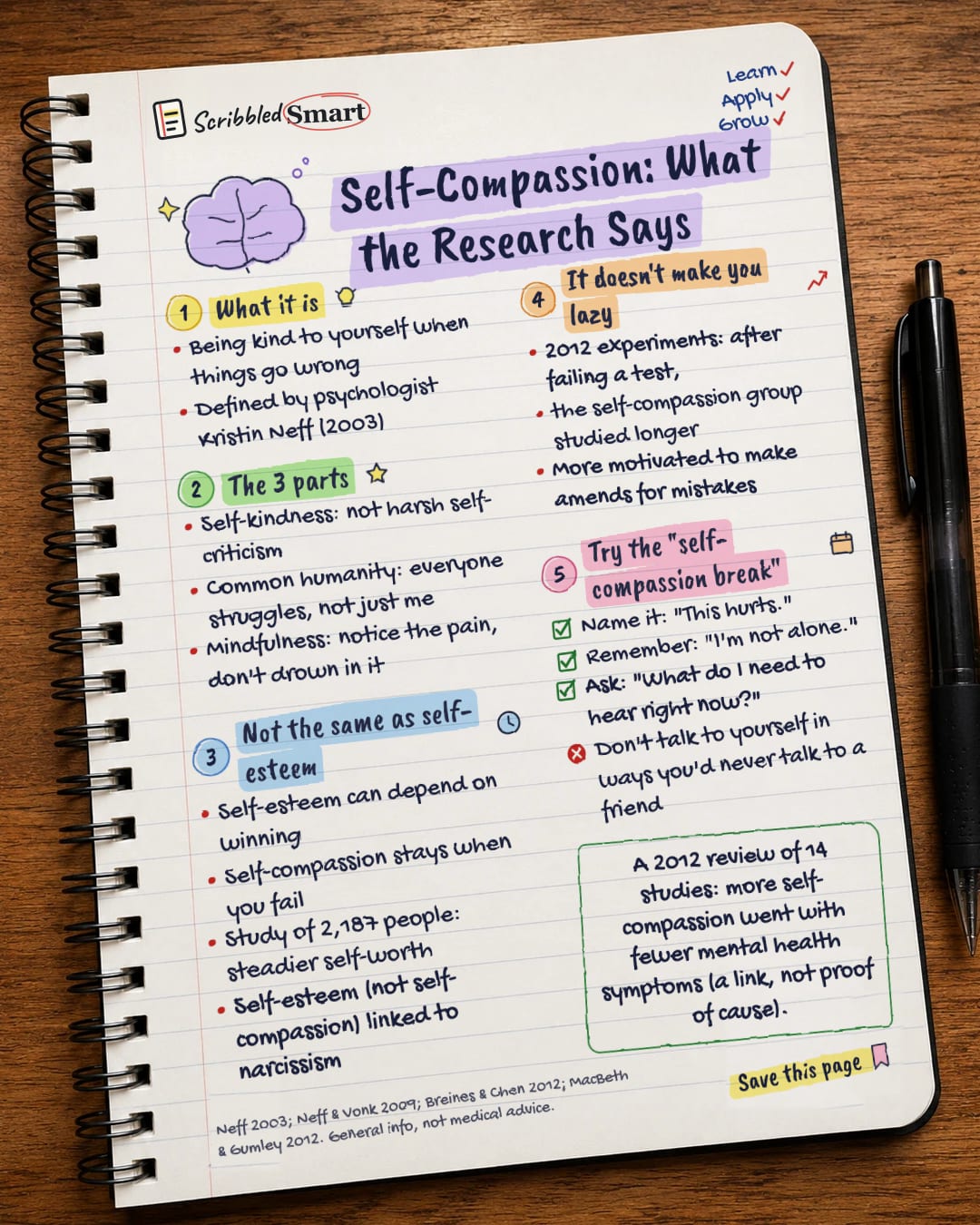
What it is
- Being kind to yourself when things go wrong
- Defined by psychologist Kristin Neff (2003)
The 3 parts
- Self-kindness: not harsh self-criticism
- Common humanity: everyone struggles, not just me
- Mindfulness: notice the pain, don't drown in it
Not the same as self-esteem
- Self-esteem can depend on winning
- Self-compassion stays when you fail
- Study of 2,187 people: steadier self-worth
- Self-esteem (not self-compassion) linked to narcissism
It doesn't make you lazy
- 2012 experiments: after failing a test,
- the self-compassion group studied longer
- More motivated to make amends for mistakes
Try the "self-compassion break"
- Name it: "This hurts."
- Remember: "I'm not alone."
- Ask: "What do I need to hear right now?"
- Don't talk to yourself in ways you'd never talk to a friend
Sources
- Neff, K. D. (2003): Self-compassion: An alternative conceptualization of a healthy attitude toward oneself. Self and Identity
- Neff, K. D. & Vonk, R. (2009): Self-compassion versus global self-esteem. Journal of Personality
- Breines, J. G. & Chen, S. (2012): Self-compassion increases self-improvement motivation. PSPB
- MacBeth, A. & Gumley, A. (2012): Exploring compassion: A meta-analysis. Clinical Psychology Review
- Self-Compassion.org (Kristin Neff): Exercise 2, Self-Compassion Break
How we checked this
Every fact on this note comes from the 5 sources listed here, checked against official or peer-reviewed sources where possible. AI tools help with drafting; a person checks every fact against the sources. How we research
Spotted a mistake? Tell us and we'll fix it and log it on the corrections page.


