
Psychology One-page note
Milgram's Obedience Study: What Really Happened
Everyone remembers the 65%. Fewer people know about the 23 versions, the script problems and the 2009 repeat. Save this page.
Good to know
Experiments run 1961–62. Results from Milgram 1963, Haslam et al. 2014, Burger 2009.
What's on the page
The note as text, so you can read it, copy it or use a screen reader.
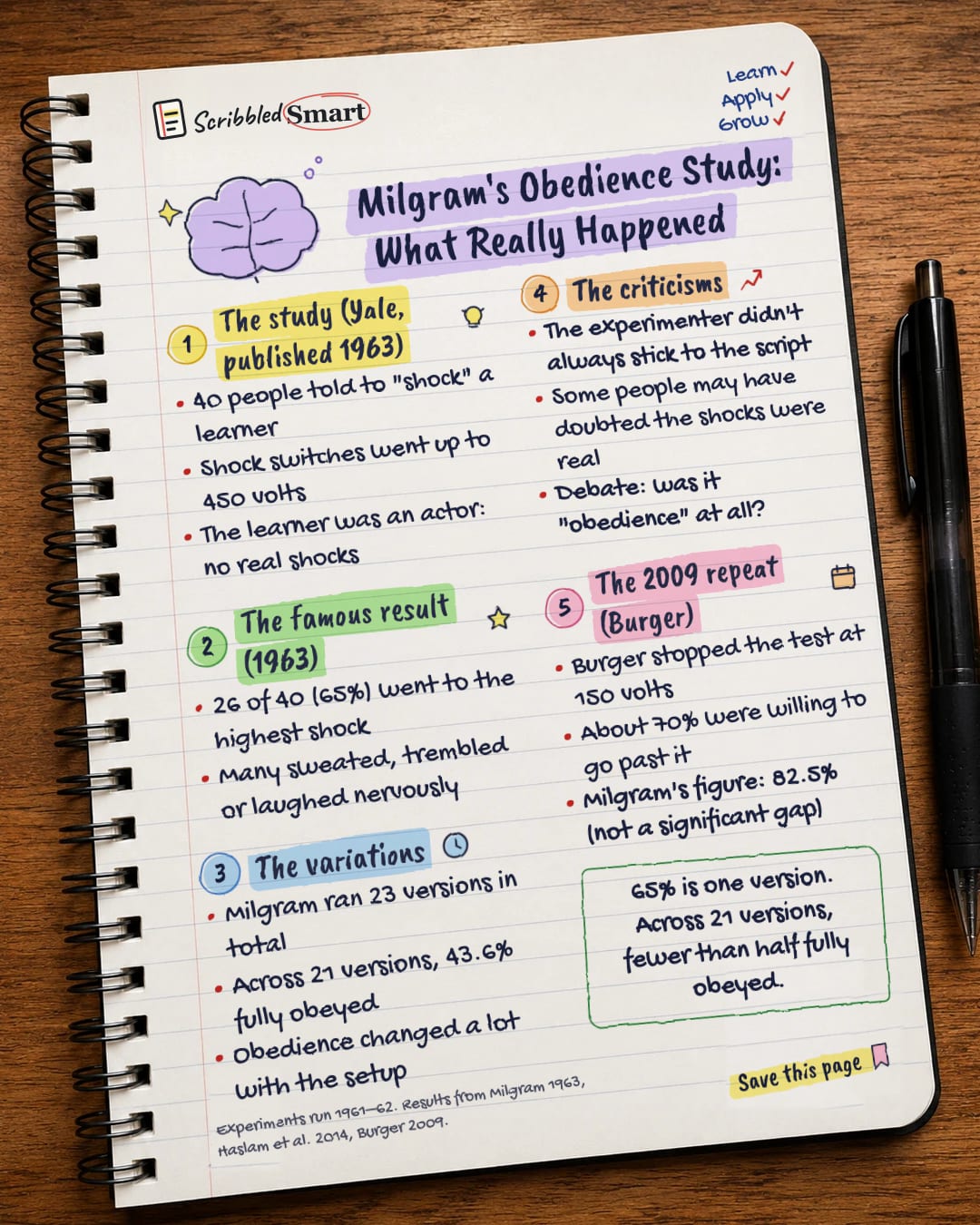
The study (Yale, published 1963)
- 40 people told to "shock" a learner
- Shock switches went up to 450 volts
- The learner was an actor: no real shocks
The famous result (1963)
- 26 of 40 (65%) went to the highest shock
- Many sweated, trembled or laughed nervously
The variations
- Milgram ran 23 versions in total
- Across 21 versions, 43.6% fully obeyed
- Obedience changed a lot with the setup
The criticisms
- The experimenter didn't always stick to the script
- Some people may have doubted the shocks were real
- Debate: was it "obedience" at all?
The 2009 repeat (Burger)
- Burger stopped the test at 150 volts
- About 70% were willing to go past it
- Milgram's figure: 82.5% (not a significant gap)
Sources
- Milgram, S. (1963): Behavioral Study of Obedience
- Milgram (1963) abstract, readable text
- Haslam, N., Loughnan, S. & Perry, G. (2014): Meta-Milgram: An empirical synthesis of the obedience experiments. PLoS ONE
- ScienceDaily (APA release, Dec 2008): Replicating Milgram
- Burger, J. M. (2009): Replicating Milgram: Would people still obey today? *American Psychologist* 64(1), 1–11
- Perry, G. (2012): Behind the Shock Machine (review summaries: Science News, Boing Boing)
How we checked this
Every fact on this note comes from the 6 sources listed here, checked against official or peer-reviewed sources where possible. AI tools help with drafting; a person checks every fact against the sources. How we research
Spotted a mistake? Tell us and we'll fix it and log it on the corrections page.


